The Regulatory Race Heats Up: Drone Delivery's Compliance Challenges and the Road Ahead
According to the latest Drone Industry Insights report, the global civil drone market is projected to nearly double, reaching $83 billion by 2035. As drone delivery expands at an unprecedented pace, regulators worldwide are struggling to keep up, making the ability to establish timely and coherent regulatory frameworks a defining challenge for the industry's long-term health.
Highlights
- The global civil drone market is forecast to reach $83 billion by 2035, nearly doubling from its current scale, according to Drone Industry Insights.
- Operators including Wing, Zipline, and Amazon Prime Air are actively expanding drone delivery services, accelerating pressure on regulators worldwide.
- The FAA, EASA, and Asia-Pacific civil aviation authorities are all working to implement BVLOS licensing and Remote ID mandates as baseline regulatory requirements.
- A persistent 'regulatory gap' — where rulemaking lags behind technological advancement — remains the core challenge for the drone delivery industry.
- Nations that establish clear, consistent, and forward-looking drone regulations stand to gain a decisive competitive advantage in the $83 billion market.
According to the latest industry report from Drone Industry Insights, the global civil drone market is set for substantial growth, with the market projected to reach $83 billion by 2035 — nearly double its current scale.
The Regulatory Challenge Behind the Growth
The drone delivery sector is expanding at an unprecedented rate, but whether regulatory bodies around the world can establish adequate frameworks in time has become the central question for the industry's sustainable development.
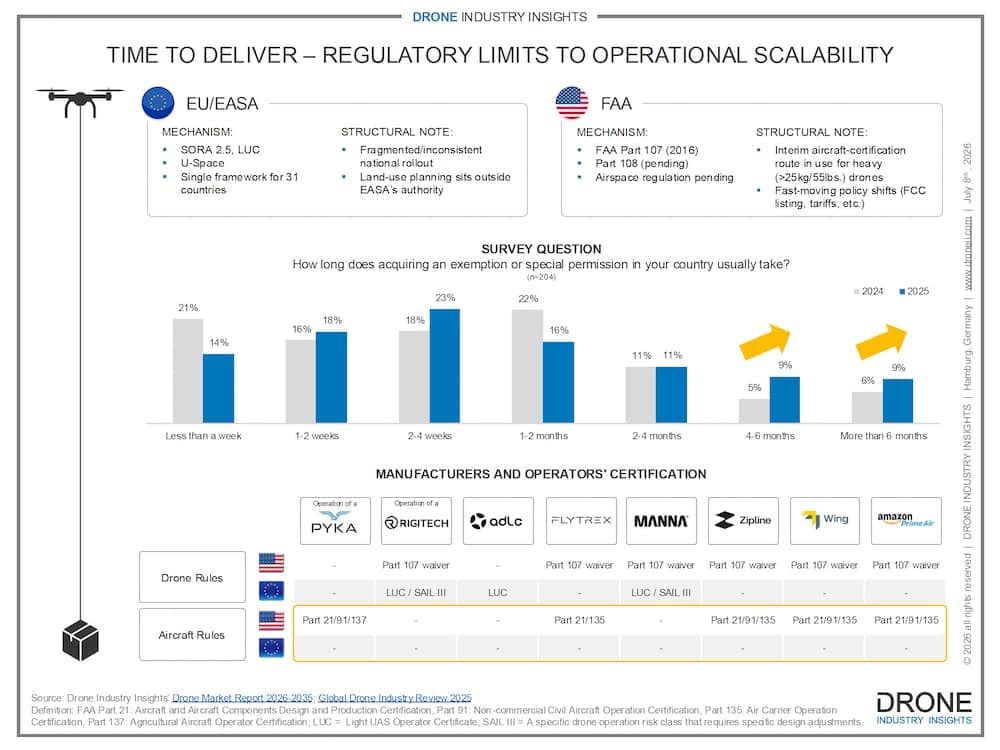
Recent policy developments across the globe reveal an intensifying tension between operators and authorities, particularly when existing regulations fail to cover emerging use cases. The U.S. Federal Aviation Administration (FAA), the European Union Aviation Safety Agency (EASA), and civil aviation authorities across the Asia-Pacific region all face the same fundamental pressure: how to ensure flight safety and protect public privacy while still leaving sufficient room for innovation.
The Global Regulatory Race Accelerates
As operators such as Wing, Zipline, and Amazon Prime Air continue to expand their service footprints, governments are moving to accelerate their regulatory responses. Some markets have begun rolling out commercial licensing frameworks for BVLOS (Beyond Visual Line of Sight) operations, alongside mandatory Remote ID requirements — both widely regarded as foundational conditions for building a viable drone delivery ecosystem.
Nevertheless, rulemaking continues to lag behind the pace of technological advancement. Bridging this "regulatory gap" remains the core challenge that industry players and policymakers must confront together.
Market Outlook
Drone Industry Insights notes that the $83 billion market forecast signals that drone delivery is far from a passing trend — it represents a long-term structural transformation set to reshape the logistics industry. The clarity, consistency, and forward-looking nature of regulatory frameworks will ultimately determine each country's competitive position in this unfolding industrial wave.
Source: Drone Industry Insights
原文來源: 查看原文
FAQ
Reviewed and published by the LAETimes editorial desk ·