Taiwan to Test Drone and Business Connectivity During 30-Minute Mobile Network Slowdown
Taiwan will include a 30-minute mobile network speed-reduction drill in its 2026 Urban Resilience (Air Defense) Exercise. The test will run from 14:30 to 15:00 in seven central jurisdictions on August 10 and seven northern jurisdictions on August 13. Designed as a systemic stress test for national digital resilience, the exercise will assess how the public and businesses respond to degraded cellular service. Drone operators using 4G or 5G for command, telemetry, video transmission, cloud platforms or fleet coordination should review contingency procedures before the scheduled drill.
Taiwan’s 2026 Urban Resilience Exercise will introduce a 30-minute mobile network slowdown in August, testing how businesses, drone operators and the public respond when cellular connectivity degrades.
Key points
- Taiwan adds its first mobile slowdown drill
- The connectivity test will last 30 minutes
- Central Taiwan participates on August 10
- Northern Taiwan participates on August 13
- Drone operators should prepare backup procedures
Highlights
- Taiwan’s 2026 Urban Resilience (Air Defense) Exercise will include its first 30-minute mobile network speed-reduction drill.
- Miaoli County, Taichung City, Nantou County, Changhua County, Yunlin County, Chiayi City and Chiayi County are scheduled for August 10 from 14:30 to 15:00.
- Keelung City, Taipei City, New Taipei City, Taoyuan City, Hsinchu County, Hsinchu City and Yilan County are scheduled for August 13 from 14:30 to 15:00.
- The source describes August 10 as a Wednesday, although August 10, 2026 falls on a Monday; operators should confirm the final official schedule.
- The announcement does not specify the degree of speed reduction, participating carrier parameters or possible exemptions for priority communications.
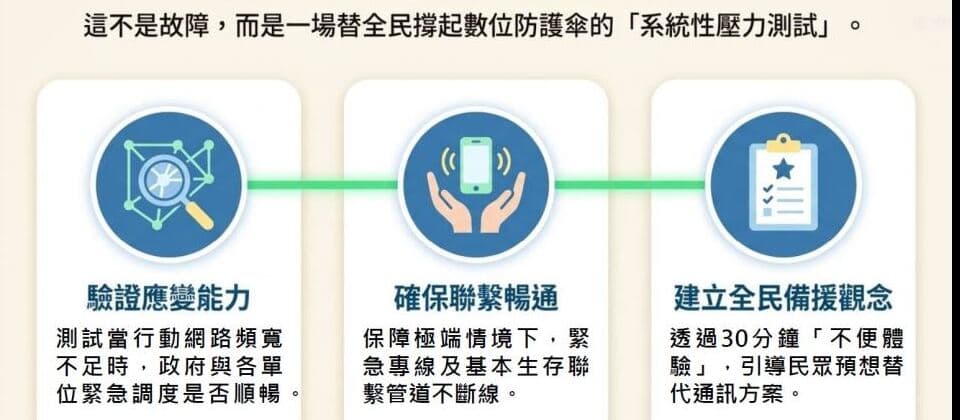
Taiwan plans to conduct its first organized mobile network speed-reduction drill as part of the 2026 Urban Resilience (Air Defense) Exercise, adding a digital-connectivity component to an exercise traditionally focused on civil defense and emergency response.
The 30-minute test is intended to examine how the public and businesses operate when mobile communications remain available but perform below normal expectations. Against a backdrop of growing geopolitical risk and concern about extreme emergencies, the government is treating digital resilience as an increasingly important element of business continuity planning, commonly known as BCP.
Two regional exercises scheduled for August
According to the published exercise plan, the mobile network slowdown in central Taiwan will take place from 14:30 to 15:00 on August 10. The participating jurisdictions are Miaoli County, Taichung City, Nantou County, Changhua County, Yunlin County, Chiayi City and Chiayi County.
A second 30-minute session covering northern Taiwan is scheduled for the same period, from 14:30 to 15:00, on August 13. It will involve Keelung City, Taipei City, New Taipei City, Taoyuan City, Hsinchu County, Hsinchu City and Yilan County.
The source identifies August 10 as a Wednesday and August 13 as a Thursday. However, August 10, 2026 falls on a Monday, while August 13 falls on a Thursday. Businesses and operators should therefore confirm the final schedule with the responsible authorities before changing operations or dispatch plans.
The announcement does not specify how much mobile data speeds will be reduced, whether every telecommunications provider will apply the same parameters, or whether emergency and priority communications will be exempt. It also does not indicate whether voice calls, text messages or only mobile data services will be affected.
Implications for connected drone operations
Although the exercise is not specifically directed at the drone industry, reduced cellular performance could affect commercial aircraft and fleet systems that rely on 4G or 5G connections. Possible pressure points include live video streaming, cloud-based mission management, map synchronization, Remote ID support infrastructure, telemetry relays and communication links used during BVLOS operations.
A slower connection does not necessarily mean a complete loss of control. Many drones use dedicated radio links for command and control, with cellular networks serving as secondary channels or carrying payload data. The operational impact will therefore depend on the aircraft, controller, network architecture and software platform being used.
Operators should nevertheless treat the exercise as an opportunity to validate lost-link behavior, return-to-home settings, local data storage and procedures for switching from cloud-dependent workflows to offline operations. Any contingency procedure must remain consistent with Taiwan’s aviation requirements, approved operating conditions and the 遙控無人機管理規則. Connectivity degradation does not authorize an operator to continue a flight when command, situational awareness or safety margins are no longer adequate.
A broader business continuity test
For companies, the exercise is a short but practical test of whether critical workflows can continue without full mobile bandwidth. Dispatch systems, field-service applications, messaging platforms, authentication tools and cloud dashboards may all perform differently under constrained conditions.
Organizations operating in the affected jurisdictions can use the August sessions to establish minimum connectivity requirements, identify applications that fail under low bandwidth and assign decision-making authority for pausing work. The results may also help companies determine whether they need redundant telecommunications providers, dedicated radio systems, offline mission files or additional edge-processing capability.
The drill lasts only 30 minutes, but it is designed to expose dependencies that could become more serious during a prolonged communications disruption. For drone companies and other connected service providers, preparation before August will be more valuable than attempting to improvise after network performance begins to decline.
What it means for Taiwan
For Taiwan’s drone manufacturers, industry associations and communications suppliers, the August drill provides a defined window to test whether domestically developed aircraft, fleet platforms and 4G or 5G modules can maintain safe functions under constrained bandwidth. Vendors should document minimum link requirements and verify offline or edge-processing capabilities before August 10 and August 13. Operators providing infrastructure inspection, exterior cleaning, agricultural spraying, mapping or emergency services in the 14 affected jurisdictions should review procurement specifications, lost-link settings, local recording and dispatch procedures. Flights requiring reliable cellular connectivity may need to be rescheduled, paused or supported by redundant links. Operators must also ensure that any response remains compliant with the 遙控無人機管理規則 and applicable flight approvals.
FAQ
Reviewed and published by the LAETimes editorial desk ·