Scientists Use AI to Crack One of Water's Greatest Mysteries
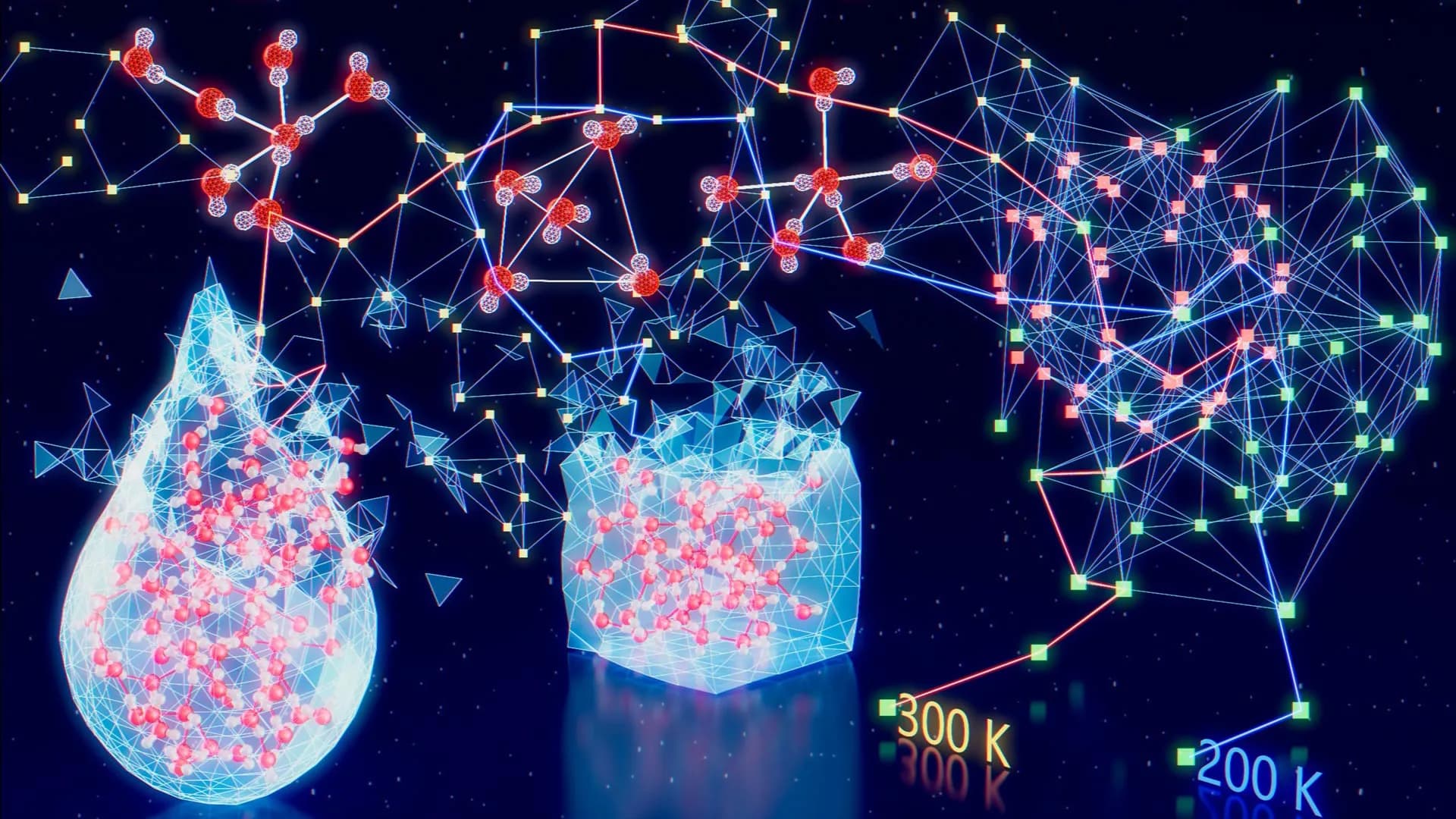
Researchers at Osaka University have used an AI model trained on computer simulation data to systematically evaluate 16 structural descriptors, identifying the most effective methods for distinguishing between water's two competing liquid states. The findings provide a clearer scientific framework for studying the anomalous behavior of supercooled water.
Highlights
- Osaka University researchers trained an AI model on computer simulation data to evaluate 16 structural descriptors of liquid water.
- The AI identified the most effective descriptors for distinguishing between water's hypothesized low-density and high-density liquid phases.
- Supercooled water—liquid below 0°C—exhibits anomalous behavior relevant to atmospheric science, cryobiology, and materials research.
- The study replaces subjective descriptor selection with an objective, AI-driven screening process, providing a clearer framework for water structure research.
- The findings highlight AI's expanding role in fundamental science, beyond engineering and commercial drone or tech applications.
Scientists Use AI to Crack One of Water's Greatest Mysteries
Water's behavior under everyday conditions has long fascinated scientists, but its physical properties become even more remarkable when it enters a supercooled state. For years, however, the research community has struggled to objectively compare the various methods used to describe water's microscopic structure.
Breakthrough by Osaka University Research Team
Researchers at Osaka University in Japan employed an AI model trained on computer simulation data to systematically evaluate 16 different structural descriptors—mathematical tools scientists use to quantify the internal arrangement of liquid water.
The AI system successfully identified which descriptors most effectively distinguish between water's two competing liquid phases: the low-density liquid and high-density liquid states hypothesized in the so-called liquid-liquid transition theory.
Why Does Supercooled Water Matter?
Supercooled water remains in a liquid state below 0°C and is commonly found in atmospheric clouds and in biological cell cryopreservation applications. The anomalous behavior water exhibits under these extreme conditions has remained one of the unsolved mysteries of physical chemistry. Understanding its microscopic structure carries significant implications for materials science, climate research, and the life sciences.
AI Provides a Clearer Research Framework
The significance of this study lies in AI's ability to objectively screen descriptors, freeing researchers from relying on subjective judgment when selecting methods to characterize water's structure. The results give scientists a more rigorous, systematic basis for their work.
The study demonstrates AI's potential in fundamental science—extending well beyond engineering or commercial applications—and shows how it can help researchers resolve longstanding questions about the natural world.
原文來源: 查看原文
FAQ
Reviewed and published by the LAETimes editorial desk ·