Amazon Prime Air Drone Delivery Coming to Omaha Suburb of Papillion
Amazon has confirmed that its next Prime Air drone delivery market will be the Omaha, Nebraska area, operating out of a fulfillment center in Papillion. The service will deliver items weighing up to 2.3 kg that fit in a shoebox, within an 11–13 km radius of the warehouse, using the MK30 drone. No official launch date has been announced. Amazon aims to serve 30 million customers with Prime Air by the end of 2026.

Highlights
- Amazon confirmed Prime Air drone delivery will operate from its Papillion, Nebraska fulfillment center, covering a radius of approximately 11 to 13 km across Omaha-area suburbs.
- The service uses the MK30 drone, which carries payloads up to 2.3 kg, cruises at 117 km/h, and completed 360 hours of FAA certification flying before commercial deployment.
- Amazon is actively recruiting Prime Air ground operations staff in the Omaha area at $20–$40 per hour, signaling the site is approaching operational status despite no official launch date being set.
- Prime Air had completed approximately 16,000 total deliveries as of February 2026 and is now live in Texas, Michigan, Arizona, Florida, and Kansas, with new markets added nearly every month.
- Amazon's stated targets are 30 million Prime Air customers by end of 2026 and 500 million drone deliveries per year by end of the decade; per-delivery pricing is $4.99 for Prime members and $9.99 for non-members.
Amazon Prime Air Drone Delivery Coming to Omaha Suburb of Papillion
Amazon has officially confirmed that its next drone delivery market will be the Omaha area, with Prime Air drones set to operate out of a fulfillment center in Papillion, Nebraska.
Image credit: Amazon
The service will handle items weighing no more than 2.3 kg that fit inside a shoebox, delivering to residential addresses within approximately 11 to 13 kilometers of the warehouse. Amazon has not announced an official launch date, telling local broadcaster KETV only that it hopes to begin serving customers by air as soon as possible. Omaha's addition marks another step in Prime Air's rapid expansion through 2026.
Amazon Confirms Plans, But Offers No Firm Timeline
Amazon says it is actively working to bring Prime Air to its Papillion fulfillment center, located on the southern edge of the greater Omaha metropolitan area. The company confirmed the broad parameters of the service but stopped short of committing to a go-live date. A spokesperson said the company is continually looking for faster ways to deliver to customers.
Initial constraints are strict: packages must weigh less than 2.3 kg, must fit in a shoebox, and must be destined for an address within roughly 11 to 13 km of the warehouse. That coverage zone encompasses Papillion and nearby suburbs—not the entire Omaha metro.
The most concrete evidence of the plan's seriousness comes from Amazon's job postings. The company has recently been recruiting Prime Air ground operations staff in the Omaha area at hourly wages of $20 to $40, with roles covering drone loading, airspace monitoring, and package preparation. Companies typically launch this kind of hiring push only when a site is approaching operational status.
Amazon is not starting from scratch in this market. The company already offers same-day delivery in the Omaha–Council Bluffs metro and operates a delivery station within the city. The drone site can be layered directly onto that existing logistics infrastructure. Prime Air is simply an aerial tier added on top of the existing delivery fleet.
Image credit: Amazon
The MK30 Drone Will Fly Over Papillion
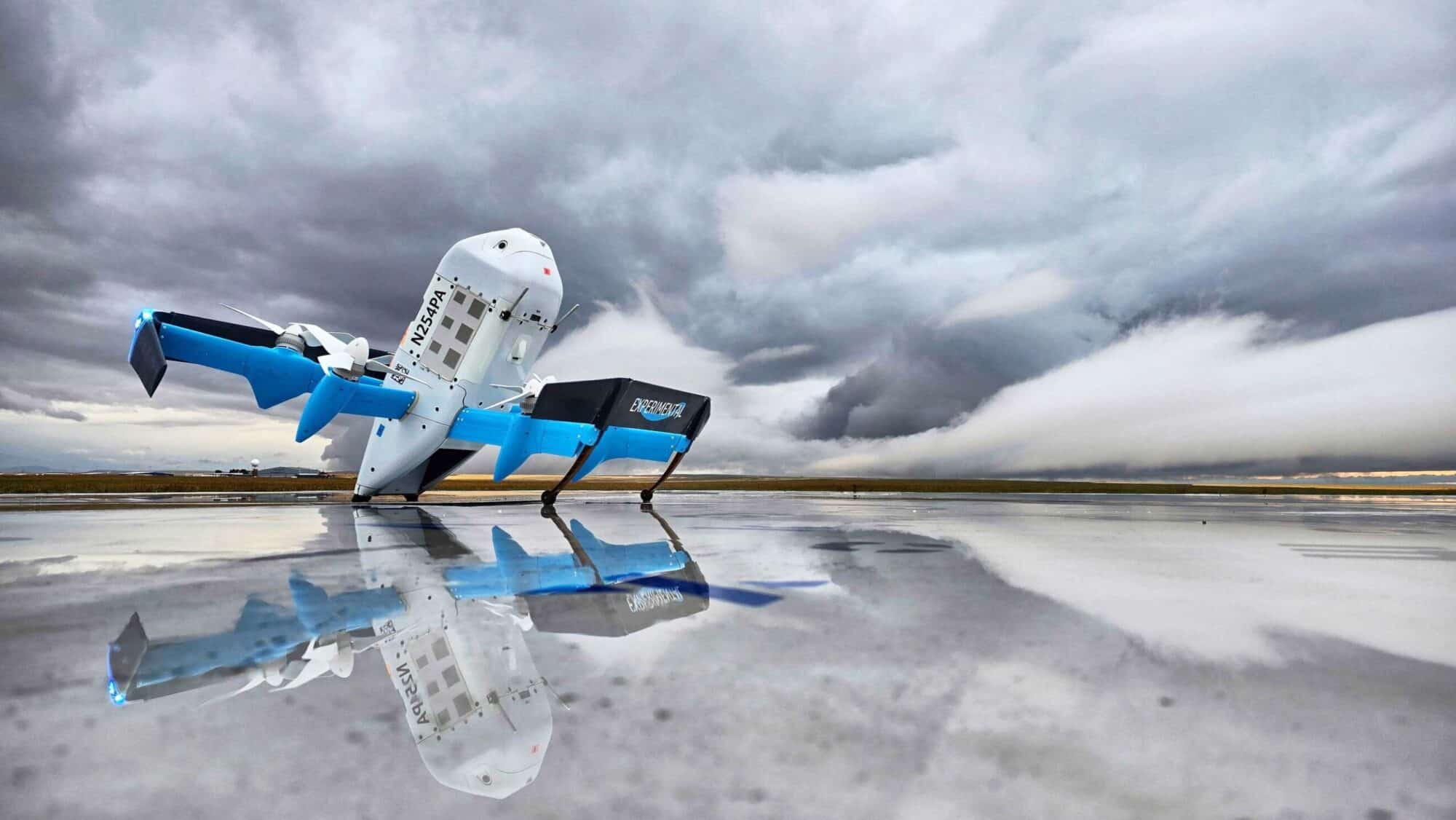
Prime Air uses Amazon's current-generation delivery drone, the MK30, which weighs 38 kg and carries a maximum payload of 2.3 kg. It cruises at approximately 117 km/h at altitudes between 61 and 91 meters. Amazon says the MK30 has roughly twice the range of its predecessor and targets delivery within one hour of an order being placed. The drone does not land; instead, it hovers at low altitude and lowers the package to a designated marker in the customer's yard before climbing away.
Image credit: Prime Air
Amazon redesigned the MK30 to be quieter and more weather-resistant than earlier models. New propellers reduce perceived noise by nearly half, and the aircraft is certified to fly in light rain following water-spray and submersion testing of its motors.
The MK30 also features landing-zone awareness: onboard sensors identify and avoid obstacles such as trampolines and clotheslines during descent before releasing the package. Amazon says the MK30 completed more than 6,300 test flights and 360 hours of FAA certification flying before entering commercial service.
One limitation that rarely gets top billing: despite being one of the larger drones currently in commercial operation, the MK30's payload ceiling remains a shoebox-sized 2.3 kg. That spec suits emergency small-item deliveries—a phone charger, a bottle of medication—but rules out bulk purchases. A bag of sugar won't fit. Neither will a rack of ribs.
Omaha Joins a Rapidly Expanding 2026 Footprint
Amazon has spent 2026 scaling Prime Air from a handful of pilot sites into an operational delivery network. As of February of this year, the program had completed approximately 16,000 deliveries and was live in Texas, Michigan, Arizona, Florida, and Kansas, with new markets being added nearly every month.
Markets added or announced so far this year include Kansas City, San Antonio, Waco, Detroit suburbs, Dallas–Fort Worth, Tampa, and the Houston area, with Baton Rouge and Chicago's south suburbs reportedly next in line.
This expansion is built on Amazon's network of more than 85 same-day fulfillment centers—warehouses stocked with high-velocity inventory that double as drone launch points, allowing new markets to go live without building dedicated airstrips from scratch. The Papillion facility is simply another warehouse being equipped with drones.
Amazon's self-imposed targets are ambitious: the company plans to make Prime Air available to 30 million customers by the end of 2026 and aims to deliver 500 million packages per year by the end of the decade. In live markets, Prime members pay $4.99 per drone delivery; non-members pay $9.99.
Analysis
The most telling number in this story may be the year. Jeff Bezos went on television in 2013 and promised drone package delivery within a few years. It is now 2026, and Prime Air had completed roughly 16,000 deliveries as of February.
That gap is the drone delivery story in microcosm. The technology outpaced regulation by a decade, and the FAA has only recently given Amazon enough operating room to move. The MK30 required 360 hours of certification flying before Omaha could even be added to the list.
Type certification from the FAA is a slow, expensive process, and it is the wall against which most drone delivery ambitions have broken.
So a package landing in a Papillion backyard is a small thing that took thirteen years and a redesigned aircraft to make possible.
The question for Omaha residents is whether this time it is real—or still a promise. Watch the dates. Amazon wants 30 million customers covered by end of 2026 but will not give Omaha a launch date, and Prime Air has a documented history of slipping timelines. Whether Papillion goes live this year or next will be a meaningful indicator of whether this delivery network is genuinely expanding or merely announcing.
Image credit: Amazon, Prime Air
原文來源: 查看原文
FAQ
Newsletter
Subscribe to our Low-Altitude Industry Newsletter
Daily curated news on low-altitude economy and drone industry, delivered to your inbox.