RAF Typhoon APKWS Deployment Proves Combat Success, All 10 Eurofighter Nations Eye 'Drone Killer' Capability
Following the RAF's successful deployment of AGR-20A APKWS-equipped Eurofighter Typhoons in the Middle East in May 2026, all 10 non-UK Eurofighter operator nations have expressed strong interest in adopting the system. BAE Systems confirmed the development, highlighting APKWS's cost-per-engagement of just $20,000–$30,000 compared to air-to-air missiles costing hundreds of thousands of dollars — making it a compelling asymmetric counter-drone solution.

Highlights
- In May 2026, RAF No. 9 Squadron at RAF Akrotiri, Cyprus deployed AGR-20A APKWS-equipped Eurofighter Typhoons in the Middle East for air defence operations, with confirmed operational success.
- BAE Systems Managing Director Richard Hamilton announced on 18 June 2026 that all 10 Eurofighter operator nations have expressed strong interest in adopting APKWS following the RAF's combat results.
- APKWS costs $20,000–$30,000 per engagement, compared to $2.5–3 million for a Meteor missile, making it over 100 times cheaper and economically viable against low-cost drones like the Shahed-136.
- The Typhoon APKWS integration moved from first test firing in April 2026 to combat deployment in under two months, enabled by collaboration between the RAF, MoD, BAE Systems, and QinetiQ.
- Ukraine's F-16s have been carrying APKWS II in LAU-131/A pods since December 2025, providing real-world combat validation that accelerated the system's adoption on the Typhoon.
RAF Typhoon APKWS Deployment Drives All Eurofighter Nations to Pursue 'Drone Killer' Capability
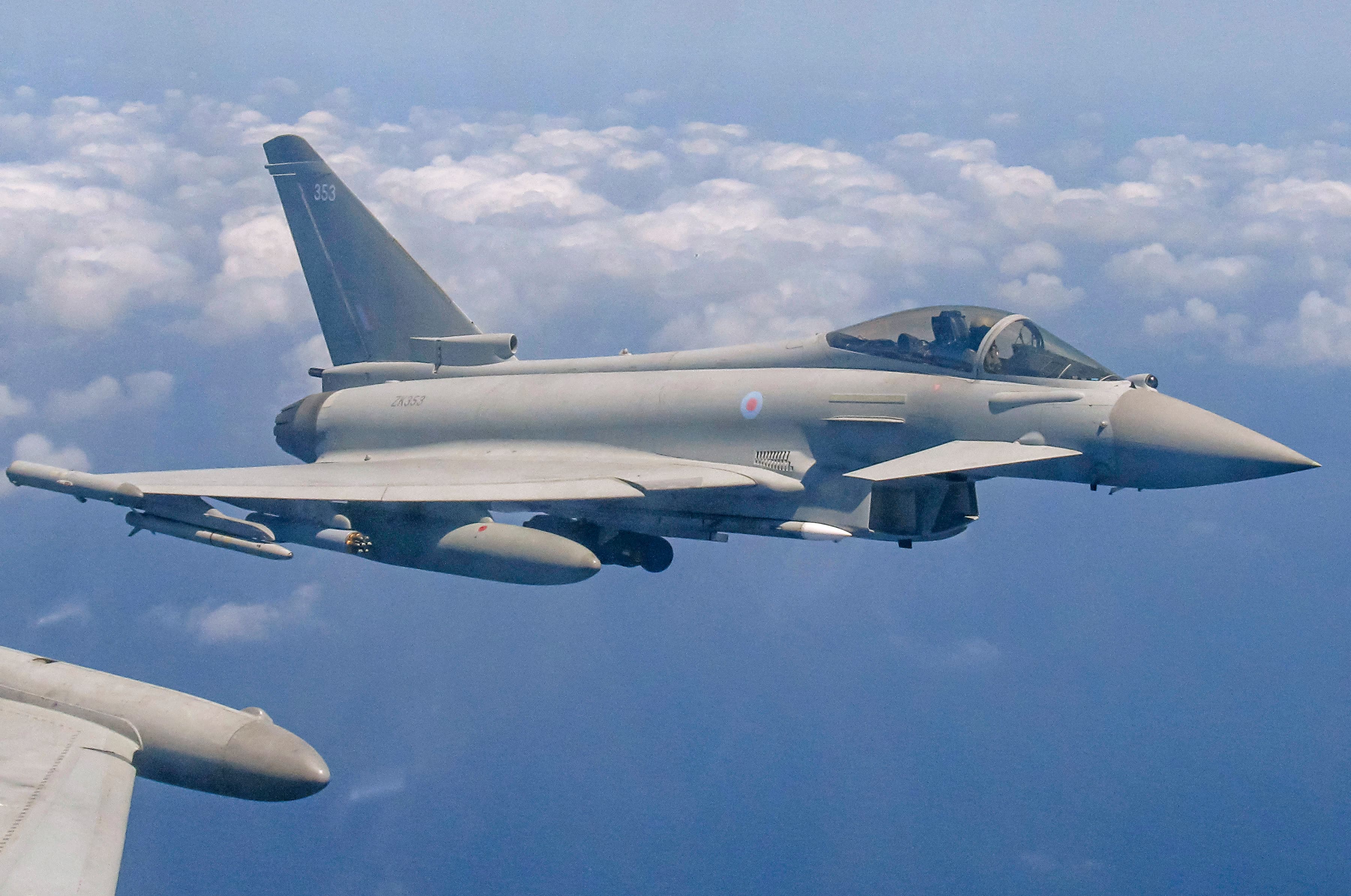
In May 2026, the Royal Air Force (RAF) deployed Eurofighter Typhoons equipped with the AGR-20A APKWS (Advanced Precision Kill Weapon System) in the Middle East for air defence operations. The mission proved highly effective — and has since prompted every non-UK Eurofighter operator nation to consider following suit.
The news was disclosed by Richard Hamilton, Managing Director of BAE Systems Air Combat, the manufacturer of APKWS.
"I can say that all Eurofighter users — all 10 of them (Turkey not yet formally a user) — have expressed strong interest. We are seeing demand from the global Eurofighter fleet," Hamilton said on 18 June 2026 at BAE Systems' Warton facility in northern England, as reported by Jane's.
The Eurofighter Consortium and Operator Nations
The Eurofighter Typhoon was developed by a consortium comprising the United Kingdom, Germany, Spain, and Italy. Beyond these founding members, Austria, Kuwait, Oman, Qatar, Saudi Arabia, and more recently Turkey have all procured the aircraft.
From Test to Combat: Less Than Two Months
No. 9 Squadron, based at RAF Akrotiri in Cyprus, operates the APKWS-integrated Typhoons. The UK Ministry of Defence (MoD) formally announced the integration on 17 May, confirming it had been completed successfully without disclosing further operational details.
"APKWS is now being employed operationally by 9 Squadron, enhancing the Typhoon's multi-role versatility and allowing it to respond more flexibly to evolving threats. The system strengthens the RAF's ability to maintain sustained air defence capabilities while managing costs and resources more effectively," the RAF stated at the time.
The pace of integration was remarkable — BAE Systems only conducted the first live firing of a 70mm laser-guided APKWS rocket from a Typhoon in April 2026, meaning the system went from initial test to combat deployment in under two months.
"The rapid collaboration between the RAF, the MoD, and industry partners QinetiQ and BAE Systems enabled the system to transition from testing to operational deployment in less than two months. Successful trials conducted by 41 Test and Evaluation Squadron, including air-to-air engagement testing, validated the system's effectiveness in real-world scenarios," the RAF noted.
Cost Asymmetry: The Core Driver for Counter-Drone Adoption
The primary motivation for Eurofighter operators seeking APKWS is its cost-effectiveness, increased magazine depth, and rapid response capability against the growing threat of low-cost drones and one-way attack munitions — a threat pattern seen acutely in the high-intensity environment over Iran and on the drone-saturated Ukrainian battlefield.
Conventionally, an advanced fighter intercepting a drone with an air-to-air missile may expend a weapon costing hundreds of thousands of dollars to destroy a target worth just a few thousand — a deeply unfavourable exchange rate.
The Typhoon's Meteor missile, for example, costs approximately $2.5–3 million per round. By contrast, the Shahed-136 drone widely used by Iran and Russia costs an estimated $35,000–$50,000. This cost asymmetry places a significant long-term burden on the defending side in sustained conflicts.
APKWS-guided 70mm rockets, at roughly $20,000–$30,000 per engagement, offer pilots a proportionate response option while preserving high-end missiles for faster or more sophisticated threats. This is particularly critical when facing mass drone attacks or swarm tactics, where depleting expensive missile stocks against cheap targets quickly becomes economically unsustainable.
Greater Magazine Depth, Purpose-Built 'Drone Killer'
Beyond cost, APKWS significantly increases a fighter's engagement capacity per sortie.
A standard rocket pod carries seven APKWS rounds, and a Typhoon can carry multiple pods across several hardpoints simultaneously — enabling dozens of engagements per mission and effectively turning the aircraft into a low-cost drone killer without requiring an early return to base for rearming.
As the RAF described it: "APKWS gives RAF pilots a high-precision option to destroy airborne targets and intercept drones at a fraction of the cost of conventional air-to-air missiles. This improves combat persistence and ensures more efficient use of munitions over extended operations. APKWS uses a laser guidance system to convert unguided rockets into low-cost precision weapons, capable of shooting down enemy drones and other threats."
Technical Breakdown: APKWS Counter-Drone Rocket System
The Advanced Precision Kill Weapon System (APKWS), formally designated AGR-20 or APKWS II, is a laser-guided rocket system developed by BAE Systems in collaboration with the United States. It converts the standard unguided Hydra 70 (2.75-inch / 70mm) rocket into a precision-guided munition by inserting a mid-body guidance section between the motor and warhead.
The guidance kit adds folding fins for stability and manoeuvrability, resulting in a solution that costs and weighs approximately one-third of comparable precision-guided missiles. The system uses semi-active laser homing to achieve circular error probable (CEP) accuracy suitable for point target engagement.
The key innovation is BAE Systems' Distributed Aperture Semi-Active Laser Seeker (DASALS) technology. The laser seekers are embedded in the leading edges of the forward control canards, allowing the guidance section to fit within the existing rocket form factor without major redesign.
This mid-body design preserves full compatibility with existing Hydra 70 inventory, launchers, and aircraft platforms — requiring no modification to weapons systems and minimal retraining for personnel, significantly reducing integration complexity.
Combat Validation: U.S. Forces and Ukraine
The United States has prioritised APKWS integration for fighter-based counter-drone missions. The F-16, F-15E, and A-10 Warthog have all been equipped with the rocket.
In combat, Ukrainian F-16s have been observed carrying LAU-131/A seven-round rocket pods loaded with APKWS II munitions since December 2025. More recently, A-10 Warthogs were also observed carrying APKWS rockets during sorties in Operation Epic Fury.
It was precisely this proven combat record — demonstrated by U.S. and Ukrainian forces in counter-drone roles — that drove BAE Systems to integrate APKWS onto the Typhoon and prompted the RAF to deploy it operationally in the Middle East for drone interception.
原文來源: 查看原文
FAQ
Newsletter
Subscribe to our Low-Altitude Industry Newsletter
Daily curated news on low-altitude economy and drone industry, delivered to your inbox.