Franco-German CAPINT Tank Unveiled: Unmanned Turret Paired with Drone Teaming System
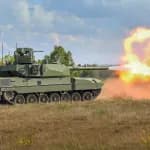
Defense group KNDS has unveiled the CAPINT main battle tank at Eurosatory 2026, built on a Leopard 2A8 hull and featuring an unmanned turret integrated with robotic vehicles and drones. Positioned as a transitional solution ahead of the Franco-German MGCS program, the CAPINT is targeted for deployment in the 2030s.

Highlights
- KNDS在Eurosatory 2026展示CAPINT主戰坦克,以豹式2A8車體為基礎,配備全無人砲塔與有人-無人協同作戰系統,目標2030年代服役。
- CAPINT砲塔採用KNDS ASCALON 120mm滑膛砲與自動裝彈機,完全相容現行北約標準彈藥,且設計可擴展至更大口徑。
- CAPINT搭載1,500馬力柴油引擎並可補充電池儲能,結合電動傳動系統以降低紅外線與聲學特徵,提升戰場隱匿性。
- KNDS同場展示豹式2 A-RC 3.0概念車,保留三人乘員並採遠端遙控砲塔,可搭載120mm至140mm不同口徑火砲。
- KNDS 2025年營收達44億歐元,訂單積壓量高達331億歐元,旗下員工逾11,000人。
Franco-German CAPINT Tank Unveiled: Unmanned Turret Paired with Drone Teaming System
Franco-German defense group Krauss-Maffei Wegmann and Nexter (KNDS) has officially unveiled a new main battle tank designed for European customers at the Eurosatory 2026 international defense exhibition.
KNDS — formed by the merger of the companies behind Germany's Leopard 2 and France's Leclerc main battle tanks — positions itself as a "pan-European land defense company," with a workforce of over 11,000 employees, revenues of €4.4 billion in 2025, and a backlog of orders reaching €33.1 billion.
CAPINT: A Transitional Capability Tank
The new tank is designated CAPINT (short for "Capability Intermédiaire," or Intermediate Capability). In essence, it combines the proven Leopard 2A8 hull with a futuristic unmanned turret, integrated with robotic vehicles and drone systems.
According to KNDS, CAPINT is intended as a bridging solution ahead of France's Main Ground Combat System (MGCS) program. With MGCS development timelines stretching well into the future — the system is not expected to be operational until 2040 — CAPINT aims to be deployable in the 2030s.
On the mobility side, CAPINT retains the mature drivetrain and armor protection of the Leopard 2A8, while benefiting from established logistics supply chains that significantly reduce development risk. The powertrain features a 1,500 hp (1,119 kW) diesel engine, on par with current Western main battle tanks. The system can also be supplemented by battery packs to provide additional onboard energy storage, and works in conjunction with an electric drive to reduce infrared and acoustic signatures, enhancing battlefield concealment.
The Unmanned Turret: The Most Groundbreaking Feature
The most striking aspect of CAPINT's design is its fully unmanned turret. Unlike conventional main battle tanks, no crew members are stationed in the turret; it is instead operated remotely, allowing all crew to remain inside the hull under full armor protection.
With no need to accommodate crew, the turret can be made smaller and lighter — without compromising firepower. CAPINT is reported to be armed with the KNDS ASCALON 120mm smoothbore cannon, fitted with an autoloader and fully compatible with current NATO-standard ammunition stocks.
KNDS has also noted that the turret is designed with scalability in mind, allowing future upgrades to larger calibers without requiring a complete redesign of the overall architecture.
Manned-Unmanned Teaming
Another notable feature of CAPINT is its planned integration with drones and robotic vehicles to form a manned-unmanned teaming (MUM-T) formation. In this configuration, the tank serves as an armored command platform, directing robotic vehicles and drones in combined operations.
Full details have not yet been publicly disclosed, but the system is expected to include drones for forward reconnaissance as well as counter-drone systems to protect the tank itself. Counter-drone measures are likely to combine both hard-kill and soft-kill approaches, including active protection systems (APS) and tube-launched interceptor drones.
Leopard 2 A-RC 3.0 Research Program Also Advances
Alongside CAPINT, KNDS also presented the latest development of its company-funded Leopard 2 A-RC 3.0 research concept at the same exhibition. This concept vehicle similarly adopts a remote-controlled turret, but retains a three-person crew.
The core design philosophy centers on an innovative unmanned turret and a distinctive weapon mounting approach: the main gun no longer needs to extend downward into the hull, freeing up additional interior space. The reduced crew complement also shrinks the armored volume required, lowering overall vehicle weight and thereby improving the power-to-weight ratio for enhanced tactical mobility.
The Leopard 2 A-RC 3.0 can accommodate main guns of 120mm, 130mm, or 140mm caliber, and is equipped with advanced auxiliary weapon systems to address the growing threat of drone swarms.
原文來源: 查看原文
FAQ
Newsletter
Subscribe to our Low-Altitude Industry Newsletter
Daily curated news on low-altitude economy and drone industry, delivered to your inbox.