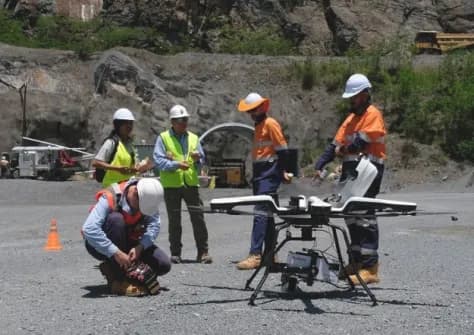
University of Queensland Achieves Near-Real-Time Hyperspectral Aerial Imaging Breakthrough
The University of Queensland has played a pivotal role in what the industry is calling a 'paradigm shift' in hyperspectral data acquisition, enabling near-immediate availability of aerial imagery data. The breakthrough dramatically reduces processing time from hours or days to near-real-time, with significant implications for agriculture, environmental monitoring, mineral exploration, and emergency response.

Highlights
- The University of Queensland has helped drive a paradigm shift that reduces hyperspectral aerial data acquisition time from hours or days to near-real-time.
- Hyperspectral imaging captures electromagnetic data beyond human vision and is used in agriculture, environmental monitoring, mineral exploration, and infrastructure inspection.
- The breakthrough is especially impactful for time-critical applications including emergency response, precision agriculture, and real-time environmental monitoring.
- The advancement was reported by geospatial media outlet Spatial Source and has generated significant attention across the remote sensing industry.
- Near-real-time hyperspectral processing is expected to become a key competitive advantage for commercial drone service providers as sensor-equipped UAVs grow more prevalent.
University of Queensland Drives Paradigm Shift in Hyperspectral Data Acquisition
The University of Queensland (UQ) in Australia has played a key role in advancing a technology breakthrough described by the industry as a 'paradigm shift in hyperspectral data acquisition' — enabling aerial imagery data to be made available in near-real-time.
What Is Hyperspectral Imaging?
Hyperspectral imaging captures electromagnetic spectrum information far beyond the range of the human eye. The technology is widely used across a range of sectors, including agricultural monitoring, environmental surveys, mineral exploration, and infrastructure inspection. When deployed on drone platforms, hyperspectral sensors can provide highly detailed spectral data across large areas that would be impractical to survey on foot.
The Core Breakthrough: From Days to Near-Instant
Traditionally, hyperspectral aerial imagery has required complex post-processing workflows, with analysts often waiting hours or even days before data becomes usable for decision-making. The innovation that UQ has helped drive is expected to dramatically compress that waiting period, delivering near-immediate access to processed, analysis-ready data.
This capability is particularly significant in time-critical applications such as:
- Emergency response and disaster management, where situational awareness must be established rapidly
- Precision agriculture, where real-time crop health monitoring can inform same-day interventions
- Environmental monitoring, where tracking fast-moving events such as pollution incidents or wildfire progression demands timely data
Industry Implications
The development was reported by spatial information media outlet Spatial Source and has attracted considerable attention across the remote sensing and geospatial industries. As drone-mounted hyperspectral sensors become increasingly prevalent in commercial operations, the ability to process and deliver data in near-real-time is set to become a key competitive differentiator for drone service providers.
For the broader drone industry, this advancement underscores the growing convergence of UAV hardware, advanced sensor payloads, and on-board or edge computing capabilities — a combination that is steadily unlocking new commercial use cases and raising the bar for what operators and clients expect from aerial data services.
原文來源: 查看原文
FAQ
Newsletter
Subscribe to our Low-Altitude Industry Newsletter
Daily curated news on low-altitude economy and drone industry, delivered to your inbox.