'Time on Scene' Is the Metric That Truly Defines a Drone as First Responder Program
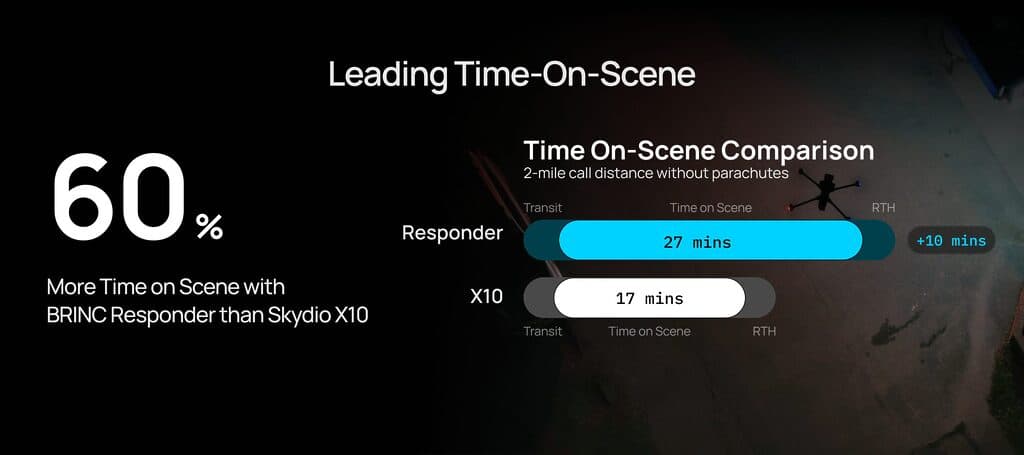
The benchmark for evaluating Drone as First Responder (DFR) programs is shifting from arrival speed to on-scene endurance. As most DFR platforms now beat patrol cars to the scene in more than 50% of calls, rapid response has become table stakes. The real competitive differentiator is how long a drone can remain on scene — directly affecting the quality of police decision-making and overall operational coverage.

Highlights
- Most DFR platforms now arrive before patrol cars on more than 50% of calls, making sub-minute arrival speed a baseline expectation rather than a competitive advantage.
- Short on-scene endurance creates critical intelligence gaps — suspects can disappear, foot pursuits can span multiple city blocks, and barricaded subjects can remain stationary for up to an hour before moving.
- The Guardian platform integrates two-way communications, a loudspeaker, emergency lighting, and a parachute directly into the airframe to maximize on-scene endurance without payload weight penalties.
- Higher operational uptime — faster turnaround between missions combined with longer loiter times — allows a single DFR system to cover more calls per shift with fewer total docking stations, directly reducing program costs.
- The strategic shift in DFR is moving from deploying drones that arrive quickly to building response systems capable of sustaining continuous, cost-effective operations throughout an entire duty day.
'Time on Scene' Is the Metric That Truly Defines a Drone as First Responder Program
For years, Drone as First Responder (DFR) programs were evaluated by a single metric: How fast can the drone get there?
In the early days of DFR, that made sense. Systems relied heavily on manual Pilot in Command (PIC) operation, automation had yet to be fully integrated, and agencies were working to prove that drones could actually arrive before officers — establishing visual contact in seconds rather than minutes. Speed was the entire point.
But DFR is maturing. The questions agencies are asking have fundamentally changed.
No longer: How fast can the drone arrive?
Instead: How long can it stay once it gets there?
In real-world operations, drone value lies not only in rapid arrival, but in the ability to remain on scene while officers make decisions, maintain situational awareness, and avoid escalating a confrontation. In this new era of DFR, arrival time is the baseline — time on scene is the differentiator.
The Scorecard for DFR Is Changing
Today, most DFR platforms beat the first patrol car to the scene on a substantial portion of calls. In Reno, Nevada's emerging DFR program, for example, drones arrive first on more than 50% of deployments. That advantage remains important — but it has become an industry expectation.
The new point of differentiation is how long the drone remains on scene after arrival.
A drone that arrives quickly but can only loiter briefly creates a dangerous intelligence gap. Officers lose visual coverage of the scene. Suspects slip behind buildings or into tree lines. Critical situational information disappears at precisely the moment it is most needed.
The cost of that intelligence gap is real.
A barricaded subject may remain stationary for an hour before suddenly moving. A missing-child search may require extended aerial surveillance over a wide area. A foot pursuit can span multiple city blocks in minutes.
During large-scale incidents, commanders need uninterrupted aerial intelligence throughout the entire operation.
The Hidden Cost of Forced Returns
Every forced return to the dock creates operational friction. If a drone must break off because a critical accessory is draining power faster than expected — compressing available flight time — agencies may find themselves sacrificing capability at exactly the moment they cannot afford to.
This tension has quietly shaped how the DFR market has developed.
Many systems were originally designed as general-purpose commercial drones and later adapted for public safety. Agencies added loudspeakers, parachutes, mission payloads, and other equipment over time. Each addition increased weight, reduced endurance, and made deployments more complex.
The result is often a drone that looks well-equipped on a spec sheet but, once fully loaded, delivers far less usable mission time than anticipated.
This matters because emergencies almost never occur under ideal conditions. Agencies cannot choose whether a pursuit happens at night, whether a suspect flees into dense vegetation, or whether an officer suddenly needs two-way communication support from overhead.
The drone must be ready to arrive at real-world incident scenes — and stay long enough to make a genuine difference.
Persistent Endurance Is an Architecture Decision
Time on scene is not a single specification number. It is the product of the entire system architecture working together.
Airframe design, battery capacity, charge cycle time, payload integration, and the degree of autonomy — each element matters. Even total operational uptime across a full shift directly determines time on scene.
This is precisely where purpose-built public safety systems pull ahead of adapted general-purpose platforms.
The Responder platform established the importance of time on scene as a foundational principle when designing a public safety drone system. As a system purpose-built for emergency response, it prioritized the operational realities agencies actually face — indoor and outdoor operation, integrated two-way communications, and usable flight time under full mission load.
Now, Guardian extends that philosophy to the next generation of DFR.
Rather than treating critical mission accessories as afterthoughts, Guardian integrates public safety functions — two-way communications, a loudspeaker, emergency lighting, and a parachute — directly into the airframe. This allows agencies to launch in a fully mission-ready configuration without sacrificing the operational capability at the heart of any DFR program: staying airborne.
Uptime Matters More Than Agencies Expect
The industry typically discusses flight time in terms of individual sorties. But agencies should be thinking about something broader: total operational uptime across a full duty day.
How many calls can a single system realistically cover within a 24-hour period?
The answer has profound implications for program economics.
A platform with limited on-scene endurance and long recharge cycles may technically support DFR operations — but it requires more docking stations, more overlapping infrastructure, and more systems to maintain reliable coverage. Agencies end up spending their budget covering the same geographic area rather than expanding it.
Higher uptime changes that equation.
Faster turnaround between missions combined with longer on-scene endurance allows a single system to support more calls per shift, cover more sectors per deployment zone, and deliver greater operational coverage with fewer total installations.
This is one of the most significant strategic shifts occurring in the DFR space right now.
The future of this field is not simply about launching drones faster — it is about building response systems capable of sustaining operations continuously and cost-effectively.
Agencies are also increasingly recognizing that greater time on scene produces better outcomes: safer apprehensions, stronger situational awareness, more de-escalation opportunities, and fewer visual blind spots for officers on the ground.
Arrival speed opened the door for DFR programs. Time on scene is what makes them indispensable.
原文來源: 查看原文
FAQ
Newsletter
Subscribe to our Low-Altitude Industry Newsletter
Daily curated news on low-altitude economy and drone industry, delivered to your inbox.
Reviewed and published by the LAETimes editorial desk ·