IEEE Traveling Museum Brings Engineering History to Life Around the World
The IEEE Traveling Museum stages rotating exhibitions at conferences, libraries, and universities worldwide, showcasing landmark artifacts including a superheterodyne radio prototype developed by FM radio pioneer Edwin Howard Armstrong, rare microchips, and a century of mobile communications technology.

Highlights
- The IEEE Traveling Museum is a rotating exhibition initiative that brings historic engineering artifacts to conferences, libraries, and universities worldwide.
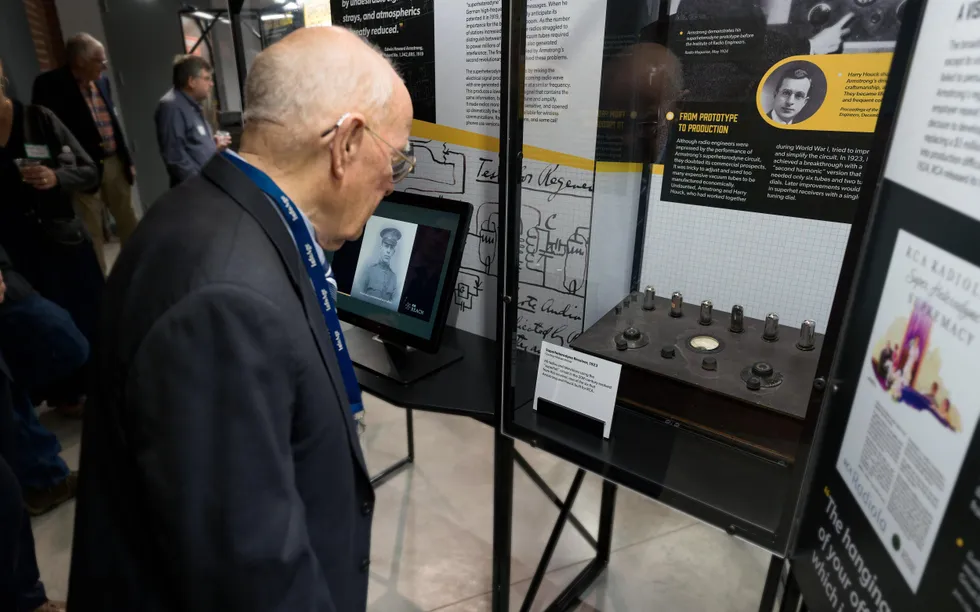
- The flagship exhibition 'Unseen Signals' features one of only six surviving superheterodyne radio prototypes developed by FM radio pioneer Edwin Howard Armstrong and covers 93 square metres.
- The Armstrong exhibition runs at the Pavek Museum in Minnesota through August 15, 2025, then travels to the Museum of Innovation and Science in New York from November 21, 2025 to May 9, 2027.
- The 'Microchips That Shook the World' exhibition includes a rare Kodak KAF-1300 image sensor from 1986, of which only approximately 500 units were ever produced globally.
- The IEEE Traveling Museum's virtual exhibition 'Powering Up,' developed with the IEEE Dielectrics and Electrical Insulation Society, is now live online and covers high-voltage power engineering history.
Many IEEE members have long maintained personal collections of historic engineering artifacts, frequently lending these treasures to the IEEE History and Heritage program — which includes the IEEE History Center — for public display. To broaden access, the program established the IEEE Traveling Museum, a rotating exhibition initiative that brings curated shows to conferences, libraries, universities, and other venues around the world.
The initiative aims to educate the public on how technological progress builds across generations, and how engineers and researchers continue to advance human welfare by standing on the shoulders of those who came before them.
Daniel Jon Mitchell, Director of Heritage Programs and the museum's chief curator, says the work is deeply rewarding.
"People tell me that when history and artifacts are presented in an accessible way, they are genuinely moved," Mitchell said. "When people are emotionally touched, they remember the experience. I think that is where the power of what we do lies."
Microchips That Shook the World
A recent touring exhibition was on display in April in New York City during the IEEE Honors Ceremony, which recognizes engineering pioneers whose technologies transformed the way humanity connects. Attendees were invited to explore "Microchips That Shook the World," an exhibition inspired by IEEE Spectrum's "Chip Hall of Fame."
The show highlights the pivotal role of integrated circuits in signal processing, audio engineering, and telecommunications. Among the featured exhibits was a Commodore 64 home computer, which stirred childhood memories among many attendees who had grown up using the machine.
Other exhibitions focus on early radio inventions and the development of electrical power and communications technologies.
Honoring Radio Pioneer Edwin Howard Armstrong
The concept of a traveling museum became reality in 2024, following a chance meeting between IEEE Outreach Historian Alexander Magoun and IEEE Associate Member Mike Molnar. Molnar owns one of just six surviving superheterodyne radio prototypes developed by Edwin Howard Armstrong — best known for inventing the FM radio system and the first recipient of the IEEE Medal of Honor in 1917.
The superheterodyne receiver uses a local oscillator and mixer to convert an incoming frequency to a fixed, lower intermediate frequency — a design that became the foundation of modern electronic communications. That prototype serves as the centerpiece of the museum's flagship exhibition, "Unseen Signals: E. Howard Armstrong's Radio Revolution," which celebrates the inventor's life and his lasting influence on the broadcasting industry and wireless communications.
"The radio prototype is one of the most awe-inspiring items we can display," Mitchell said.
Mitchell and Magoun gathered additional artifacts from museums and private collectors along the U.S. East Coast, including: the Audion vacuum tube Armstrong used in early wireless signal amplification experiments; a collection of consumer products that capitalized on the radio craze of the era — including a flour sifter and a laxative — and a Korean War–era Motorola walkie-talkie.
"After [Guglielmo] Marconi, Armstrong is the most consequential figure in the history of radio," Mitchell said. "This exhibition is not just a biography — it is a story about the cultural and political ramifications of his research."
Visitors can listen to 15 short clips from historical broadcasts spanning politics, religion, sports, and other subjects.
The Armstrong exhibition debuted in 2024 at the National Museum of Industrial History in Bethlehem, Pennsylvania. The 93-square-metre show continues its U.S. tour, currently on view at the Pavek Museum in St. Louis Park, Minnesota, through August 15. It is then scheduled to travel to the Museum of Innovation and Science in Schenectady, New York, from November 21 through May 9, 2027. IEEE members with a digital membership card receive free admission.
Collaborating with IEEE Societies
The IEEE History and Heritage program also partners with IEEE technical societies to develop custom exhibitions for special events. In 2024, Mitchell curated a show marking the 75th anniversary of the IEEE Vehicular Technology Society and the 100th Vehicular Technology Conference. "Our Mobile World" made its debut at the October conference held in Washington, D.C.
Exhibits included the Motorola DynaTAC "brick" mobile phone, CB radios from the 1980s, and one of the earliest handheld GPS receivers. Visitors could test their knowledge of a century of wireless technology, motor vehicles, and mobile communications inventions through interactive games.
This year, Mitchell partnered with the IEEE Dielectrics and Electrical Insulation Society to launch a virtual exhibition, "Powering Up," now live on the Traveling Museum website. The online show provides an overview of high-voltage power engineering, highlighting the critical roles played by GE and Westinghouse in making long-distance, high-voltage power transmission possible.
The History of the Microchip
While "Unseen Signals" is designed for large venues, "Microchips That Shook the World" prioritizes flexibility and can be configured for spaces of varying sizes. Artifacts are pre-mounted on display stands and protected under glass covers, as many are rare and irreplaceable.
Among the highlights is a Kodak KAF-1300 image sensor, invented in 1986 and used in one of the earliest digital cameras built specifically for photojournalists.
"The KAF-1300 image sensor chip is credited with bringing the digital camera out of the laboratory," Mitchell said. "Only around 500 units were ever produced worldwide."
Visitors can also experience firsthand how a transistor works by toggling a button switch on a display.
The exhibition also offers a preview of IEEE's immersive video project "Inside the Microchip," which uses forensic photography and computer-generated imagery to explore the silicon layers of an Nvidia NV20 chip. The video — targeted at middle school students to explain how microchips work inside their gaming devices — is expected to be released later this year.
The exhibition was shown in May at the IEEE Electronic Components and Technology Conference in Orlando, Florida. Later this year, members will have the opportunity to see it at the Computer History Museum in Mountain View, California, and at the University of Waterloo in Ontario, Canada.
The IEEE Traveling Museum operates through the generous support of donors to the IEEE Foundation.
原文來源: 查看原文
FAQ
Newsletter
Subscribe to our Low-Altitude Industry Newsletter
Daily curated news on low-altitude economy and drone industry, delivered to your inbox.