Royal Navy Conducts First Sea Launch of Combat-Proven Nyan Loitering Munition, Pointing to a 'Hybrid' Fleet Future
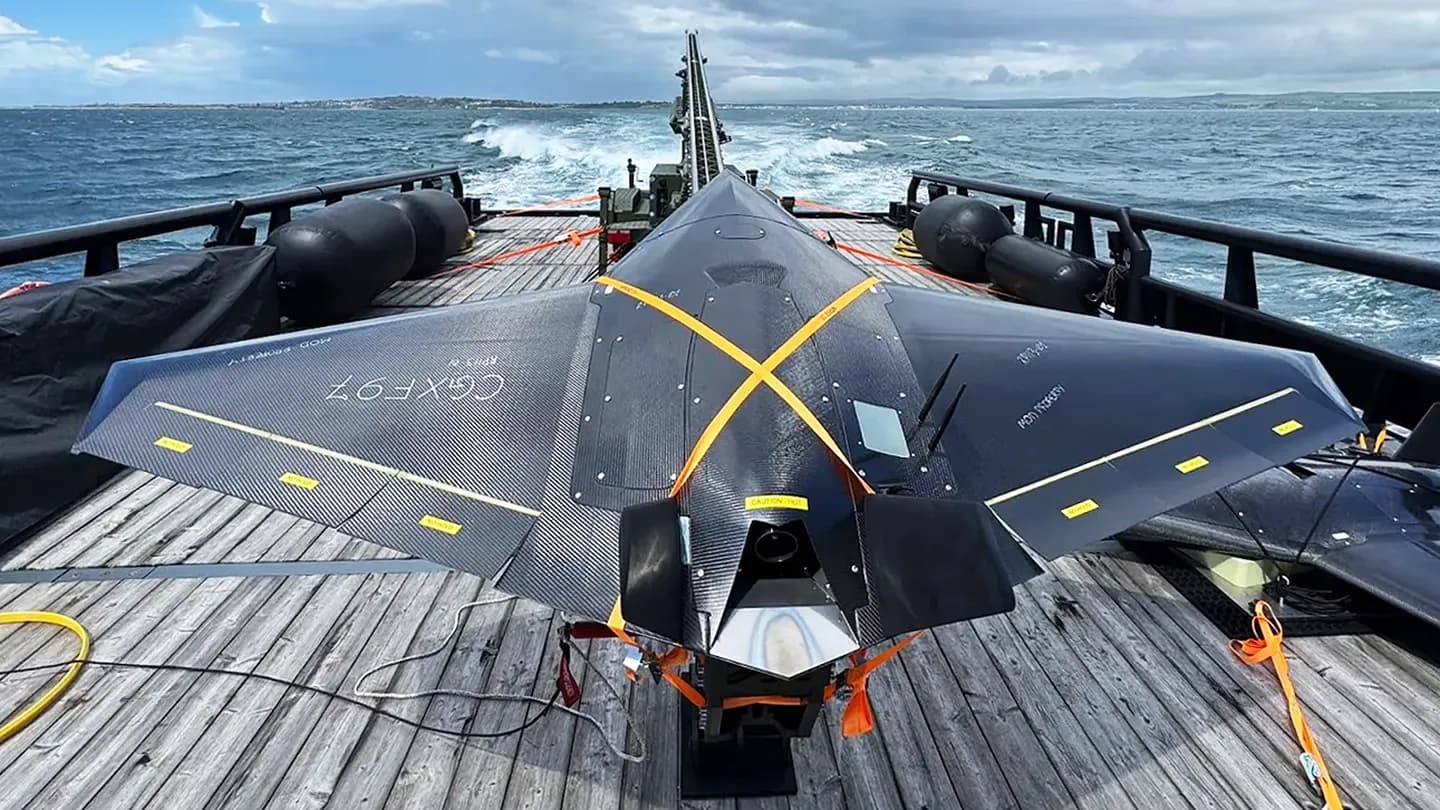
The Royal Navy has successfully launched the Nyan one-way attack drone from the trials vessel XV Patrick Blackett off England's southern coast during Exercise Neptune Reach. Developed by BAE Systems subsidiary Callen-Lenz, the Nyan costs under £100,000 per unit, spans 2.9 metres, and has a range exceeding 150 km. With over 1,000 units produced and combat use in Ukraine, the sea-launch trial marks a key milestone in Britain's push toward a 'hybrid navy' strategy.

Highlights
- The Royal Navy launched the Nyan loitering munition from trials vessel XV Patrick Blackett off England's southern coast during Exercise Neptune Reach, the first confirmed sea launch of the system.
- The Nyan, built by BAE Systems subsidiary Callen-Lenz, costs under £100,000 per unit and has a range exceeding 150 km—surpassing the Harpoon anti-ship missile.
- Over 1,000 Nyan units have been produced and the drone has previously seen combat use with Ukrainian forces.
- The sea trial is part of tri-service Project Vantage, which aims to rapidly deliver and integrate one-way attack weapons across the Royal Navy fleet.
- BAE Systems has proposed trialling the Nyan aboard HMS Queen Elizabeth, with long-term plans under Project Ark Royal envisioning CATOBAR-capable carrier drone operations.
Royal Navy Conducts First Sea Launch of Combat-Proven Nyan Loitering Munition, Pointing to a 'Hybrid' Fleet Future
The Royal Navy has successfully launched the Nyan one-way attack drone—commonly described as a kamikaze drone—from a ship at sea, marking a significant step forward in Britain's vision of building a so-called 'hybrid' naval force. The trial is one component of a broader UK plan to substantially expand its reliance on uncrewed systems, a strategic direction further underscored in the Defence Investment Plan published earlier this week.
Exercise Neptune Reach: A Tri-Service Trial
During recent trials conducted off England's southern coast, the Nyan loitering munition was launched from XV Patrick Blackett, the Royal Navy's dedicated technology trials vessel.
The exercise, designated Exercise Neptune Reach, involved personnel from the Royal Navy's 744 Naval Air Squadron, the British Army's 26th Regiment Royal Artillery, and the Royal Air Force.
Luke Pollard MP, Minister for Defence Procurement and Industry, said in a statement: "The UK is serious about transforming into a hybrid navy, and powerful new drones will be at the heart of the Royal Navy. By integrating Army and Navy expertise to deploy attack drones from ships at sea, we are accelerating the operational capabilities our forces need to stay ahead."
Nyan: Technical Specifications
Nyan's catapult launcher is mounted on the ship's deck. Operators pre-programme a target, and the drone autonomously flies to it while the vessel remains underway.
Development of the Nyan began in 2022. Designed for precision strike missions, it is produced by Callen-Lenz, a subsidiary of BAE Systems. It is positioned as a low-cost strike platform, with the manufacturer stating a unit cost of under £100,000 (approximately US$132,000).
Key specifications:
- Wingspan: Approximately 9.5 ft (2.9 m)
- Range: Over 93 miles (150 km)—exceeding the strike distance of the Harpoon anti-ship missile
- Materials: Primarily carbon fibre construction
- Propulsion: Small turbojet engine
- Low-observable design: Includes a low-detectability exhaust nozzle to improve survivability against enemy air defences
Combat-Proven Background
The Nyan and its launch system have undergone extensive land-based exercise testing. During Exercise Spring Storm held in Estonia earlier this year, the British Army employed the system in support of NATO allied manoeuvre training. Subsequently, the Royal Artillery formally introduced Nyan into operational service.
Notably, prior to the Royal Navy's sea trial, Nyan had already seen its combat debut in the hands of Ukrainian forces.
Project Vantage: Advancing Maritime One-Way Strike Capability
In terms of maritime applications, the Patrick Blackett trial during Exercise Neptune Reach forms part of the broader tri-service Project Vantage, which focuses on rapidly testing and delivering one-way attack weapons for the Royal Navy.
Commander David Burton RN, the Royal Navy's lead for Maritime One-Way Effector Capability, stated: "This trial represents an important step in the rapid delivery of maritime one-way effectors. Under Project Vantage, we plan to integrate these capabilities into the hybrid navy, combining crewed platforms with uncrewed systems to extend strike range, increase operational tempo, and enhance lethality."
Mass Production and Future Development
According to Callen-Lenz CEO Matt Foster, the Nyan has entered mass production, with over 1,000 units manufactured to date.
The Royal Navy stated that the sea trial lays the groundwork for further testing and eventual fleet-wide deployment of the Nyan. Beyond its current strike role, Callen-Lenz indicated that the Nyan could be adapted to carry alternative payloads, or scaled up to increase range and endurance.
BAE Systems has also raised the possibility of trialling Nyan aboard the aircraft carrier HMS Queen Elizabeth.
The Hybrid Carrier Strike Group Vision
The UK Ministry of Defence's Strategic Defence Review, published last year, explicitly addressed the impact of the hybrid naval force plan on carriers and their air wings:
"The Royal Navy must continue to evolve towards a more capable but cheaper and leaner fleet, developing a 'high-low' mix of platforms and weapons that exploits autonomy and digital integration. Carrier strike is already at the forefront of NATO capability, but faster progress is needed in evolving to a hybrid carrier air wing—pairing crewed combat aircraft (F-35B) with airborne autonomous collaborative platforms and expendable one-way drones. The hybrid carrier air wing programme should also encompass long-range precision missiles launchable from the carrier deck."
The Defence Investment Plan published this week further noted that development of the hybrid carrier air wing will include trials of jet-powered drones launched from carriers. Previous carrier drone trials include the 2021 launch of a modified QinetiQ Banshee Jet 80+ target drone from HMS Prince of Wales, and the 2023 operation of a General Atomics Mojave short take-off and landing (STOL) UAS from the same vessel—the latter completing its trials without any catapult or arrestor system, thanks to its impressive short-field performance.
Project Ark Royal: Long-Term CATOBAR Ambitions
Beyond catapult-launched systems such as the Nyan, the Royal Navy harbours longer-term catapult-assisted take-off, barrier-arrested recovery (CATOBAR) ambitions for its carriers under Project Ark Royal. The programme envisions gradually equipping both carriers to operate a wider range of mission types—including heavier, more complex, and higher-performance uncrewed aircraft. General Atomics has already pitched the Royal Navy on a carrier-suitable variant within its Gambit drone family, designed to integrate into the future UK carrier air wing.
In the longer term, full CATOBAR capability could even open the door to adding fixed-wing crewed aircraft to the carriers.
The UK is not alone in this direction—China and Turkey, among others, are increasingly exploring drone deployments aboard large amphibious assault ships and other non-traditional aviation vessels.
Strategic Assessment
For the time being, the Nyan represents a relatively modest strike capability. Given its range, presumably limited warhead mass, and subsonic performance, it is best characterised as a low-cost tactical precision weapon. It falls short of the long-range precision strike capability that UK armed forces increasingly seek, but it offers a viable means of engaging targets at shorter ranges at reduced cost—and becomes particularly potent when employed in mass salvoes or launched simultaneously from multiple platforms, creating a saturation threat that defensive systems would struggle to counter against ships or shore targets.
At the same time, operational experience accumulated with the Nyan in the maritime environment will help pave the way for the introduction of more capable uncrewed systems.
The successful sea launch of the Nyan marks an important milestone in the Royal Navy's journey toward a hybrid fleet, demonstrating the UK's commitment to expanding precision strike capability and accelerating the integration of uncrewed platforms. As the Royal Navy continues to trial carrier-based drone operations, assets of this kind will play an increasingly significant role in complementing traditional platforms and enhancing overall fleet effectiveness.
原文來源: 查看原文
FAQ
Newsletter
Subscribe to our Low-Altitude Industry Newsletter
Daily curated news on low-altitude economy and drone industry, delivered to your inbox.