Orlando Police Department Launches 11-Drone Skydio DFR Network in $6.83M Deployment
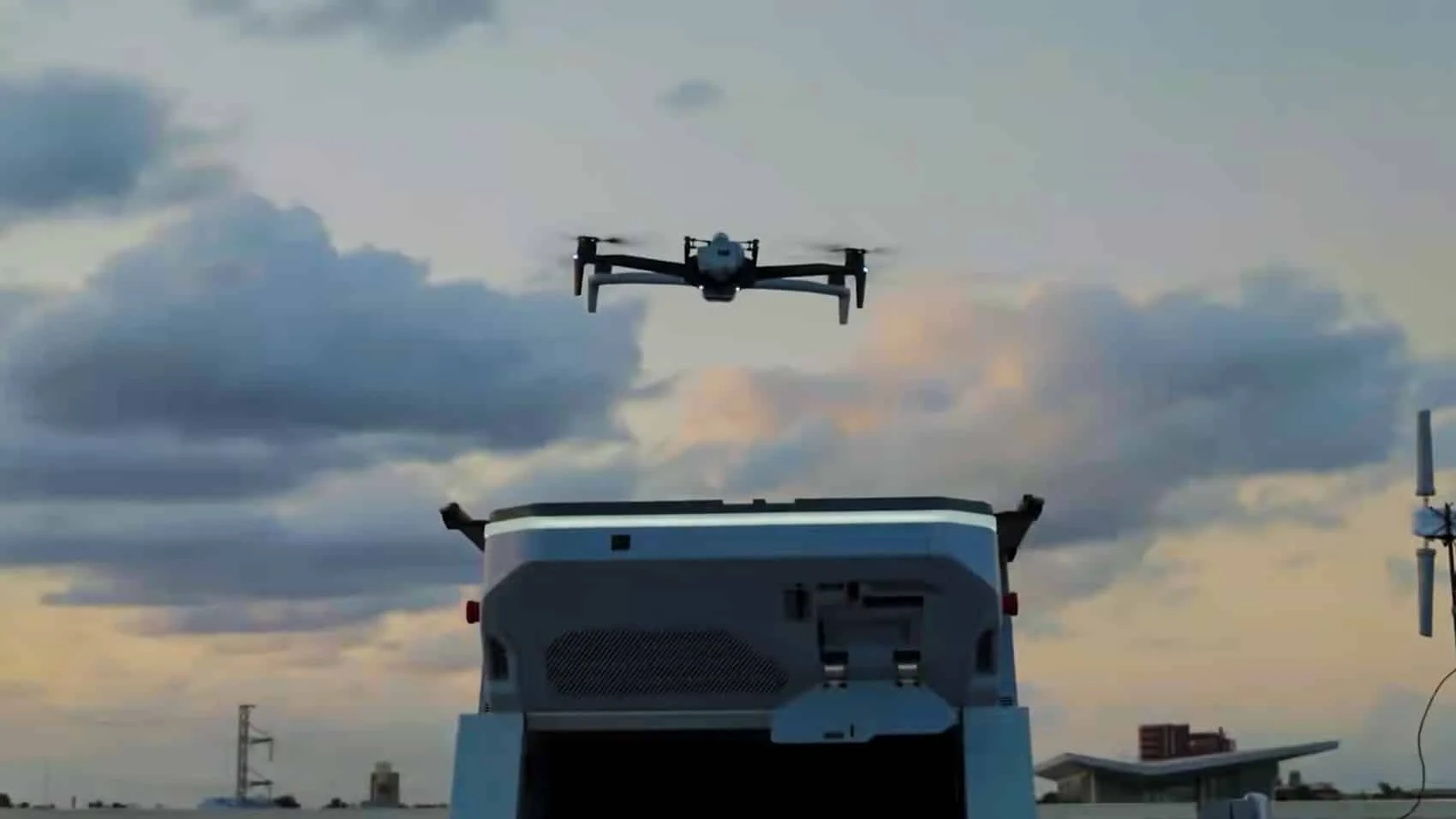
The Orlando Police Department officially activated its automated Drone as First Responder (DFR) network on June 17, deploying 11 Skydio drones across nine rooftop docking stations citywide. The $6.83 million program—sold through Axon—targets a sub-3-minute response time for life-threatening 911 calls, making Orlando the largest multi-dock Skydio DFR deployment in the United States.
Highlights
- Orlando PD activated 11 Skydio drones across nine rooftop docking stations on June 17 under a $6.83 million contract, making it the largest multi-dock Skydio DFR deployment in the United States.
- The system targets a sub-3-minute response time for qualifying 911 calls including life-threatening incidents, in-progress violent crimes, and significant property loss.
- A seven-week single-drone pilot responded to 185 calls, arriving before patrol units 33% of the time and delivering actionable situational awareness in 97% of cases.
- The contract was brokered through Axon, whose existing enterprise agreements with large U.S. police departments created a streamlined procurement pathway for the $6.83M deal.
- The launch came nine days after Skydio CEO Adam Bry publicly argued for small, multi-dock autonomous drones over larger DFR platforms, with Orlando serving as a direct operational validation of that thesis.
The Orlando Police Department (OPD) officially activated its automated Drone as First Responder (DFR) network on June 17, following city council approval of a $6.83 million contract amendment four months earlier. The program covers 11 Skydio drones operating from nine rooftop docking stations distributed across the city.
Image credit: Orlando Police Department
The system is now actively responding to 911 calls involving life-threatening situations, significant property loss, and time-critical emergencies. The launch also makes Orlando the largest multi-dock Skydio DFR deployment in the United States—arriving just nine days after Skydio CEO Adam Bry published his case for the physics of DFR on June 8.
System Architecture and Capabilities
Orlando's setup follows a standard drone-in-a-box model scaled to major-city dimensions. Nine weatherproof, auto-charging rooftop docking stations keep drones in a persistent ready state, each integrated with OPD's computer-aided dispatch (CAD) system.
Image credit: Orlando Police Department
When a qualifying 911 call enters the dispatch system, the nearest drone autonomously lifts off, follows pre-planned flight corridors to the incident location, and streams live video back to the Crime Command Center and responding patrol units.
Activation criteria are deliberately narrow: life-threatening incidents, in-progress violent crimes, significant property loss, traffic collisions with casualties, and time-sensitive calls where an aerial view can meaningfully reduce ground search time.
The target response time is under three minutes from dispatch trigger to drone on-scene—the same benchmark cited by Flock customers such as Normal PD in Illinois, and the standard adopted by DFR programs in California, Texas, and Virginia since 2024.
Skydio–Axon Integration
The drones are Skydio platforms sold and integrated through Axon—best known for its body-worn cameras and Taser products—and that sales channel is central to understanding why this deal came together.
Image credit: Orlando Police Department
Axon already holds enterprise contracts with most large U.S. police departments, covering evidence management, body-cam infrastructure, and digital evidence software. Bundling a Skydio DFR deployment into an existing Axon master contract framework substantially lowers the procurement barrier for a department of Orlando's size.
The drones fall into the 5-pound (approximately 2.3 kg) class—consistent with the physics argument Bry outlined in his June article. Autonomous software handles flight planning, obstacle avoidance, and automated dock returns without operator intervention. FAA-licensed officers at the Crime Command Center decide whether to launch, set search patterns, and can override autonomous commands; the drone executes the mission.
Pilot Data That Supported the $6.83M Vote
According to the Florida Voice, OPD's case to the city council—presented in February of last year—drew primarily on a seven-week, single-drone pilot. During that trial, the aircraft responded to 185 calls, arrived on scene before patrol units 33% of the time, and provided actionable situational awareness in 97% of responses.
Image credit: Orlando Police Department
The 33% first-arrival rate is lower than the 70–75% targets cited by Flock customers such as Normal PD—understandably so, since the pilot used one drone covering an entire city rather than a distributed dock network. The 97% actionable-information rate is the more compelling figure: once overhead, the drone was useful nearly every single time.
The nine-dock network is effectively the geographic fix for the pilot's limitations. By pre-positioning drones across the city rather than launching from a single OPD location, the first-arrival rate should move closer to the 70–75% figures Flock references.
The Skydio X10 carries a substantially longer real-world flight record than later-arriving Flock hardware, which helps sustain the procurement justification. Whether the per-drone annual cost delivers commensurate value is a separate question—one that remains open. What is clear is that agencies now have genuine multi-vendor options when selecting a DFR platform.
Orlando as a Counter-Case to Bry's Argument
The timing carries editorial weight. On June 8, Skydio CEO Adam Bry published a piece arguing that the DFR trend toward larger drones—implicitly aimed at Flock—was solving the wrong problem. He contended that doubling sensor range cubes weight, which in turn drives up noise, kinetic energy risk, and cost per flight minute. His preferred model: more small autonomous drones covering more calls.
Image credit: Orlando Police Department
Nine days later, the largest U.S. city Skydio DFR network of the year went live, built exactly on that architecture: 11 drones, nine docks, autonomous flight, a sub-3-minute response target, and a 5-pound platform.
Orlando is, in effect, the operational proof-of-concept for Bry's thesis. The city has become the flagship deployment for the "small drones, many docks" side of the municipal procurement debate.
That does not mean the debate is settled. Just four days before Orlando's launch, Normal PD in Illinois purchased Flock DFR equipment using a federal COPS grant—a different path entirely. Smaller agencies deploying their first DFR system via grant funding tend to choose Flock. Larger departments with existing Axon contracts and bigger annual budgets tend to choose Skydio. Bry framed this as a physics question; actual U.S. purchasing behavior in mid-2026 looks more like a procurement-pathway contest.
DroneXL Analysis
One thing nobody is saying plainly: Orlando's deployment is as much an Axon win as a Skydio win. A $6.83 million DFR contract clearing Orlando's city council master-contract framework succeeded for the same reason that body-cam spending at large U.S. departments rarely faces serious scrutiny. Axon controls the procurement pipeline; Skydio is the cargo riding that rail. That distribution advantage will shape the outcome of the next 50 U.S. municipal DFR deployments far more than any physics white paper.
The open question is how Flock responds. Flock has its own enterprise sales motion, anchored primarily in its existing license-plate-recognition install base. Whether Flock can translate that into a dispatch-console integration story comparable to Axon's position at departments like Orlando will determine whether the next large-city DFR deployment in 2026—Houston, San Diego, Tampa, and Charlotte all have active procurement discussions underway—lands on Aerodome-derived hardware or Skydio hardware.
For Orlando residents: expect routine police air traffic over your neighborhood. The upside, based on evidence from most jurisdictions that have adopted DFR, is measurably faster response times and improved situational awareness for officers on the ground.
原文來源: 查看原文
FAQ
Reviewed and published by the LAETimes editorial desk ·


