2,300-Hour Rare Experiment Confirms Graphite Seals Can Withstand Molten Salt Reactor Conditions
A University of Michigan research team has completed a rare 2,300-hour experiment testing commercial shaft seals under simulated molten salt reactor (MSR) conditions. Results showed that graphite sleeve seals exhibited no significant corrosion or degradation when exposed to FLiNaK molten salt, high temperatures, and 1,500 RPM shaft speeds. Argon was identified as the optimal cover gas, providing critical engineering data for next-generation reactor design.
Highlights
- University of Michigan completed a rare 2,300-hour experiment testing commercial graphite sleeve shaft seals under simulated MSR conditions using FLiNaK salt at 1,500 RPM.
- Post-test inspection revealed no significant corrosion or degradation of the graphite sleeve seal after the full 2,300-hour test duration.
- Argon was identified as the optimal cover gas, maintaining the highest in-vessel pressure at equivalent flow rates compared to helium and nitrogen.
- Fewer than 10 facilities worldwide are capable of conducting experiments with more than 10 kg of high-temperature fluoride salt sustained for over 100 hours.
- The findings were published in Progress in Nuclear Energy and provide practical engineering guidelines for Gen-IV molten salt reactor design, including a demonstration reactor under construction in Oak Ridge, Tennessee.
A research team at the University of Michigan (U-M) has successfully completed an exceptionally rare 2,300-hour experiment, comprehensively testing commercial shaft seals under simulated molten salt reactor (MSR) operating conditions.
Using a custom-built Shaft Seal Test Facility, the researchers validated a circumferential graphite sleeve seal. Test results indicated that the shaft seal requires approximately 10 days of run-in time before reaching stable operation, and performs best when used with argon as the cover gas.
Professor Xiaodong Sun, a professor of nuclear engineering and radiological sciences at the University of Michigan, stated: "The reliable performance of pumps and seals is critical to the safe deployment of molten salt reactor technology. This study provides valuable experimental data under near-realistic operating conditions, helping to fill important knowledge gaps in future reactor design."
Exceptional Durability Performance
Molten salt reactors are highly efficient and operate at lower pressures than conventional water-cooled reactors. However, they require highly reliable seals to prevent the leakage of highly corrosive salt vapors and toxic gases such as hydrogen fluoride.
To simulate MSR operating conditions, the researchers constructed a custom facility containing two stainless steel tanks connected by piping. The system uses a lower tank holding 32 kg of FLiNaK salt, which is pushed into the upper primary tank via differential pressure to simulate the conditions of a radioactive reactor core.
FLiNaK — a mixture of lithium fluoride, sodium fluoride, and potassium fluoride — closely mimics the behavior of salts used in radioactive reactor cores without posing actual radiation hazards, making it an ideal simulation medium.
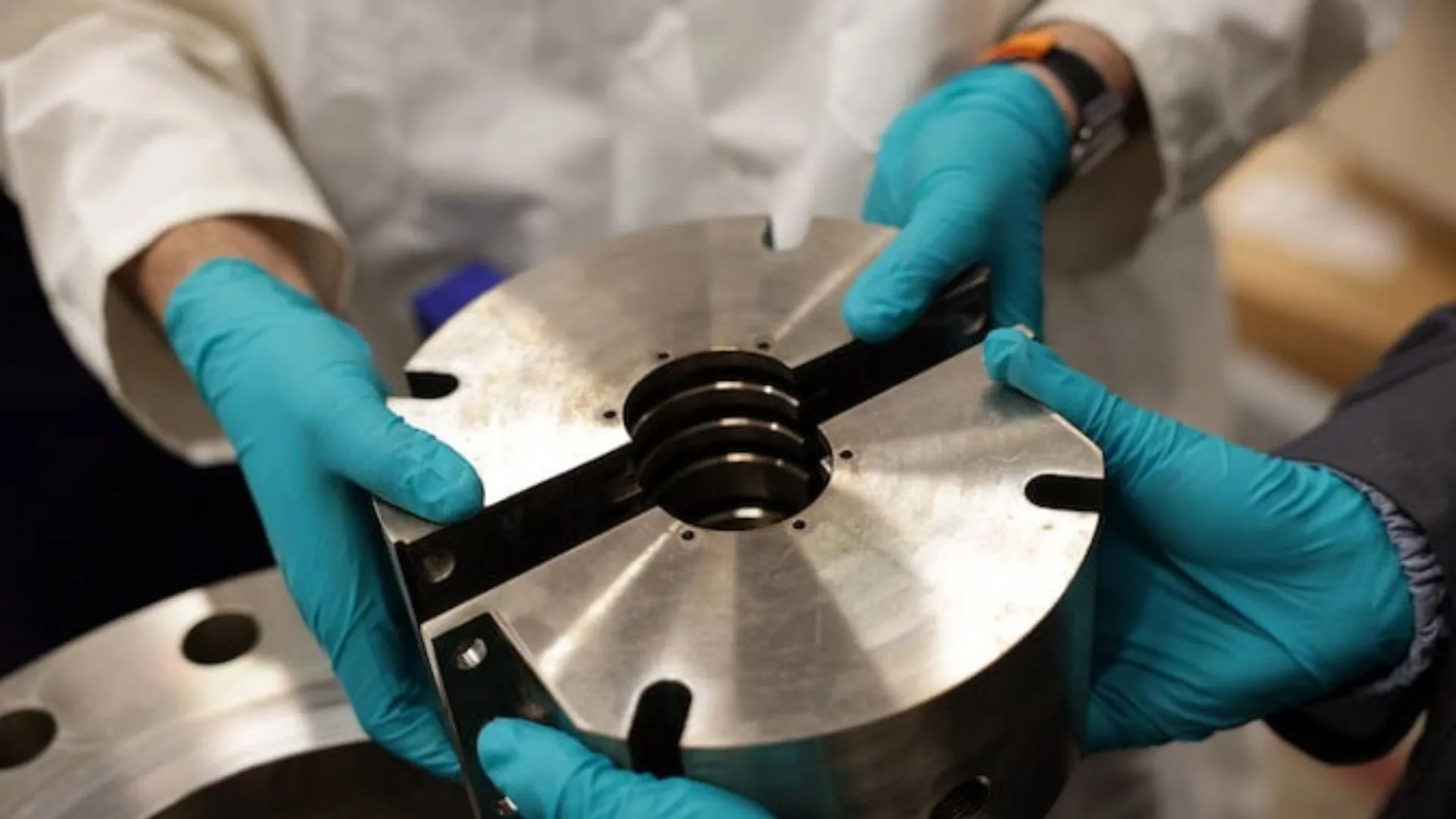
Inside the test chamber, a rotating shaft connected to an electric motor was protected by a commercially available graphite sleeve seal. The entire assembly was tested for seal durability under salt vapor, high temperature, and 1,500 RPM shaft speed conditions, with comparative experiments conducted using different inert cover gases.
Following the 2,300-hour FLiNaK salt test, post-test inspection of the Shaft Seal Test Facility revealed no significant seal corrosion or degradation. The commercial seal stabilized after approximately 10 days of run-in — during which friction creates microscopic gaps that allow internal pressure to equalize.
Test results also showed that operating temperature and shaft rotation speed had minimal impact on performance. Notably, the choice of cover gas proved critical: argon maintained the highest in-vessel pressure at equivalent flow rates, outperforming both helium and nitrogen.
Laying the Groundwork for Future Reactor Design
This experiment helps address a significant knowledge gap that has long hindered the scale-up of molten salt reactors.
Long-duration experiments involving molten salts are extremely rare. These materials are highly volatile and difficult to handle — fewer than 10 facilities worldwide are capable of conducting experiments with more than 10 kg of high-temperature fluoride salt sustained for over 100 hours.
Shuai Che, a doctoral graduate from U-M's Department of Nuclear Engineering and Radiological Sciences and lead author of the study, commented: "These results help transform an under-researched pump component into a quantifiable engineering problem, and provide guidance for the design, optimization, and scale-up of seals for future molten salt reactors and other advanced energy systems."
The timing of this finding is particularly significant. Generation IV (Gen-IV) advanced molten salt reactors are gaining momentum, including a high-profile demonstration reactor currently under construction in Oak Ridge, Tennessee. As a result, the University of Michigan's findings offer industry developers an immediately applicable practical framework.
The engineering parameters documented — including radial clearance and cover gas selection — can serve as practical guidelines for the design, optimization, and scale-up of next-generation high-efficiency molten salt reactors.
The study has been published in the academic journal Progress in Nuclear Energy.
原文來源: 查看原文
FAQ
Newsletter
Subscribe to our Low-Altitude Industry Newsletter
Daily curated news on low-altitude economy and drone industry, delivered to your inbox.
Reviewed and published by the LAETimes editorial desk ·