27 Years, $5 Billion: Russia's Reborn Battle Cruiser Is a Monument to Naval Dysfunction
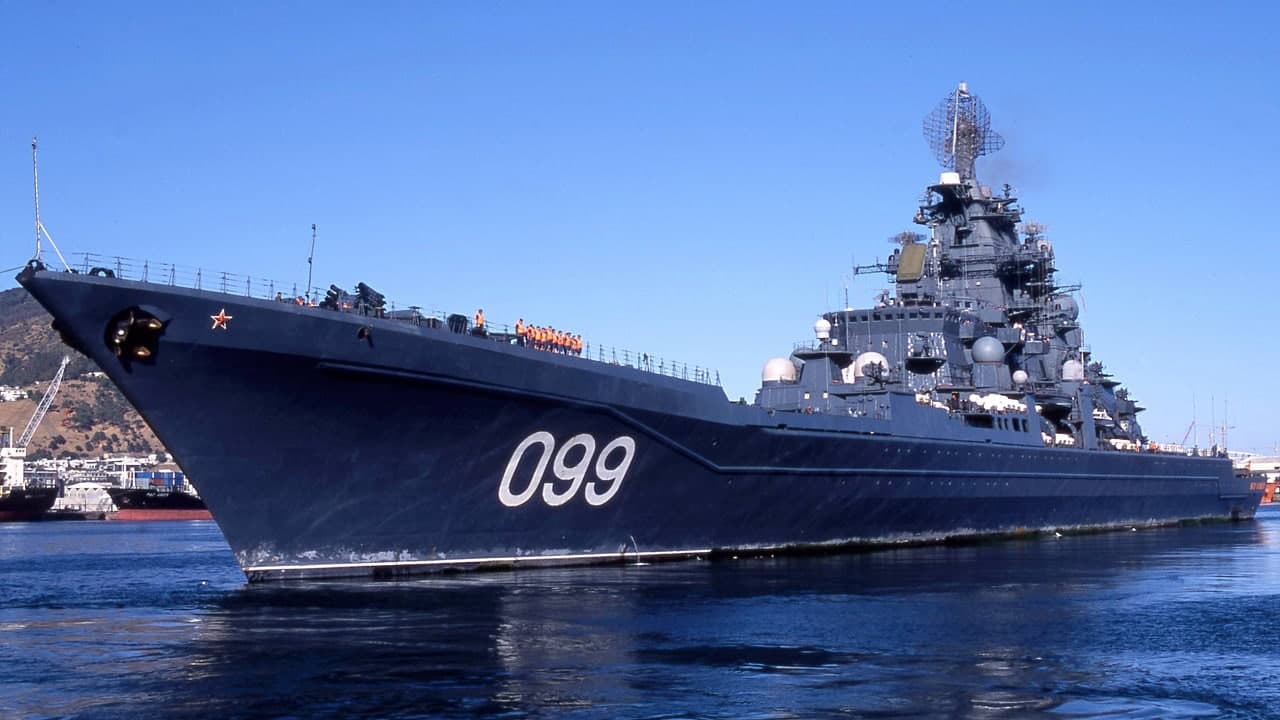
Russia's nuclear-powered battle cruiser Admiral Nakhimov has returned to sea after nearly 27 years in refit and an estimated $5 billion in costs. Armed with 80 vertical launch cells capable of firing Zircon hypersonic missiles, it is the most heavily armed surface warship on paper — yet its return exposes deep structural failings in Russian naval power, from targeting gaps to fleet attrition by cheap Ukrainian drones.
Highlights
- Admiral Nakhimov returns to sea after 27 years at Sevmash shipyard and an estimated total cost of approximately $5 billion, replacing — not adding to — Russia's battle-cruiser inventory as sister ship Pyotr Velikiy is scrapped.
- The ship carries 80 vertical launch cells loadable with Kalibr, Oniks, Otvet, and Zircon missiles, making it the most heavily armed surface warship in the world on paper.
- Operational data from Ukraine shows Zircon's terminal speed is approximately Mach 4.5–5.5 (not the claimed Mach 9), and Patriot systems intercepted 41% of 46 Zircon missiles fired; researcher Fabian Hinz estimates actual range at 500–750 km.
- Russia's over-the-horizon targeting capability — essential to use long-range anti-ship missiles in open ocean — remains critically limited, making Nakhimov's 1,000-km headline range largely theoretical against manoeuvring warships.
- Ukraine's cheap drone and missile campaign sank the Moskva and degraded Russian Black Sea Fleet surface-ship strength by roughly one-third, reducing Russia's Black Sea control from ~90% to ~25% — a direct warning for how Nakhimov would fare in peer combat.
Russia's Battle Cruiser Gamble
Somewhere in the White Sea this summer, the largest surface warship in the world outside of an aircraft carrier — the first since World War II — is completing final sea trials before rejoining the Russian Navy. The Admiral Nakhimov, a Kirov-class nuclear-powered battle cruiser, has been out of service for nearly three decades. Its return has been almost universally framed in media coverage as the resurrection of a Cold War deterrence concept, now equipped with the hypersonic missiles that have dominated defence headlines. All of that is true — Nakhimov is genuinely formidable. Yet the celebratory framing obscures a more revealing story: this ship is nearly a perfect mirror of Russian naval power's ambitions and deep dysfunctions in 2026.
27 Years and an Estimated $5 Billion in Refit
The vessel entered Soviet service in 1988 under the name Kalinin and effectively disappeared from active use after roughly a decade — refit preparations began in 1997, and she entered the Sevmash shipyard in 1999, languishing in various states of inactivity ever since. Russia formally decided to modernise her in the mid-2000s, with work beginning in earnest around 2013 and a projected return to service by 2018. That schedule slipped by more than a decade. By the time she rejoins the fleet, nearly 27 years will have passed since she entered the yard — longer than her entire Soviet-era front-line service life.
Costs escalated with the delays. The 2013 refit contract was reportedly worth around 50 billion roubles, approximately $667 million at the exchange rate of the time; final cost estimates have risen to roughly 200 billion roubles, or about $2.7 billion, with some Western analysts placing the all-in figure closer to $5 billion. Whatever the precise figure, it represents an enormous share of Russia's naval budget staked on returning a Cold War-era hull to service. The ship's two KN-3 nuclear reactors were restarted in December 2024 and February 2025, restoring nuclear propulsion for the first time in decades. On 1 June 2026, Nakhimov departed Sevmash under her own power to begin final sea trials.
Armament and Intended Mission
What Russia has bought, on paper, is staggering firepower. The original Soviet weapon systems — including 20 massive P-700 Granit anti-ship missiles that defined the ship's "carrier killer" role — have been stripped out and replaced with 10 universal launch modules totalling 80 vertical launch cells. These can be loaded in various combinations with Kalibr land-attack cruise missiles, P-800 Oniks supersonic anti-ship missiles, Otvet anti-submarine weapons, and 3M22 Zircon hypersonic missiles. Dedicated launchers carry the naval variant of the Fort-M (S-400) air-defence system, supplemented by six Pantsir-M close-in weapon systems, giving the ship an air-defence magazine that exceeds virtually any Western surface combatant. At roughly 28,000 tonnes displacement and approximately 823 feet (251 metres) in length, the ship dwarfs American destroyers.
Her intended mission is real and legitimate. Nakhimov will serve as flagship of Russia's Northern Fleet, based in the Arctic, with a primary role of helping to defend the "bastion" areas — the patrol zones of Russia's ballistic missile submarines that form the core of its nuclear deterrent. This is a sensible fit: a nuclear-powered cruiser with a massive air-defence magazine and effectively unlimited range is well suited to that task. However, Nakhimov will replace her sister ship Pyotr Velikiy, which is reportedly to be retired and scrapped rather than undergo a similar overhaul. This means the entire multi-billion-dollar effort has not added a single battle cruiser to Russia's order of battle — it has merely replaced an ageing hull with a refurbished one.
What Zircon Can Actually Do
The most heavily promoted fact about the refitted Nakhimov is that she carries Zircon missiles — which Moscow has described as a Mach-9, "unstoppable" hypersonic weapon that renders Western defences obsolete. The operational reality, after the missile's actual use against Ukraine, is considerably more complicated, and this is where most coverage falls short.
Russia claims Zircon flies at Mach 9 with a range of 1,000 km. Ukrainian forensic analysts examining Zircon debris from strikes on Kyiv calculated actual flight speeds closer to Mach 5.5, with terminal-phase speeds dropping to approximately Mach 4.5 — far below advertised figures, and a terminal deceleration that opens a window for intercept. Ukraine's air force has reported that of 46 Zircon missiles fired, 41 percent were intercepted by Patriot systems. Independent analysts have gone further: open-source researcher Fabian Hinz, working from debris analysis and Russian patent filings, has argued that Zircon may not be a scramjet-powered hypersonic cruise missile as advertised, but rather a manoeuvring quasi-ballistic weapon with an actual range of perhaps 500–750 km. A former British naval warfare officer who has studied its operational use said he was, as an expert, "not impressed."
None of this means Zircon is harmless. It is a deployed, fast, manoeuvring missile that is genuinely difficult to intercept. Russia's Zircon inventory reportedly grew from around 40 missiles in 2024 to approximately 230 by 2026, at a reported unit cost exceeding $5 million. But it is not the invincible weapon of Russian propaganda, and Western air-defence systems have demonstrated the ability to shoot it down. Deploying Zircon on Nakhimov makes the ship more dangerous; it does not make it invulnerable.
The Deeper Problem: Finding the Target
The question almost never raised in coverage of the ship is this: a missile with a theoretical 1,000-km range is only as useful as your ability to locate a target and transmit precise, real-time coordinates to the weapon. Against a non-cooperative ship manoeuvring in open ocean, this is an extraordinarily hard problem — and one Russia has never fully solved.
As analysts at the Center for International Maritime Security have detailed, over-the-horizon (OTH) targeting is Russia's single most critical maritime operational gap. Its naval forces have built world-class long-range anti-ship missiles, but as analysts put it bluntly: "if you can't find it, you can't hit it." Russian shore-based sensors reach only a few hundred miles; beyond that range, the area of ocean to be searched expands explosively. Moscow's answer is the Liana signals-intelligence satellite constellation, which can detect enemy ship emissions and relay them to Russian weapon systems — but the system has limited capacity, and tracking a manoeuvring US carrier strike group in real time across the Atlantic or Pacific represents a capability Russia can currently achieve only partially.
The conclusion is that Nakhimov's headline anti-ship range is far closer to theoretical than operational against the targets that matter most. Against fixed land targets the calculus is different, and more operationally meaningful — which is why Russian naval doctrine has increasingly emphasised strikes on shore-based "critical infrastructure" targets rather than blue-water surface engagements.
A Single Ship, a Diminished Fleet
Nakhimov's return comes after three years in which the Russian Navy has painfully learned just how vulnerable large surface combatants have become. In April 2022, the Black Sea Fleet flagship Moskva was sunk by two Ukrainian Neptune missiles — a loss Russia did not formally acknowledge until January 2026. It was not an isolated incident. Open-source assessments indicate Ukraine has damaged or sunk approximately one-third of the Black Sea Fleet's principal surface combatants; Russia's control of that sea collapsed from roughly 90 percent at the war's outset to approximately 25 percent, and the fleet was forced to abandon its main base at Sevastopol for Novorossiysk. All of this was accomplished by a country with virtually no conventional navy, using cheap drones and missiles.
That experience carries stark implications for a ship like Nakhimov. A Georgetown University analysis of the maritime drone revolution noted that in modern naval warfare, concentrated quality makes targets conspicuous and vulnerable — there are no trenches at sea. Nakhimov concentrates a large share of Russia's remaining naval strike power into a single hull that, whatever its size, is not meaningfully better protected against modern anti-ship missiles or explosive uncrewed surface vessels than Moskva was. This gamble is being placed at the very moment Russia is least able to absorb losses: sanctions have severed access to advanced microelectronics and components, shipyards are aged and overstretched, and the sole aircraft carrier Admiral Kuznetsov has not put to sea since 2017 and is widely expected never to do so again. Nakhimov is not the vanguard of a growing fleet — she is one of the last large ships, with almost nothing behind her.
What Nakhimov Actually Represents
Taken together, the refitted Nakhimov emerges as something more nuanced than either "triumph" or "white elephant." She is a genuinely powerful warship whose mission of protecting Russia's nuclear-armed submarine bastions in the Arctic is sound. Her Zircon and Oniks missiles pose real threats, particularly against land targets and against ships within range of Russian shore-based sensors. No Western planner should dismiss her.
But she is also a Cold War solution to problems that modern Russia is structurally ill-equipped to execute.
She was designed to hunt American carrier strike groups — a mission that requires first finding them, something Russia can barely accomplish at oceanic distances. She carries powerful but not invincible hypersonic missiles. She concentrates enormous resources and a quarter-century of effort into a single, unarmoured, irreplaceable hull at the very moment Russia's own catastrophic losses in the Black Sea have demonstrated that this class of warship can be sunk by an adversary spending a fraction of the cost.
Nakhimov is ultimately a monument to two things simultaneously: the enduring ambition of Russian naval power, and the widening gap between that ambition and what Russia can actually deploy.
She is the most heavily armed surface warship on Earth and a symbol of a navy in decline. Those two facts are not in contradiction — they are the same story.
Author: Harry J. Kazianis, former Senior Director of National Security Affairs at the Center for the National Interest (CFTNI), holds a master's degree in international affairs from Harvard University. His work has appeared in The New York Times, The Washington Post, The Wall Street Journal, CNN, and other outlets.
原文來源: 查看原文
FAQ
Newsletter
Subscribe to our Low-Altitude Industry Newsletter
Daily curated news on low-altitude economy and drone industry, delivered to your inbox.
Reviewed and published by the LAETimes editorial desk ·