Seattle World Cup Drone Scoreboard: 400 Drones Display Match Results and National Flags Next to the Space Needle
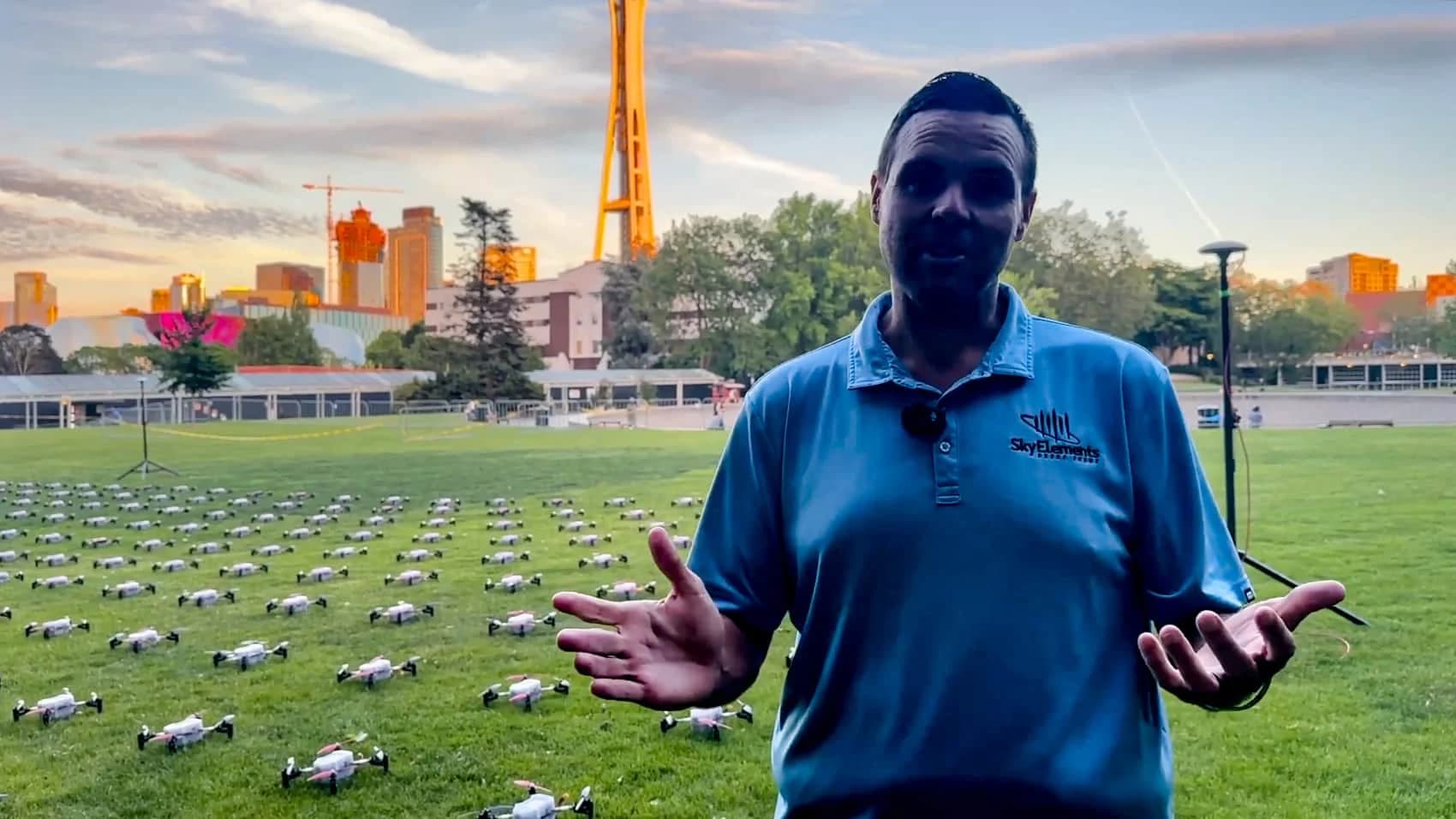
Seattle has launched a drone scoreboard initiative for its six 2026 FIFA World Cup matches, with Sky Elements operating 400 drones over Seattle Center after each game to display final scores and competing nations' flags alongside the Space Needle. The first show took place after Belgium vs. Egypt on June 15, with the series running through July 6. It marks the first time a U.S. World Cup host city has integrated commercial drone performances into match-night programming at this frequency.
Highlights
- Sky Elements will operate 400 drones over Seattle Center after each of Seattle's six 2026 FIFA World Cup matches, running from June 15 to July 6.
- Each show displays the final score and national flags of both competing teams in GPS-synchronized formation, visible alongside the Space Needle, and lasts approximately 8 to 12 minutes.
- Confirmed shows begin at 10:00 p.m. local time; Fisher Pavilion and the International Fountain plaza are the officially recommended viewing locations.
- Sky Elements holds FAA waivers under Part 107.35 and Part 107.39 and coordinates each performance window with Sea-Tac air traffic control via NOTAM.
- Seattle is simultaneously operating a public drone entertainment program at Seattle Center and enforcing a TFR over Lumen Field — a dual-track model that contrasts with the eight drone seizures and one federal prosecution reported in Houston during the same tournament.
Seattle has unveiled a signature activation for its six 2026 FIFA World Cup matches: Texas-based drone show company Sky Elements will fly 400 drones over Seattle Center after each game, projecting the final score and both nations' flags in the night sky alongside the Space Needle.
The first show followed Belgium vs. Egypt on Monday, June 15. The program runs through July 6, making Seattle the first U.S. World Cup host city to integrate commercial drone performances into match-night programming at this density.
Show Schedule and Venue Setup
The Seattle Center configuration ensures visibility for anyone at the central plaza and surrounding blocks. Fisher Pavilion and the International Fountain plaza are the officially recommended viewing locations.
The six match-night show dates are as follows:
- June 15 – Belgium vs. Egypt
- June 19 – USA vs. Australia
- June 24 – Bosnia and Herzegovina vs. Qatar
- June 26 – Egypt vs. Iran
- July 1 – Match 82
- July 6 – Match 94
The four confirmed shows are scheduled to begin at 10:00 p.m. local time; the Friday show time remains listed as TBD on the public schedule.
The post-match timing matters for both local residents and traveling fans. Shows take place after the final whistle, not during play, and the performance window is brief. At this fleet size, Sky Elements typically flies from launch to landing in 8 to 12 minutes — well within the FAA-approved single-window requirement — giving Seattle Center crowds enough time to gather and watch.
Displaying Scores and Flags in Formation
The centerpiece of each show is informational, not merely artistic. Every performance concludes with the final score and both competing nations' flags, visible against the Space Needle's silhouette from the recommended viewing zones.
This makes the overall program a hybrid of public information broadcast and fan entertainment. The score-plus-flag combination represents the kind of legible information graphic that commercial drone show operators have been refining since 2023 — rendering readable data visuals is one of the technical challenges that separates polished shows from generic light displays.
For spectators, the format feels closer to a stadium scoreboard than a fireworks display. The information appears once, reads clearly, and the show is over.
Sky Elements: The Operator Behind the Lights
According to KIRO 7, the Seattle shows are produced by Sky Elements, headquartered in Fort Worth, Texas. The company has previously performed at T-Mobile Park (Seattle Mariners), Lumen Field (Seattle Seahawks), and other public events around the Space Needle.
Sky Elements is one of the largest drone show operators in the United States, with a fleet inventory exceeding 4,000 aircraft and a performance record spanning the World Series, NBA Finals, and multiple major broadcast network events.
The 400-drone configuration used for the World Cup sits in the mid-range of contemporary commercial shows. Deployments in the 400–600 aircraft range produce visuals dense enough for text and flag graphics while avoiding the significant operational overhead Sky Elements carries when deploying 1,000-plus drones for higher-budget productions.
Hardware runs on the company's proprietary swarm platform, using GPS-synchronized formation flight from a single ground control station, with each aircraft positioned to within centimeters of its assigned slot in the array.
FAA Authorization
Large-scale drone shows in U.S. airspace require specific waivers under FAA regulations — Part 107.39 (flight over people) and Part 107.35 (single control station operating multiple aircraft). Operators of Sky Elements' scale maintain standing waivers with site-specific applications and safety assessments for each venue.
Given Seattle Center's proximity to controlled airspace, the shows require coordination with Seattle-Tacoma International Airport (Sea-Tac) air traffic control, and a Notice to Airmen (NOTAM) must be issued for each performance window. For an operator at this maturity level, these procedures are routine.
What is less routine is the venue tempo: six shows at the same city location tied to a major sporting schedule across three weeks — a density that exceeds the execution standard most U.S. drone show programs have operated under.
Contrast With Houston Enforcement
DroneXL reported separately this week on eight drone seizures and one federal prosecution by the Texas Department of Public Safety (DPS) inside a Houston World Cup Temporary Flight Restriction (TFR). That is one side of the 2026 World Cup drone story. Seattle is the other.
The same tournament, the same broad airspace regulatory framework — producing completely different outcomes based entirely on whether an operator is flying under a waiver or not.
Both things are true at once: the United States is aggressively locking down airspace through TFRs and enforcement, and simultaneously maximizing drone entertainment for visiting fans. That is a net positive signal for the U.S. drone industry.
DroneXL's Take
The drone scoreboard story will almost certainly receive wider news cycle coverage than the eight Houston seizures, but that weighting does not serve the industry's long-term reputation particularly well. The 400-drone show over Seattle Center after Belgium vs. Egypt is the most photogenic version of drone operations at the 2026 World Cup.
The eight seized drones in Houston and one federal felony prosecution are the harder side of the same story. Both are real. Seattle's show will dominate the B-roll footage of national broadcasts because it is beautiful. But the Houston enforcement story is the one that determines whether your nephew keeps his Mini-series drone at the next big event.
The open question is whether U.S. host cities for future events of comparable scale will begin treating planned drone entertainment and stadium counter-drone enforcement as parts of a single integrated operational plan. Seattle is running both simultaneously during the same World Cup — public-facing shows at Seattle Center, and TFR protection over Lumen Field. The cleaner that division becomes, the easier the broader U.S. regulatory conversation gets.
Watching a drone show during the World Cup will be an unforgettable experience. Just make sure you enjoy it from the ground — not the air — because unauthorized operators are finding out the hard way that the consequences are severe.
原文來源: 查看原文
FAQ
Reviewed and published by the LAETimes editorial desk ·