Curiosity Rover Update, Sols 4934–4940: Roving Across Polygonal Terrain
NASA's Curiosity rover spent late June 2026 investigating a light-toned geological unit covered in polygon structures on Mars. Scientists used APXS, MAHLI, and ChemCam instruments to analyze polygon ridges and centers, while also probing whether dark pebbles scattered across the unit may be meteorites — a question raised by previous nickel detections in similar rocks.
Highlights
- Curiosity rover discovered unexpected polygon structures resembling giant honeycombs upon entering a light-toned geological unit during Sols 4934–4940 in late June 2026.
- Dark pebbles scattered across the polygon unit are under investigation as potential meteorites, based on prior nickel detections in similar rocks at Gale Crater.
- ChemCam LIBS targeted two polygon ridges and one polygon center for chemical composition analysis during the Monday four-sol plan.
- A dark pebble sample designated 'Cortadera' was measured by both APXS/MAHLI and ChemCam LIBS during the Friday three-sol plan.
- Curiosity will next cross into a darker, rougher-textured terrain band visible in orbital imagery as it continues geological exploration.
By William Farrand, Senior Research Scientist, Space Science Institute
Earth Planning Date: Friday, June 26, 2026
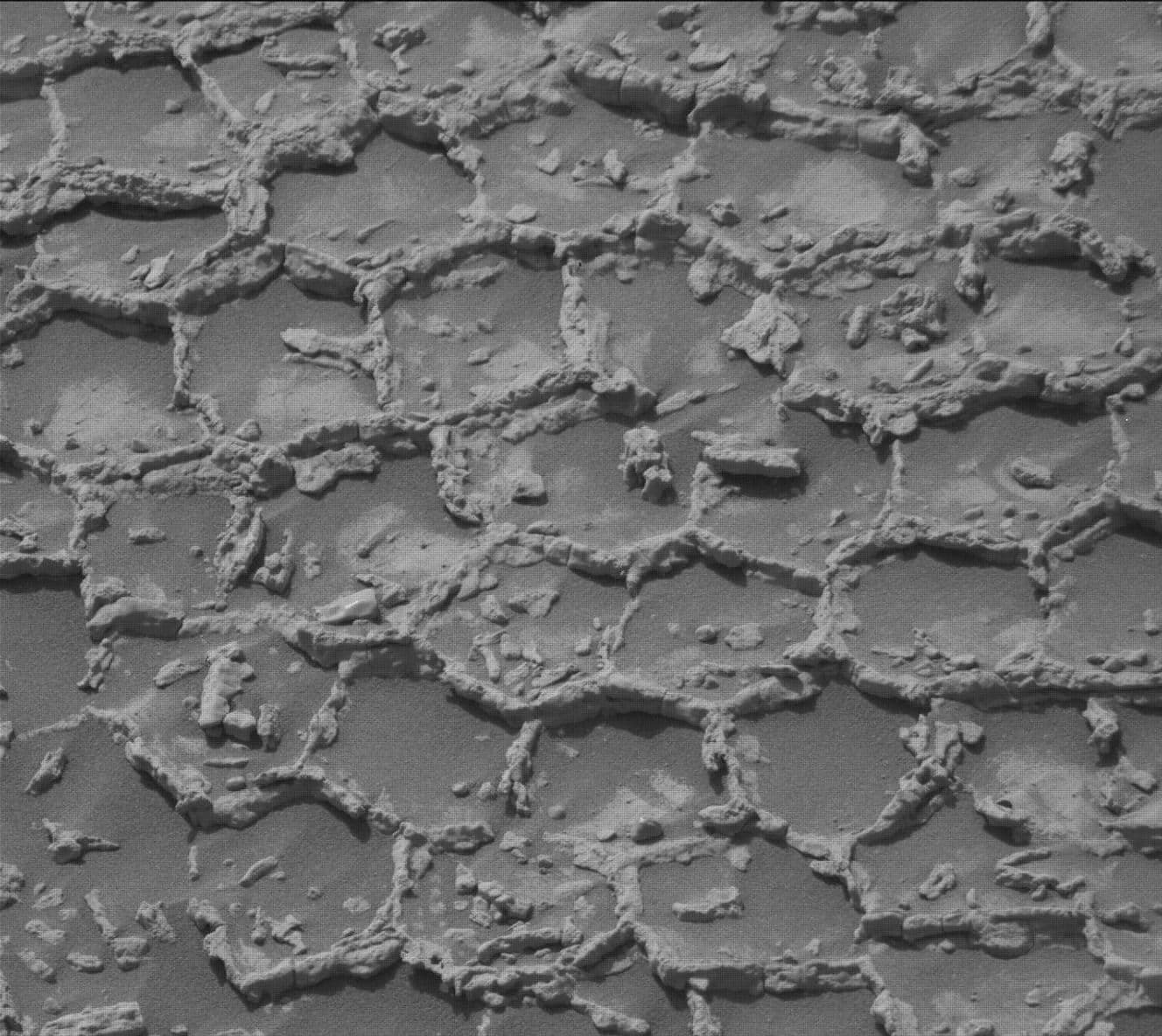
NASA's Mars rover Curiosity captured images of polygon structures using its Mastcam on Sol 4932 (June 21, 2026) at 14:57:55 UTC.
This mission period covered two planning cycles. During Monday's planning session, Curiosity was situated within a geological unit that appeared light-toned in orbital imagery and seemingly smooth from earlier vantage points. However, upon the rover's arrival, the science team was surprised to find the surface blanketed in polygon structures resembling the tops of enormous Martian honeycombs. As the rover pushed deeper into the unit, the polygon ridges showed increasing signs of erosion.
The Mystery of the Dark Pebbles
Scattered across this geological unit are dark rocks ranging in size from gravel to pebbles. The key question scientists are working to resolve is whether these rocks are Mars-sourced material that "drifted" down from higher stratigraphic layers, ejecta from distant impacts outside Gale Crater, or meteorites originating from beyond Mars itself.
Previous analyses of some dark "float rocks" detected nickel — an element common in meteorites but relatively rare in Martian rocks — yet whether all of these dark pebbles and gravels are meteorites remains an open question requiring further investigation.
Monday's Four-Sol Plan
The Monday four-sol plan included:
- APXS and MAHLI: Close-contact science investigations of polygon ridges and centers
- ChemCam Remote Micro-Imager (RMI): Imaging of the "Miraflores" mound and "Cordillera" mesa
- ChemCam Laser-Induced Breakdown Spectroscopy (LIBS): Chemical composition analysis of polygons, with measurements targeting two separate ridges and one polygon center
- ChemCam passive reflectance measurements: Targeting one of the aforementioned dark pebbles
- Environmental monitoring: Navcam dust devil searches and atmospheric opacity ("tau") measurements
Friday's Three-Sol Plan
After the rover advanced toward the upper boundary of the light-toned polygon unit, Friday's three-sol plan included:
- APXS and MAHLI: Measurements of another polygon ridge and a dark pebble sample designated "Cortadera"
- ChemCam LIBS: Targeting "Cortadera" and a polygon ridge
- ChemCam RMI: Imaging the top and base of the "Cordillera" mesa
- Mastcam panoramic mosaic: Covering "Cordillera," nearby troughs, a portion of the "Valle Grande" channel, along with documentation of LIBS targets and the Mastcam calibration target
What's Next
In the coming week, Curiosity will cross into another material band — one that appears darker in orbital imagery and has been confirmed by the rover to be rougher in texture — as it continues to unravel the geological secrets of Mars.
Image credit: NASA/JPL-Caltech/MSSS
原文來源: 查看原文
FAQ
Newsletter
Subscribe to our Low-Altitude Industry Newsletter
Daily curated news on low-altitude economy and drone industry, delivered to your inbox.
Reviewed and published by the LAETimes editorial desk ·