4D Printing Breakthrough: Flat Carbon Fiber Panels Self-Form into Wind Turbine Blades, Cutting Weight by 80%
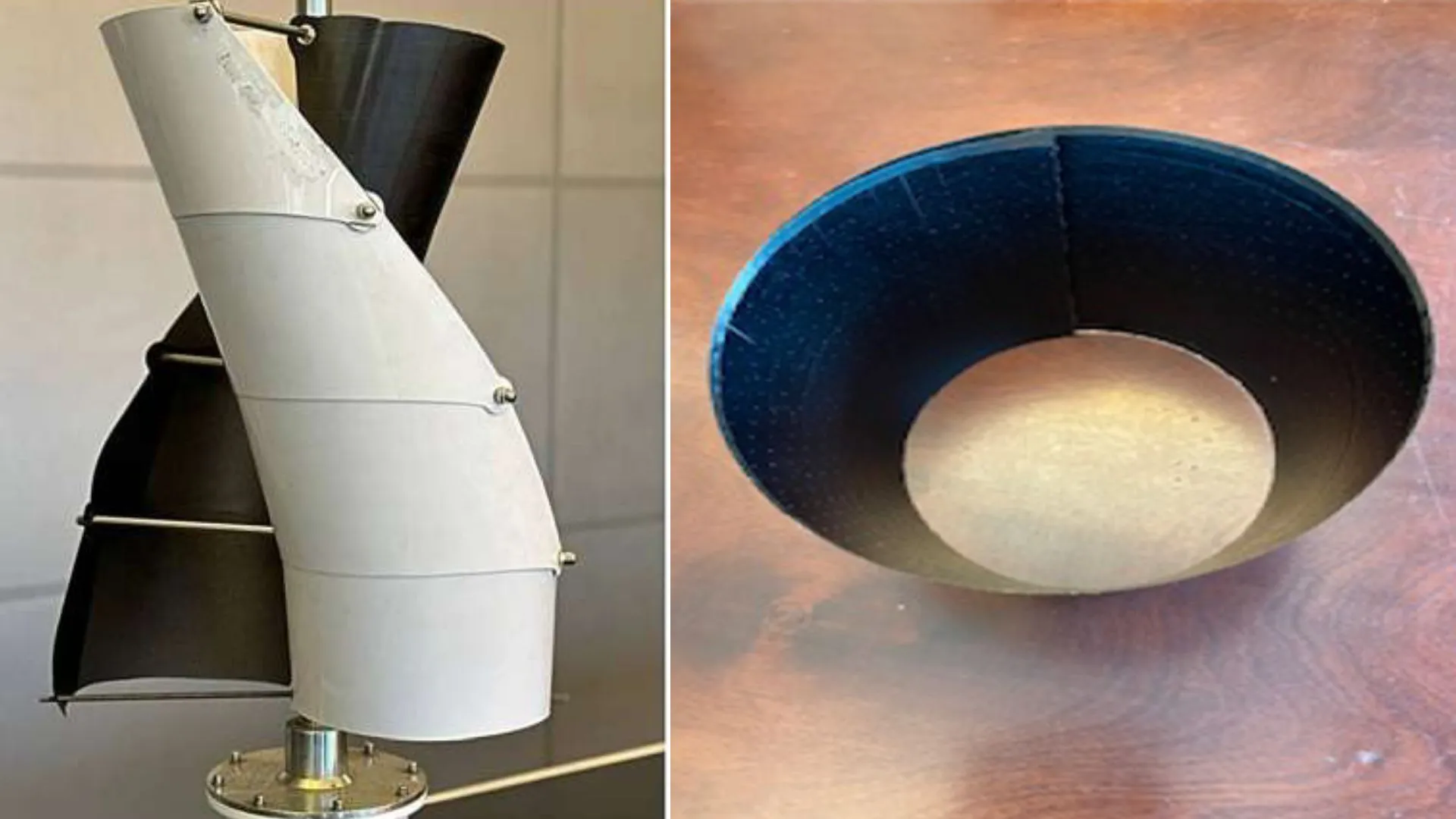
Researchers at Concordia University in Canada have developed a 4D printing process that transforms flat carbon fiber composite panels into curved vertical-axis wind turbine blades without complex molds. The resulting blades are 80% lighter than aluminum equivalents, spin faster in lab tests, and could significantly reduce production costs for small wind turbines—advancing urban renewable energy adoption.
Highlights
- Concordia University's 4D printing process converts flat carbon fiber composite panels into curved VAWT blades without molds or additional forming steps.
- Composite blades produced by this method are 80% lighter than commercially available aluminum wind turbine blades of the same size.
- Lab tests showed that turbines fitted with the new composite blades spun faster than those using aluminum blades under identical conditions.
- The reverse-design workflow starts from the target blade geometry and back-calculates the exact carbon fiber ply orientations needed for automatic self-forming during cure.
- The research was published in the journal Polymer Composites and was led by PhD candidate Emad Fakhimi and Professor Suong Van Hoa at the Concordia Center for Composites.
4D Printing Process Turns Flat Panels into Wind Turbine Blades, Reducing Weight by 80%
Researchers at Concordia University in Canada have developed a new method for manufacturing small wind turbine blades that promises to make them lighter, cheaper, and easier to produce. A newly published study describes a 4D printing approach that converts flat carbon fiber panels into the curved blades required for vertical-axis wind turbines (VAWTs)—eliminating the need for complex forming molds.
The project was led by PhD candidate Emad Fakhimi and Professor Suong Van Hoa at the Concordia Center for Composites. Their findings could simplify blade manufacturing for rooftop and urban wind turbines while simultaneously improving performance.
Reverse-Engineering the Design Process to Eliminate Complex Molds
VAWTs are gaining traction in urban environments because they can operate in variable wind directions and are well-suited for installation on buildings. However, manufacturing their curved blades has long been a significant challenge.
Conventional fabrication requires specialized forming processes and custom molds to achieve the required shape, raising production costs, extending lead times, and adding unwanted weight to the finished blades.
To address these issues, the Concordia team developed a novel "reverse" design workflow. Rather than starting with a carbon fiber layup and observing what shape results, the researchers begin with the target blade geometry and work backwards to determine the precise fiber orientation and ply positioning needed for the panel to self-form into the correct shape during manufacturing.
Composite Panels Curve Automatically After Curing
The new approach leverages 4D printing—a process in which a material continues to change shape after fabrication is complete. The team starts with flat sheets of carbon fiber or epoxy composite. Upon cooling after the cure cycle, the sheets automatically bend into the required curved geometry. This occurs because each layer within the composite is deliberately engineered with different shrinkage characteristics.
By planning the ply configuration in advance, the researchers can produce wind turbine blades without any additional forming steps, doing away with heavy molds while maintaining the precise geometry the blades require.
Lighter Blades Deliver Better Turbine Performance
Testing confirmed that the composite blades closely matched the shape of commercially available aluminum wind turbine blades. The standout advantage is weight: the composite blades are 80% lighter than their aluminum counterparts of equivalent size, substantially reducing manufacturing and installation complexity.
Laboratory performance tests also validated superior turbine output—turbines fitted with the composite blades achieved higher rotational speeds than those using aluminum blades, indicating that the lighter design generates more electricity under identical conditions.
Applications Extend Beyond Wind Energy
The researchers believe this manufacturing method can lower the production cost of small wind turbines, making lightweight renewable energy technology accessible to a wider audience. Because the process is straightforward and relies on composite materials, it is also applicable to other engineering applications that require curved, lightweight components.
Beyond renewable energy, the reverse-design methodology could help engineers produce complex composite parts in fewer steps, reducing material consumption and overall costs. As demand for lightweight, high-performance structures grows across industries, this new process could serve as a practical alternative to conventional mold-based manufacturing.
The research has been published in the academic journal Polymer Composites.
原文來源: 查看原文
FAQ
Newsletter
Subscribe to our Low-Altitude Industry Newsletter
Daily curated news on low-altitude economy and drone industry, delivered to your inbox.
Reviewed and published by the LAETimes editorial desk ·