France Integrates 68mm Laser-Guided Rockets on Rafale, Joining F-16 and Eurofighter Typhoon in Counter-Drone Role
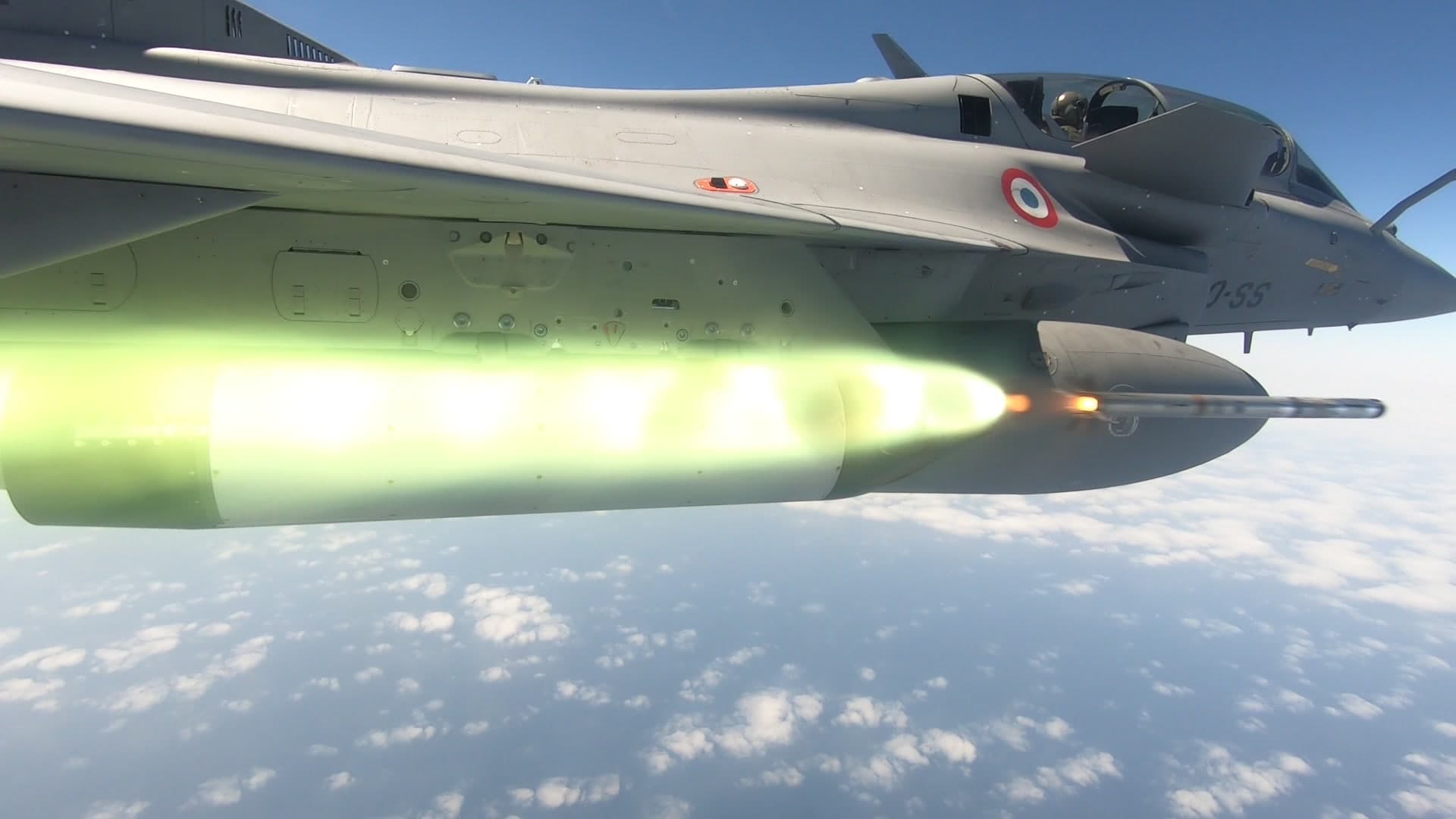
France's defence procurement agency DGA announced on July 13 that 68mm laser-guided rockets have been successfully integrated onto the Rafale fighter jet under the LADAC counter-drone programme. Achieved in under eight months from contract award to initial operational capability, the integration mirrors similar efforts with the US APKWS system on F-16s and the UK Royal Air Force's Eurofighter Typhoon, reflecting urgent demand for cost-effective counter-drone solutions.
Highlights
- France's DGA announced on July 13, 2026 that 68mm laser-guided Aculeus-LG rockets have been successfully integrated onto the Rafale fighter jet under the LADAC counter-drone programme, reaching initial operational capability in under eight months from contract award.
- The LADAC system uses Thales TDA Telson JF12 pods (12 rockets each, two pods per standard loadout) paired with the Talios targeting pod for laser designation and the RBE2 AESA radar for long-range drone detection.
- A single laser-guided 68mm rocket costs USD 25,000–40,000, compared to USD 680,000–1.14 million for a MICA air-to-air missile — the primary cost driver behind France's urgent development of the alternative.
- The UK Royal Air Force deployed APKWS-equipped Eurofighter Typhoons to the Middle East for air defence duties in May 2026, with BAE Systems having only completed single-aircraft test integration in April 2026.
- All ten Eurofighter Typhoon operator nations have expressed strong interest in APKWS integration, according to BAE Systems Air Combat Managing Director Richard Hamilton, reflecting broad demand across allied air forces for cost-effective counter-drone rocket systems.
Following the United States and the United Kingdom, France has now equipped its most advanced fighter jet — the Rafale — with laser-guided rockets for counter-drone (C-UAS) missions.
France's defence procurement and technology agency, the Direction Générale de l'Armement (DGA), announced on July 13 that 68mm laser-guided rockets had been successfully integrated onto the Rafale under the LADAC (Lutte anti-drone sur avion de combat, or Fighter Aircraft Counter-Drone Capability) programme.
Background to the LADAC Programme
The DGA stated that the integration was led by the French Air and Space Force's Centre d'expertise aéronautique et de recherche militaire (Aeronautical Research and Military Test Centre), with support from Thales and Dassault Aviation.
France had been evaluating the integration of a laser rocket system on the Rafale for some time, particularly in light of lessons drawn from the large-scale use of low-cost one-way attack drones on the Ukrainian battlefield and from recent conflicts in the Middle East.
A DGA chief engineer first disclosed the programme at the 2025 Paris Air Show. Speaking to Janes, he said: "We absolutely must start using rockets for counter-drone missions, because we cannot keep using expensive missiles against these kinds of targets. We are currently evaluating both unguided and guided rockets, and we intend to act very soon."
General Jérôme Bellanger, Chief of Staff of the French Air and Space Force, made a compelling case for the use of low-cost laser-guided rockets in counter-drone missions during a parliamentary hearing in October 2025. He stated: "In airborne counter-drone operations, using a MICA air-to-air missile costing more than one million euros to shoot down a drone worth only a few thousand dollars is simply not sustainable. We must develop our own low-cost engagement capability, or improve our fire-control systems."
Rapid Programme Execution
France launched the LADAC programme on 31 December 2025 under an "Urgence Opérationnelle" (Operational Urgency) designation, issuing contract notifications to Dassault Aviation and Thales. Testing began as early as February 2026, underscoring the urgency with which the programme was pursued from the outset.
In mid-April 2026, DGA Director-General Patrick Pailloux reported to the French National Assembly that development and integration of the laser-guided 68mm rocket pod for C-UAS missions was actively under way, with initial operational availability expected by summer.
Notably, a French Navy Rafale M was spotted in April with at least one Thales 68mm rocket pod mounted under its left wing, signalling that work was proceeding at full speed.
System Specifications
LADAC is equipped with the Telson JF12 rocket pod, loaded with laser-guided 68mm Aculeus-LG rockets. The rocket follows an "approximate ballistic trajectory" following initial motor burn, then homes in on a laser-designated target during its terminal phase.
The TDA TELSON 12 JF pod holds 12 rockets per pod; the standard operational configuration is two pods, providing a total of 24 rockets per sortie.
The system operates in conjunction with the Talios targeting pod — which provides precise tracking, target identification, and continuous laser designation for the Aculeus-LG rockets — as well as the RBE2 AESA active electronically scanned array radar, which offers long-range initial detection and tracking of small, slow-moving drones.
Cost-Effectiveness Rationale
France's urgent integration of low-cost laser-guided rockets on the Rafale stems directly from operational experience earlier this year, when French aircraft assisted in intercepting Iranian drones over UAE airspace.
French officials cited the prohibitive cost of using MICA air-to-air missiles against inexpensive drones as a key driver for developing an alternative. A single MICA missile costs between USD 680,000 and USD 1.14 million, while a Shahed-series drone is estimated to cost only USD 20,000–50,000.
By contrast, a single laser-guided 68mm rocket costs approximately USD 25,000–40,000, maintaining precision while offering a far more proportionate response to the threat.
In a dynamic modern battlespace, deploying low-cost laser-guided rockets allows high-end missiles to be reserved for faster or more sophisticated threats, while giving pilots a more symmetrical engagement option. This is particularly critical when countering mass drone attacks or swarms — using expensive missiles against low-cost targets rapidly depletes munitions stocks and is economically unsustainable.
Furthermore, deploying laser-guided rockets significantly increases the magazine depth available to the aircraft. The Rafale can carry multiple pods across its hardpoints, enabling dozens of engagements per sortie without returning to base to rearm — effectively transforming the aircraft into a highly efficient drone-hunting platform.
Export Potential
Although LADAC was developed for the French Air and Space Force's Rafale and the Navy's Rafale M, export customers may also show strong interest. India, for example, currently operates 36 Rafales, has 26 Rafale Ms on order, and is on the verge of signing a contract for an additional 114 aircraft. Given the increasing salience of low-cost drone threats highlighted during the 2025 India-Pakistan conflict, Indian adoption of the French 68mm laser-guided rocket system would deliver significant operational, economic, and strategic benefits.
The US and UK Lead the Way
The US military pioneered the integration and combat deployment of APKWS (Advanced Precision Kill Weapon System) laser-guided rockets on fighter aircraft. The F-16, F-15E, and A-10 Warthog have all been equipped with the system.
In early September 2025, the Air Force Test Center announced the completion of APKWS II rocket integration on the F-15E, with flight testing completed in a remarkably compressed nine-day schedule. The rocket has since become the primary air-to-air weapon used by US Air Forces in the Middle East against drone threats; F-16s are known to have used it against Houthi drones.
In another theatre, Ukrainian F-16s were photographed in December 2025 carrying LAU-131/A seven-round rocket pods loaded with APKWS II, and have since been widely reported by open-source intelligence sources to have used them to shoot down drones. Earlier this year, aging US Air Force A-10 Warthogs were also observed carrying APKWS rockets during Operation Epic Fury for counter-drone missions.
In May 2026, the Royal Air Force (RAF) deployed Eurofighter Typhoons equipped with laser-guided APKWS rockets to the Middle East for air defence duties. In an official statement, the RAF said: "APKWS is now in operational use with No. 9 Squadron, enhancing the Typhoon's versatility and allowing the aircraft to respond more flexibly to evolving threats. The system enhances the RAF's ability to sustain air defence operations while managing costs and resources effectively."
The speed of the Eurofighter Typhoon–APKWS deployment was remarkable — BAE Systems had only completed laser-guided 70mm APKWS rocket testing on a single aircraft in April 2026.
The RAF elaborated: "APKWS gives RAF pilots a high-precision option to defeat airborne targets — including drones — at a fraction of the cost of conventional air-to-air missiles. This helps sustain persistent operational capability and ensures more efficient use of munitions over extended operations."
Significantly, virtually all Eurofighter Typhoon operator nations are now seeking to integrate APKWS on their aircraft. Richard Hamilton, Managing Director of BAE Systems Air Combat, recently revealed: "I can say that all Eurofighter Typhoon users — all ten of them, except Turkey which has not yet become a user — have expressed strong interest. We are seeing this demand from Typhoon operators across the global fleet."
Laser-guided rockets have clearly emerged as the weapon of choice for countering the proliferating drone threat on the modern battlefield.
原文來源: 查看原文
FAQ
Newsletter
Subscribe to our Low-Altitude Industry Newsletter
Daily curated news on low-altitude economy and drone industry, delivered to your inbox.
Reviewed and published by the LAETimes editorial desk ·


