Hayward City Council Approves Expanded Drone as First Responder Program, Deploying Eight Drones for 911 Calls
The Hayward, California City Council approved an expanded Drone as First Responder (DFR) program on June 16, authorizing an annual budget of $589,000 to deploy eight pre-positioned drones capable of reaching 911 call scenes before officers arrive. The program has drawn criticism over privacy, protest surveillance, and the boundaries of 'passive' drone use.
Highlights
- The Hayward City Council approved a $589,000 annual DFR program on June 16, authorizing eight pre-positioned drones to respond to 911 calls before patrol officers arrive.
- During a one-month pilot, drones arrived on scene before officers in more than half of all calls responded to, according to Police Chief Bryan Matthews.
- UAVs were deployed 62 times across 61 incidents during the pilot period, providing live video feeds to the command center ahead of patrol car arrival.
- Hayward joins at least eight Bay Area agencies — including San Francisco, Fremont, Alameda County, and San Mateo County — that have adopted DFR programs.
- Critics, including Vice Mayor George Syrop (the sole 'no' vote), warned the policy's privacy safeguards are partially dependent on battery life limitations, meaning boundaries could shift as drone hardware improves.
The City of Hayward, California has approved an expanded Drone as First Responder (DFR) program, integrating eight new drones into the Bay Area city's policing model. The initiative promises faster situational awareness before officers arrive on scene, while raising familiar questions about privacy protections, protest surveillance, and how far a so-called "passive" drone deployment can actually extend.
Drones Arriving Before Officers
The Hayward City Council approved the drone expansion on June 16, authorizing an annual program budget of $589,000 for the police department. Central to the program are pre-positioned drones that can launch in response to a 911 call and relay live video to a command center before patrol cars reach the scene.
The city previously operated under a drone policy that functioned more like a traditional police tool — officers arrived first, a supervisor assessed the situation, and a drone was dispatched only when a legitimate use case was established.
The new policy moves drones earlier in the dispatch workflow. Dispatchers can request a drone launch through civilian staff, sending the aircraft from a fixed station to preset coordinates.
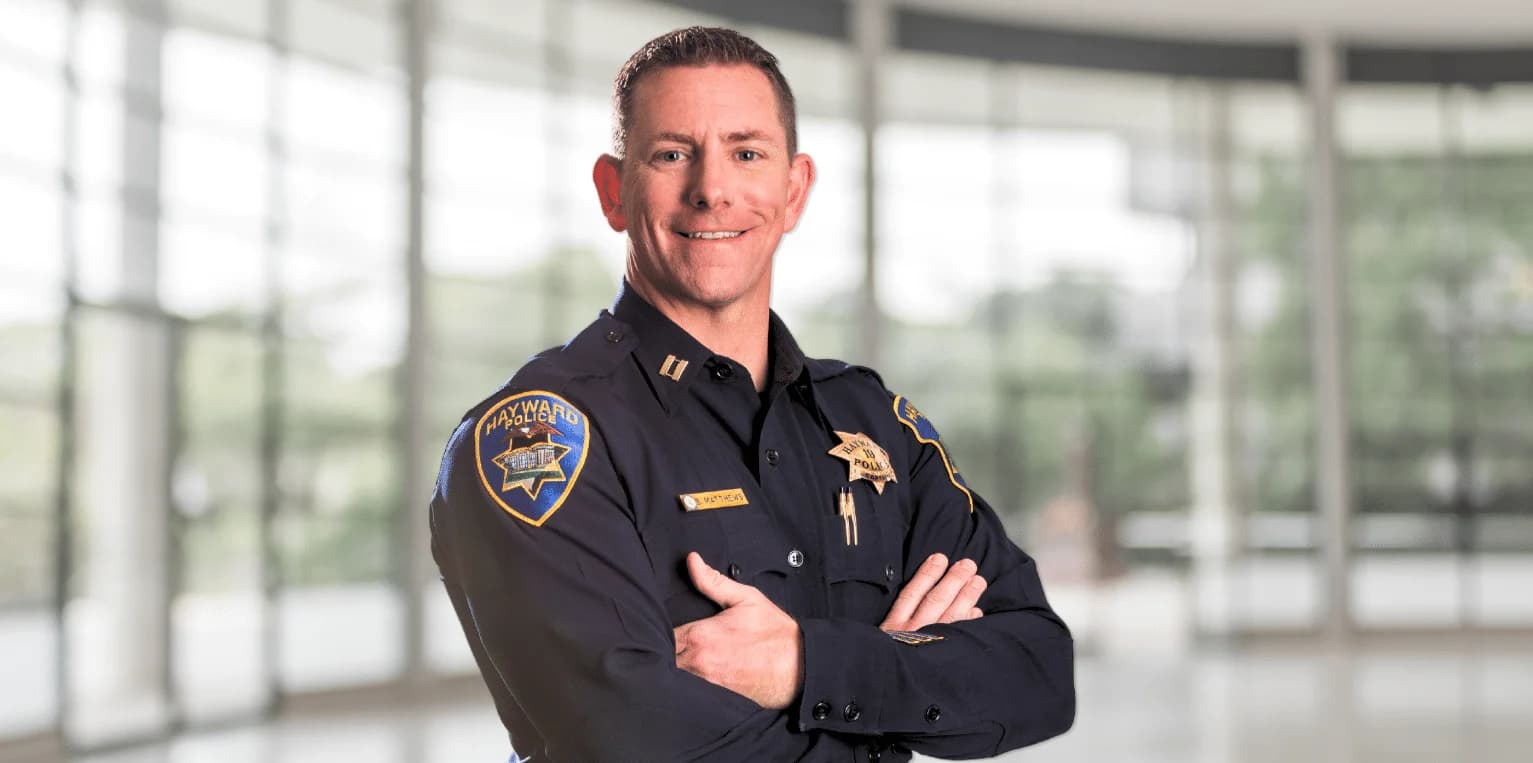
Police Chief Bryan Matthews told the City Council that during a one-month pilot program, drones arrived before officers in more than half of the calls they responded to.
Image credit: Hayward Police Department
That is the core value proposition of the DFR concept: faster situational awareness, better information for officers and dispatchers, and in some cases, the ability to close out a call without deploying an officer at all.
Despite relatively high costs compared to other drone programs launched across the country, DFR has demonstrably improved both officer safety and response effectiveness in every city where it has been deployed. The numbers support the concept: when a drone can be on scene in two minutes while a patrol car takes five, the informational advantage compounds quickly.
Policy Commitments to Limit Surveillance
According to SFGATE, Hayward officials stated that the drones will not carry facial recognition technology, will not be weaponized, and will not be used for proactive surveillance. On paper, that sounds like a tightly scoped authorization. In practice, the definition of a "service call" is where the real boundary lies.
Matthews said the onboard cameras are oriented toward the horizon to assist with automated navigation while limiting wide-area surveillance capture. He also stated that operators are not permitted to move cameras outside policy restrictions during flight.
That is a useful safeguard, but the City Council discussion exposed where it gets thin. When Councilmember Francisco Zermeno asked whether drones could monitor recurring problems at predictable times and locations — such as reckless driving or vandalism — Matthews indicated that persistent or recurring situations could technically qualify as a service call.
He added that the drones' roughly 40-minute battery life makes sustained surveillance operationally impractical.
That answer is candid, to a point — but it is also the pivot on which much of the policy hangs. If the boundary is partially defined by battery life, that boundary shifts when hardware improves. A drone with two hours of flight time changes the definition of what surveillance is "practically feasible."
Bay Area Agencies Continue DFR Adoption
Hayward is joining a growing list of Bay Area agencies operating drone response programs, including Alameda County, San Mateo County, San Francisco, Fremont, Livermore, San Mateo, Elk Grove, and Concord. DFR has moved from novelty to standard municipal procurement language. Agencies share a familiar political framing: faster information reduces danger in high-risk calls.
Image credit: Port St. Lucie Police Department
The Hayward case carries an additional layer — Skydio has office facilities in the city. The police department used Skydio drones paired with Axon camera systems during preliminary operations, but Matthews stated that the equipment vendor for the new program has not yet been selected and will go through a formal Request for Proposals (RFP) process.
Skydio's local presence makes the geographic association obvious, but available reporting indicates Hayward has not directly awarded the new program to Skydio. The council approved the program; the vendor decision comes later.
Vice Mayor George Syrop cast the sole dissenting vote, raising concerns about long-term funding after Matthews clarified that the $589,000 is an annual subscription fee rather than a one-time procurement cost.
Privacy Concerns Remain the Real Test
The most prominent objections centered on privacy, protest surveillance, and constitutional boundaries. Syrop warned that the current policy leaves too much room for proactive monitoring at protest events. A local activist argued the policy could expose advocacy groups to surveillance during public gatherings.
This is the political core of the debate. Proponents emphasize officer safety and faster situational awareness; critics point to the same drone, the same camera, and ask who decides when a peaceful assembly becomes a law enforcement event.
Image credit: Hayward Police Department
Councilmember Angela Andrews offered the counterpoint directly. She argued that supporters of police reform cannot "have it both ways" if a technology can reduce officer-involved shootings and give officers better information before they enter a scene.
That argument will resonate with many, because it links drones to de-escalation rather than enforcement. A drone can let officers confirm before entry — whether a weapon is real, whether a suspect has left, or whether a call has resolved on its own.
But that benefit does not dissolve the surveillance concern; it raises the bar for policy discipline. If drones reduce unnecessary police contact, cities should be able to demonstrate that with public data rather than carefully worded assurances.
Hayward reported that UAVs were deployed 62 times across 61 incidents during the pilot period. As DFR expands, the next public report should detail call types, response times, outcomes, complaints, policy violations, and how often drones resolved calls without officer deployment. That is the only way to confirm whether the technology is working as promised — or whether the definition of "passive" has quietly expanded.
DroneXL Editorial Perspective
Hayward is where the DFR debate actually lands, because when technology can reach a dangerous scene before a patrol car and give officers enough information to slow down rather than rush in blind, it has a genuinely strong case.
DFR works well when the mission is clear: hostage situations, armed suspects, missing persons, major accidents. In those cases, the drone wins; the officer wins; and the people on scene have a far better chance of going home safely.
The harder question is what comes next. Every agency starts with clear-cut cases, and then someone starts asking about reckless driving in a parking lot, vandalism in a particular neighborhood, or a protest that might become an unlawful assembly. Just as facial recognition on license plate readers can be used for personal purposes rather than public safety, drone cameras can slide from protection toward surveillance when the hands on the controller are not honest ones.
This technology is impressive — and drone operators know firsthand what it can do. But good drones in the wrong hands become bad drones. Policy has to be rigorous enough to stop that slide before it starts.
Hayward may ultimately build a useful program that reduces unnecessary officer contact and gives dispatchers a better way to separate genuine emergencies from noise. But the city now carries a burden of proof. The drone is just the tool. The policy is the story.
Image credits: Hayward Police Department, Port St. Lucie Police Department
原文來源: 查看原文
FAQ
Reviewed and published by the LAETimes editorial desk ·