Danish Startup Acodyne Raises €2.5M Pre-Seed Round to Target Military and Offshore Heavy-Lift Drone Logistics
Danish drone startup Acodyne has closed a €2.5 million pre-seed funding round co-led by Swedish defense-focused VC Gungnir Capital and Danish firm PSV Hafnium. The company is developing an all-electric, VTOL-capable unmanned cargo aircraft with fixed-wing jet-speed performance, targeting defense resupply, offshore energy, and remote-area logistics. Its debut aircraft, the E100, is on track for initial flight testing before the end of 2026.
Highlights
- Acodyne closed a €2.5 million pre-seed round co-led by Gungnir Capital and PSV Hafnium, with EIFO, SAP9 Group, and GreenUP IV Invest as follow-on investors.
- The E100, Acodyne's debut all-electric VTOL unmanned cargo aircraft, is scheduled to complete initial flight testing before the end of 2026.
- The platform combines vertical take-off and landing with fixed-wing jet-speed flight, targeting defense resupply, offshore energy logistics, and remote-area delivery missions.
- Autonomous flight is handled by eTHOR, an AI flight system co-developed with DTU Compute at the Technical University of Denmark.
- Acodyne's four co-founders bring experience from the Danish Ministry of Defence, Scandinavian Airlines, Cobham Aerospace Communications, and DTU Space; the company currently has 10 employees.
Danish drone startup Acodyne has announced the close of a €2.5 million pre-seed funding round, with proceeds earmarked to scale its unmanned cargo aircraft platform into defense, offshore energy, and heavy-lift logistics applications in remote regions.
Funding Structure and Investors
The round was co-led by Swedish defense-focused venture capital firm Gungnir Capital and Danish investor PSV Hafnium, with EIFO, SAP9 Group, and GreenUP IV Invest participating as follow-on investors. The capital is intended to support Acodyne's contribution to European and NATO logistics resilience while driving growth in Denmark's defense technology sector.
Acodyne Co-founder and Chief Business Officer Jasmina Pless said: "This round gives us the resources to move Acodyne from a validated concept to a flight-test platform, with investors who genuinely understand how defense and offshore logistics work in practice — and the technical challenges that heavy-lift drone technology entails. The cross-border investor lineup of Gungnir, PSV Hafnium, and EIFO is a strong signal that European capital is prepared to back hardware bets in pursuit of real logistics resilience."
A Logistics Gap That Helicopters Can No Longer Fill Alone
In defense contexts, front-line resupply still relies on slow ground transport or helicopter missions that expose personnel and airframes to threat environments. In offshore operations, a single missing component can trigger production losses running into hundreds of thousands of euros per day, and helicopters are often the only option capable of timely delivery.
In remote areas such as Greenland, towns are not connected by roads, and critical supplies can take days to arrive. Across all three use cases, demand for reliable, on-demand logistics is rising faster than manned helicopters can respond.
A Platform Built for Mission-Critical Operations
Acodyne's unmanned cargo aircraft is engineered specifically for time-sensitive, heavy-lift sling-load missions, combining vertical take-off and landing (VTOL) capability with fixed-wing, jet-speed flight performance. The platform is all-electric and modular, designed to deliver payloads directly to forward unloading points — locations currently accessible at speed only by helicopter.
Autonomous flight functions are handled by eTHOR, an AI flight system developed in collaboration with the DTU Compute department at the Technical University of Denmark (DTU).
Gungnir Capital Managing Partner Max Villman commented: "Acodyne brings a fundamentally new approach to unmanned military logistics: jet-class speed, helicopter-class payload capacity, full autonomy from ground to air — and all-electric. It compresses one of the most expensive line items in modern warfare — manned helicopter logistics — into a platform that requires no crew operating within threat range. NATO needs resilient, scalable resupply systems that actually work. This is exactly the kind of operations-driven defense technology Gungnir Capital was established to back: engineering teams solving real battlefield problems with engineered hardware."
From Demonstrator to Production Platform
Acodyne is currently developing its debut aircraft, the E100, with initial flight testing scheduled for completion before the end of 2026. The pre-seed funding will support prototype development and flight testing in real operational environments, while laying the groundwork for the transition to commercial operations.
PSV Hafnium Managing Partner Marianne Hyltoft added: "We backed Acodyne early, and what convinced us was their engineering progress — independently verified by a third party. This funding will take Acodyne from a validated concept to a pre-production prototype and toward an aerial logistics network serving defense, infrastructure, and remote operations."
A Market Opening
Initiatives such as the EU's U-space framework are clearing a regulatory path for drone operations in rural and inter-city managed corridors. At the same time, NATO and European defense industrial autonomy drives are generating public and private demand for drone platforms. Rapid advances in AI and battery technology are further accelerating the emergence of unmanned heavy-lift logistics as a distinct market category, with applications extending well beyond defense.
Leadership Team
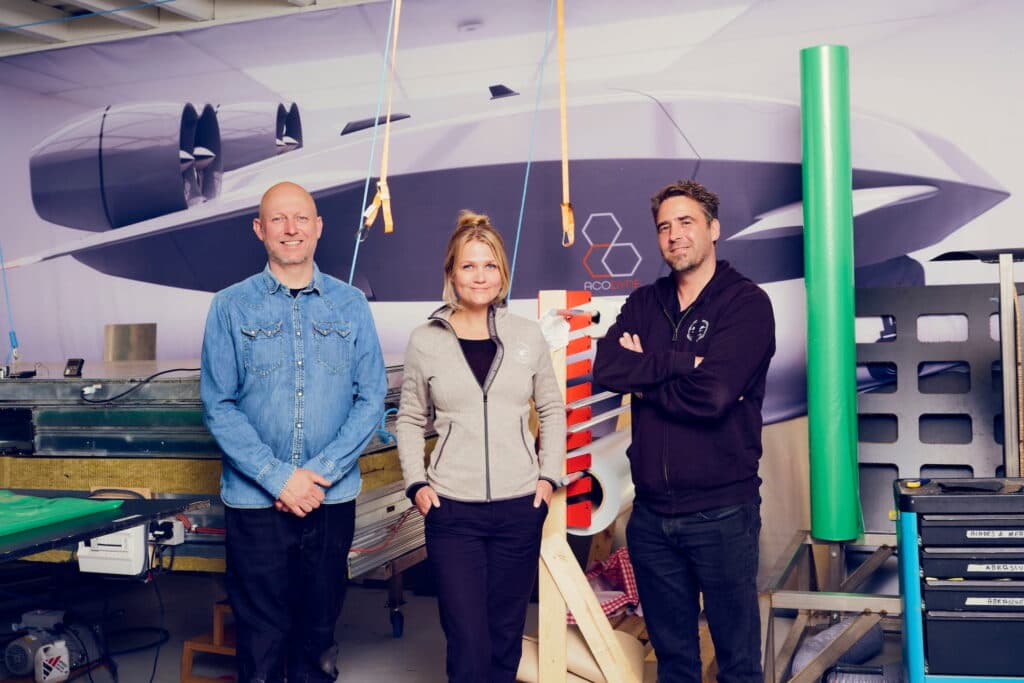
Acodyne's four co-founders bring backgrounds spanning the Danish Ministry of Defence, Scandinavian Airlines (SAS), Cobham Aerospace Communications, and DTU Space.
- CEO Mads Schnack: Former Danish Ministry of Defence, with experience in counter-drone systems and Joint Terminal Attack Controller (JTAC) operations.
- CTO Claes Nicolaisen: Helicopter and fixed-wing pilot with 25 years of aviation experience.
- Chief Electronics Engineer Martin Arndt: 25 years of experience in aerospace communications and airborne systems certification.
- CBO Jasmina Pless: Former economic diplomat who supported deep-tech ventures in Silicon Valley.
The company currently employs a team of 10.
原文來源: 查看原文
FAQ
Newsletter
Subscribe to our Low-Altitude Industry Newsletter
Daily curated news on low-altitude economy and drone industry, delivered to your inbox.
Reviewed and published by the LAETimes editorial desk ·