Ukraine's Adis Heavy Bomber Drone Debuts: Satellite Link Control Keeps Operators Away from the Front Lines
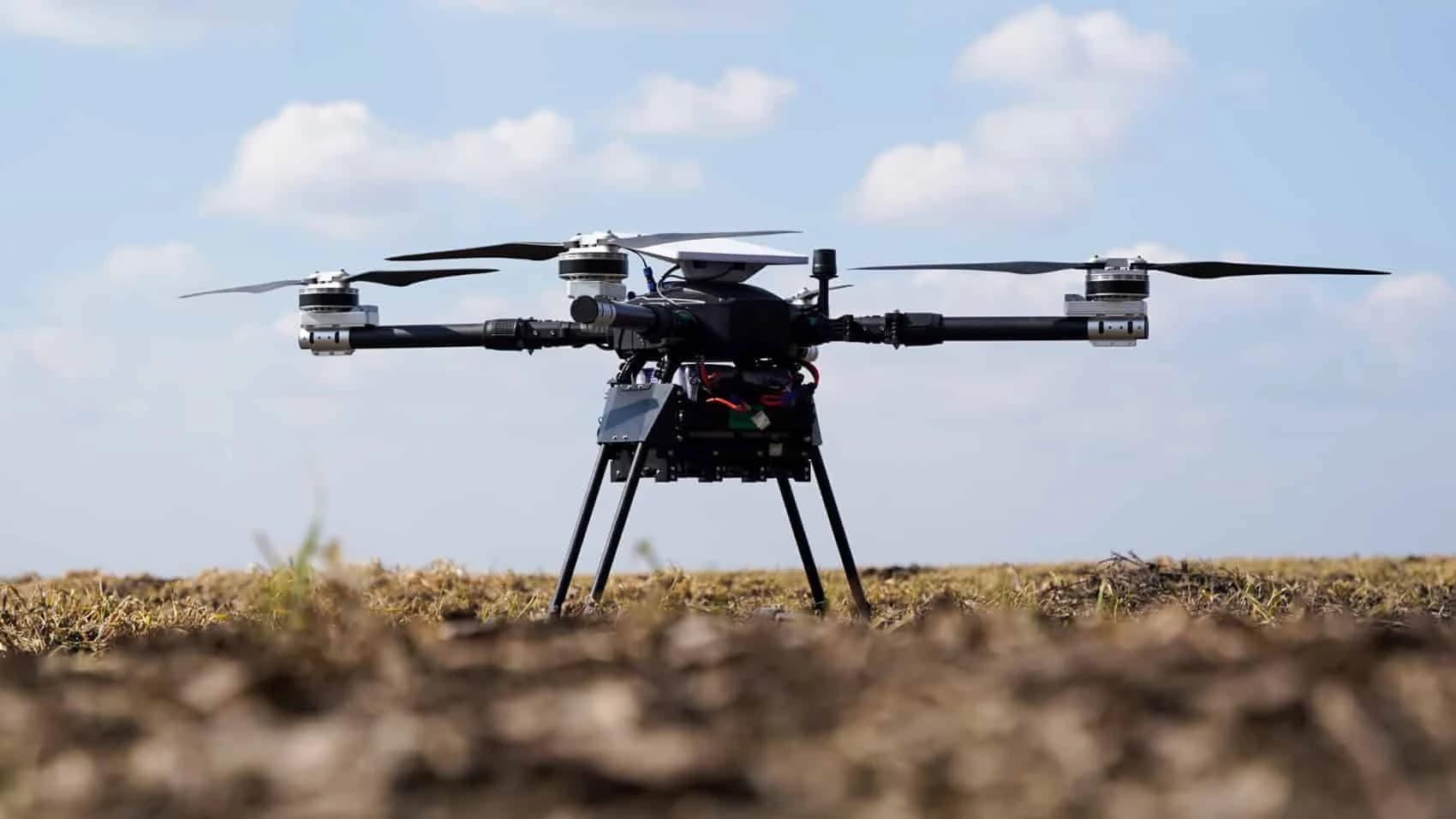
Ukrainian company Martyn Tech has unveiled the Adis, a heavy bomber quadcopter featuring satellite communication control that allows operators to execute missions without approaching the front lines. Capable of carrying a 10 kg payload over 20 km with roughly one hour of flight time, the Adis has passed official military codification and is set to enter procurement channels.
Highlights
- Martyn Tech's Adis quadcopter uses satellite communication control, allowing operators to execute missions without approaching the front lines.
- The Adis carries a 10 kg payload over 20 km with one-hour endurance; testing showed 50 km range with a 3 kg load.
- Named after a fallen soldier from Ukraine's 72nd Mechanized Brigade killed in Donetsk in June 2022.
- The drone supports three mission roles: munition strikes, remote mine-laying, and resupply to hard-to-reach positions.
- Adis has passed official military codification and will soon be listed on Ukraine's Brave1 Market and DOT-Chain Defence procurement platforms.
Ukraine's Adis Heavy Bomber Drone: Satellite Control Rewrites the Battlefield Risk Equation
Ukrainian company Martyn Tech has unveiled a heavy bomber quadcopter called "Adis," and its most notable feature is not its payload capacity but its satellite communication link. By controlling the drone via satellite rather than conventional radio signals, operators no longer need to be positioned near the front lines to carry out missions. This design fundamentally changes the risk calculus for pilots and deserves close attention.
Named After a Fallen Soldier
Martyn Tech built the Adis in response to a military requirement, and the name carries profound significance. It honors a soldier from Ukraine's 72nd Mechanized Brigade who used "Adis" as his radio call sign and was killed in action in the Donetsk region in June 2022.
This detail reveals the drone's positioning — it is not a trade-show concept vehicle chasing export contracts, but a combat tool shaped by frontline users and named after one of their own.
Breaking Through the Radio Horizon Limitation
Every radio-controlled drone faces a hard constraint known as the "radio horizon." Once the aircraft drops below the curvature of the Earth or is obscured by terrain, the control signal degrades or cuts out entirely. Operators typically compensate by moving closer to the combat zone, but this exposes them to enemy fire and counter-battery strikes.
Satellite control completely rewrites this equation. According to Martyn Tech, the Adis operates via satellite link, eliminating radio horizon limitations and allowing the control crew to execute missions from a safe distance. In practice, operators can remain far to the rear while the drone carries out operations near the front lines.
An important distinction must be clarified here: satellite control extends where the operator can sit, not how far the drone can strike. The Adis still has a limited operational radius; what truly changes is operator survivability. In a war where drone crews are priority targets, this is a tangible advantage — not marketing spin.
Technical Specifications
According to The Defender, Martyn Tech rates the Adis at an operational radius of 20 km (12.4 miles), a payload capacity of 10 kg (22 lbs), and approximately one hour of flight endurance. These are officially published baseline figures that have not been independently verified.
Test data paints an even more impressive picture. Martyn Tech states that during testing, the Adis carried a 12 kg (26.5 lbs) payload over the same 20 km distance, while a lighter 3 kg (6.6 lbs) load extended range to 50 km (31 miles). Cruise speed is 65 km/h (40 mph), with a designed operating altitude of approximately 400 meters (1,312 feet).
For target acquisition, the Adis is equipped with a dual-camera system. Martyn Tech reports daytime target detection at 600 meters (1,969 feet) and nighttime detection at 150 meters (492 feet). These detection ranges are modest compared to dedicated reconnaissance platforms, but this is consistent with a drone designed for close-range strike rather than deep reconnaissance.
Multi-Mission Capability
The Adis features a modular design, allowing crews to reconfigure the platform for different missions without swapping airframes. Martyn Tech lists three mission roles: strike missions with munition drops, remote mine-laying, and resupply to positions that are difficult to reach by ground.
This versatility reflects a quiet but important trend in Ukraine's drone forces. A single platform capable of bombing, mine-laying, and resupply operations dramatically reduces logistics and training costs — a critical factor given the wartime pace of rapid production and consumption of aircraft.
The Adis has passed official codification, the formal process for a system to be approved for military use. Martyn Tech expects it to be listed soon on the Brave1 Market and DOT-Chain Defence platforms — Ukraine's procurement channels designed to rapidly move approved equipment from manufacturers to combat units.
Analysis
The Adis is a textbook case of where drone warfare is heading. The headline spec is satellite control, but the truly smart design lies in what it protects — the operator. Ukraine has learned at great cost that pilots are often more valuable and harder to replace than airframes, and pulling operators back from the front lines is worth far more than adding an extra kilogram of payload.
It is worth noting that this does not mean Ukraine can "launch attacks from anywhere on Earth." The drone's range is still measured in tens of kilometers, and a nighttime detection range of under 500 feet means targets must still be approached at close range after dark. The real innovation is decoupling the operator's location from the drone's location — this is a survivability story, not a range story.
The modular design and rapid progression through codification and the Brave1 platform reveal a deeper message. Ukraine is not building boutique hardware; it is building tools that move quickly from requirement to front line, named after the warriors who need them. This production philosophy, more than any single specification, explains how Ukraine continues to outperform a much larger adversary.
原文來源: 查看原文
FAQ
Reviewed and published by the LAETimes editorial desk ·


