DJI Agriculture Launches Agras T55 and T100 Dual-Battery; Both Cleared FCC Authorization Three Days Before US Drone Ban
DJI Agriculture globally launched the Agras T55 (50-liter lightweight sprayer) and Agras T100 Dual-Battery Spraying System on July 1, 2026. Notably, both models received FCC equipment authorization on December 19, 2025 — three days before the December 22 ruling that placed foreign-made drones on the US Covered List — leaving a potential legal opening for the American market.
Highlights
- DJI Agriculture於2026年7月1日全球同步推出Agras T55(50公升)與Agras T100雙電池噴灑系統兩款農用無人機。
- 兩款機型均於2025年12月19日取得FCC設備授權(T55: SS3-T55A2510;T100: SS3-T100A2411),早於12月22日禁止採購清單生效日三天。
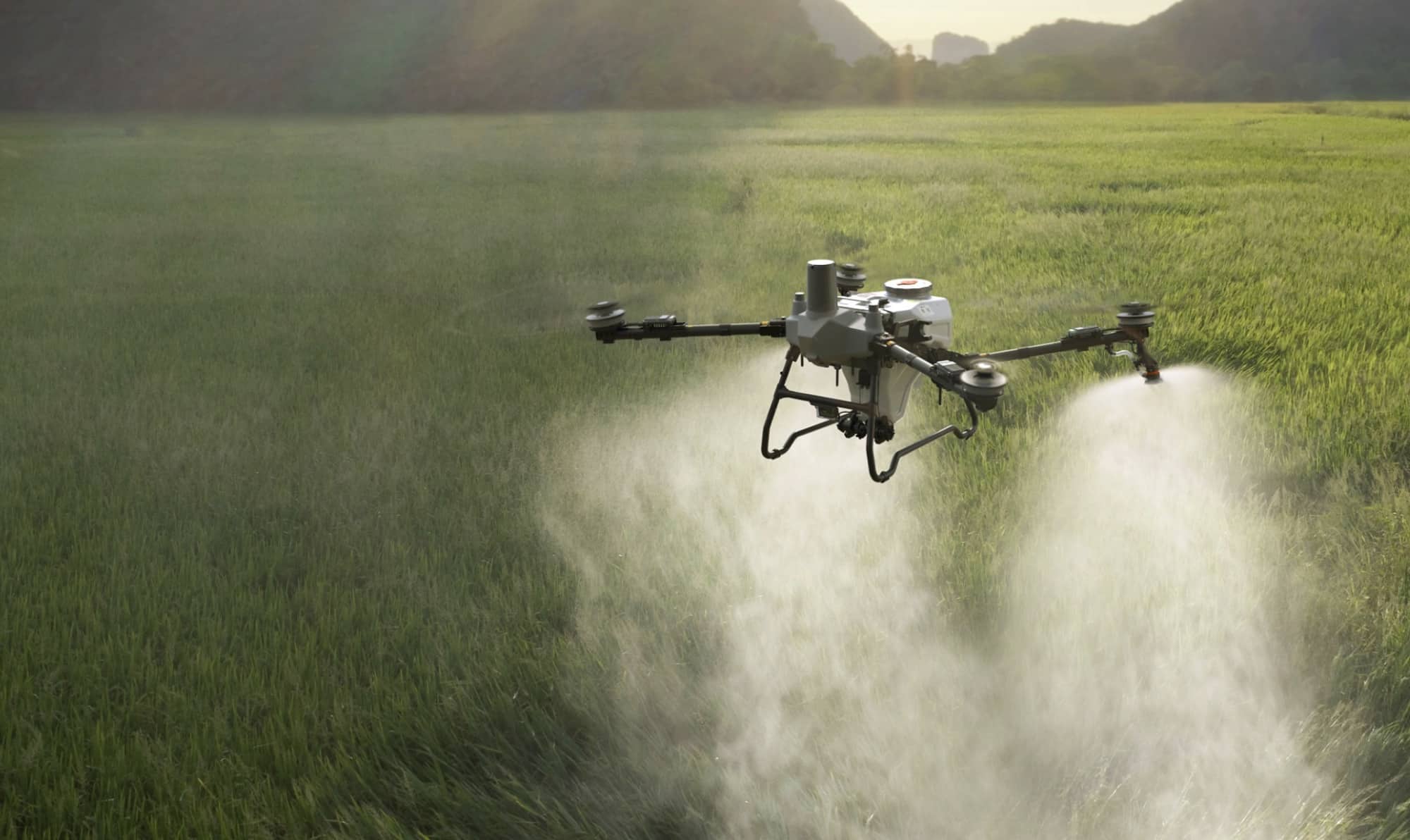
- Agras T55搭載每秒25萬點點雲密度毫米波雷達、四目視覺系統及機載電池散熱片,噴灑流量50公升/分鐘。
- T100雙電池配置在相同負載下懸停時間提升50%,搭配90公升藥桶,流量40公升/分鐘。
- DJI掌控美國農業噴灑市場約80%份額,但大疆對兩款新機型均未承諾美國上市日期或售價。
DJI Agriculture launched two new agricultural spraying platforms simultaneously worldwide on July 1, 2026: the Agras T55 — a lightweight 50-liter sprayer built around an upgraded safety system — and the Agras T100 Dual-Battery Spraying System, an endurance-enhanced revision of the flagship model introduced last November. Both launches carried the same language DJI has attached to every Agras release over the past two years: regional availability varies, and prospective buyers must contact authorized dealers for pricing.
One detail, however, escaped most coverage: both models have formal US documentation. The Agras T55 received FCC equipment authorization on December 19, 2025 (FCC ID: SS3-T55A2510), while the base T100 underlying the dual-battery variant holds its own separate authorization (FCC ID: SS3-T100A2411). The FCC added foreign-manufactured drones to its Covered List three days later, on December 22. That timing places the core hardware of both models on the legally permissible side of the ban's effective date — even as nearly every subsequent DJI launch has been blocked. For US agricultural drone operators, the gap between "authorized" and "actually available for sale here" is the first question to answer before diving into spray-rate data.
Agras T55: A Lighter Airframe, Smarter Safety
The T55 is DJI's attempt at a 50-liter agricultural sprayer that one person can carry, set up, and operate without support crew. In spraying mode, it carries 50 liters (13.2 gallons) of liquid, delivered at 50 L/min through atomizing nozzles. In spreading mode, it handles a 55 kg (121 lb) payload at 400 kg/min. The new sling system supports up to 40 kg (88 lb), with Auto Balance Control and an Emergency Cable Release — hardware design choices that signal DJI expects these machines to carry irregular loads over rough terrain.
Safety is the T55's central selling point. DJI equipped it with a new millimeter-wave radar generating a point cloud density of 250,000 points per second, paired with a quad-vision camera system: three cameras on top of the airframe plus a low-light full-color FPV camera covering front, rear, left, right, and below. The radar operates in rain and fog, and detected obstacles are logged so the aircraft avoids them on subsequent flights — what DJI describes as "safety that improves over time," a reasonable characterization of persistent obstacle mapping whose real-world value depends entirely on how consistently the same field is flown.
One hardware detail buried in the spec sheet deserves attention: the T55 features an Onboard Battery Heat Sink designed to maintain stable performance in high-temperature environments. Anyone who has watched an agricultural battery sag in a July field knows thermal management is not a footnote — it determines whether you finish a block or wait for cells to cool. This heat sink detail was first spotted in our analysis of leaked silhouette images last July and is now confirmed as a production feature.
Agras T100 Dual-Battery: More Hover Time, Not a Bigger Tank
The Agras T100 Dual-Battery Spraying System is a revision, not a new platform. DJI first showed the T100 to a global audience last July, then exhibited it alongside the T70P and T25P at Agritechnica in Hanover in November. The dual-battery configuration delivers endurance gains: DJI claims 50% longer hover time under equivalent payload, with this configuration paired to a 90-liter (23.8-gallon) tank delivering 40 L/min through four atomizing nozzles.
The single-battery standard configuration retains a 150-liter (39.6-gallon) spreading capacity, a 400 kg/min spread rate, and an 80 kg (176 lb) sling capacity. Dual centrifugal atomizing nozzles are tuned for higher flight speeds and wider coverage widths, and DJI is heavily marketing orchard applications: with an optional atomizer kit, the company says atomization penetrates dense canopies and reaches the undersides of leaves on tall trees — a genuine pain point in traditional orchard spraying, and one where a hovering, dynamically adjustable aircraft is a logical solution.
One minor inconsistency is worth flagging: the press release boasts "more than 13 years" of R&D history, while the T100 product page describes the model as "built over twelve years." This matters little to buyers but is worth noting — DJI's marketing copy is not internally consistent, and the "measured under controlled conditions" disclaimer attached to the published specs is not a field performance guarantee.
DJI Agriculture's Fleet Keeps Growing; US Market Access Keeps Shrinking
DJI Agriculture Global Sales Director Yuan Zhang stated that the global agricultural drone fleet now exceeds 600,000 units, serving more than 100 countries, 300 crop types, and supported by 3,500 service and repair centers and 7,000 certified trainers. These figures are consistent with DJI's late-2025 reporting, when the agricultural fleet first crossed the 600,000-unit mark and environmental benefit figures roughly doubled year over year.
The United States is excluded from that growth curve. Since the FCC added all foreign-manufactured drones to the Covered List on December 22, 2025, new equipment authorization applications from DJI, Autel, and XAG have been blocked. DJI controls approximately 80% of the US agricultural spraying market — a dependency that became acutely visible this April, when 15 agricultural spraying drones were stolen in New Jersey, leaving operators facing a replacement market in which US-made alternatives from companies like Hylio and Ceres Air cost three to five times as much as the Chinese platforms being replaced.
In this context, the FCC documentation is the part US operators should read carefully. DJI's official announcement makes no mention of US availability, but the underlying hardware of both models was authorized before the ban. Both the T55 and T100 authorization applications predate the December 22 Covered List action — which is why US-authorized dealers such as Talos Drones have already listed the base T100 as legally saleable, flyable, and serviceable in the United States. The T55 was authorized in the same batch as the Avata 360, the Lito series, and the RC Mini. Authorization is not the same as a stocked, priced, dealer-supported product, and DJI has committed to no US launch date or pricing for either model. What the authorizations establish is limited but real: the door on the underlying platform is open, not sealed.
DroneXL Analysis
What this launch reveals is worth sitting with. DJI has just introduced two agricultural sprayers to a global market that will absorb them without friction in every other region. For US readers, the only question that materially matters is: can these models legally reach American farmland? This is precisely the outcome critics of the DJI ban predicted — the ban has not stopped DJI, whose agricultural fleet continues to grow past 600,000 units across Brazil, Europe, and Southeast Asia. What it has stopped is American farmers, who read this product announcement the way a diner reads the menu of a restaurant that won't seat them.
Having tracked Agras drones for nearly a decade, this pattern has been consistent: hardware improves, fleets grow, and the US market falls one quarter further from the product frontier. The genuinely good news in this launch is that the T55 and base T100 made it through FCC authorization before the deadline, and the legal pathway exists. But authorization is not inventory, pricing, or dealer support, and DJI has made no commitment on either model for the US market. The 80% of the US agricultural spraying market already flying Agras hardware is watching this company build exactly what they need, clear FCC authorization, and then go silent on whether Americans can actually buy it.
This is protectionism dressed as security, and the people absorbing the impact are the operators it claims to protect. A T55 working a coffee plantation in Brazil and the stolen New Jersey Agras fleet that cannot be cost-effectively replaced are two ends of the same policy. If the FCC Covered List's scope is narrowed through DJI's Ninth Circuit appeal, the calculus for every US agricultural drone operator changes overnight. Until then, each new launch like this one adds to the cumulative list of what US farmers cannot access — while the FCC authorization sitting under both models is a reminder that the door is not fully closed, only tightly guarded.
Sources: DJI (via PR Newswire), DJI Agras T55 product page, DJI Agras T100 product page, FCC equipment authorization filings.
DroneXL uses automated tools to assist with research and data retrieval. All reporting and editorial perspective by Haye Kesteloo.
原文來源: 查看原文
FAQ
Reviewed and published by the LAETimes editorial desk ·