Taiwan's Ministry of Economic Affairs Unveils Domestic Quadruped Robot R&D Platform with AI, LiDAR, and Control System Integration
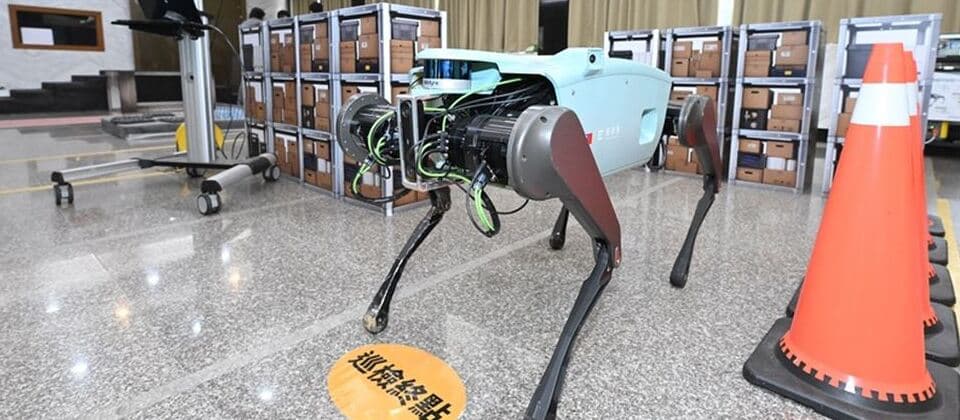
Taiwan's Ministry of Economic Affairs unveiled a domestically developed open-source quadruped robot (robot dog) R&D platform on July 8, led by the Industrial Technology Research Institute (ITRI). Built over 18 months with government funding, the platform integrates joint actuation, motion control, AI perception, and autonomous navigation. Two prototype units debuted alongside field validation in underground culvert inspection and firefighting scenarios.
Highlights
- Taiwan's Ministry of Economic Affairs unveiled a domestically developed open quadruped robot R&D platform on July 8, built by ITRI over 18 months.
- The platform integrates joint actuation, motion control, AI perception, autonomous navigation, and simulation training into a shared open-development stack.
- Two domestic quadruped robot prototypes made their public debut at the launch event, with field validation completed in underground inspection and firefighting scenarios.
- The consortium includes ITRI and six industry partners — Solomon, Compal Electronics, Inventec, TECO Electric and Machinery, Cre8bot, and Lida Technology.
- The platform's goal is to enable Taiwanese firms to rapidly develop robot dog applications without building hardware or software from scratch.
Taiwan Launches Open Quadruped Robot R&D Platform for Industrial Applications
Taiwan's Ministry of Economic Affairs on July 8 officially unveiled a domestically developed quadruped robot — commonly referred to as a "robot dog" — open R&D platform. Led by the Industrial Technology Research Institute (ITRI) and backed by the Ministry's science and technology programs, the platform was completed over an 18-month development period and is designed to lower the barrier to entry for domestic companies seeking to commercialize legged-robot solutions.
Platform Capabilities
The platform provides a comprehensive stack of foundational technologies, including:
- Joint actuation
- Motion control
- AI perception
- Autonomous navigation
- Simulation and training environments
By offering these core capabilities as a shared, open development base, ITRI aims to eliminate the need for domestic firms to build quadruped robot hardware and software from scratch — enabling faster time-to-market for specific application use cases.
Industry Consortium
The initiative brings together ITRI alongside several leading Taiwanese companies, forming an integrated supply and technology chain:
- Solomon (advanced vision and AI systems)
- Compal Electronics (contract manufacturing and systems integration)
- Inventec (electronics and hardware)
- TECO Electric and Machinery (motor and drive systems)
- Cre8bot
- Lida Technology
Together, the consortium has established end-to-end autonomous capability spanning components, control modules, AI software, and complete robot systems.
Debut Prototypes and Field Validation
At the July 8 launch event, two domestic quadruped robot prototypes made their public debut. The platform has also completed field validation across several operational scenarios:
- Underground culvert inspection
- Autonomous navigation patrol
- Swarm collaborative cargo transport
- Firefighting and disaster response
These demonstrations underscore the platform's versatility and its readiness for real-world deployment in hazardous or hard-to-reach environments.
Strategic Objectives
The initiative reflects Taiwan's broader push to develop sovereign capabilities in robotics, reducing reliance on foreign platforms and accelerating domestic industry participation in the global quadruped robot market. By offering an open, customizable foundation, the platform enables Taiwanese enterprises across sectors such as infrastructure inspection, logistics, and emergency services to rapidly develop and deploy purpose-built robot dog solutions.
原文來源: 查看原文
FAQ
Newsletter
Subscribe to our Low-Altitude Industry Newsletter
Daily curated news on low-altitude economy and drone industry, delivered to your inbox.
Reviewed and published by the LAETimes editorial desk ·