New AI Model Reveals How Neutron Star Mergers Forge Heavy Elements
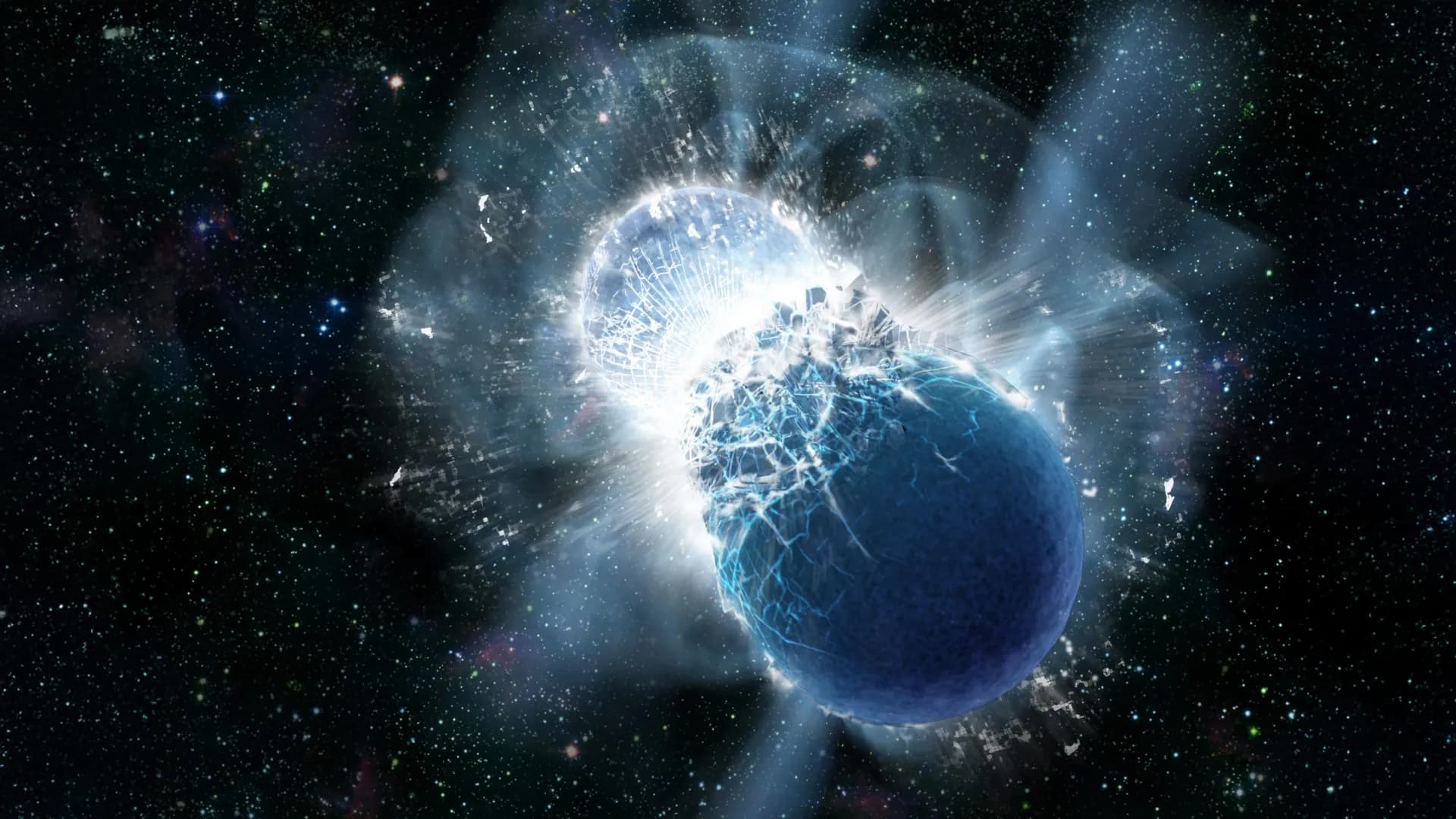
Researchers have developed an AI-based simulation tool that dramatically accelerates modeling of heavy element production in neutron star mergers. The tool aims to improve predictions of these extreme astrophysical events and help scientists bridge the gap between space observations and laboratory nuclear physics research on Earth.
Highlights
- Researchers developed an AI-based simulation system that significantly accelerates modeling of heavy element production in neutron star mergers.
- Neutron star mergers are the primary known source of heavy elements such as gold, platinum, and uranium in the universe.
- The AI tool overcomes the high computational cost of traditional numerical simulations, enabling exploration of broader physical parameter spaces.
- The system can help bridge astronomical observation data — including from LIGO gravitational wave detectors — with Earth-based nuclear physics laboratory findings.
- Future applications include more accurate predictions of spectral signatures and elemental abundances from neutron star merger events.
Researchers have developed an artificial intelligence (AI)-based simulation system that significantly accelerates the modeling of heavy element production during neutron star mergers — events responsible for forging many of the universe's heaviest elements. The new tool promises to improve predictions of these extraordinarily energetic explosions and to more effectively connect astronomical observations with laboratory research conducted on Earth.
Breaking Through Traditional Simulation Bottlenecks
Neutron star mergers rank among the most energetic events in the known universe and are widely believed to be the primary source of heavy elements such as gold, platinum, and uranium. However, conventional numerical simulations have long demanded enormous computational resources and processing time, severely limiting scientists' ability to conduct in-depth study of these astrophysical events.
By incorporating AI models, the research team successfully overcame this bottleneck, achieving a marked improvement in modeling speed. This allows scientists to explore a much broader range of physical parameter spaces in a fraction of the time previously required.
Bridging Space Observations and Earth-Based Experiments
Another significant implication of the new AI simulation tool is its ability to help scientists cross-validate astronomical observational data with findings from nuclear physics laboratories on Earth. This carries considerable potential value for interpreting data gathered by gravitational wave detectors such as LIGO, as well as observations of gamma-ray bursts.
The researchers stated that the tool will in the future help more accurately predict the spectral signatures and elemental abundances produced by neutron star merger events, further deepening humanity's understanding of the cosmic origins of heavy elements.
原文來源: 查看原文
FAQ
Reviewed and published by the LAETimes editorial desk ·