A First in U.S. Military History: Navy Unmanned Surface Vessel Rescues Two Downed Apache Pilots in the Strait of Hormuz
A U.S. Navy unmanned surface vessel operated by Task Force 59 located and rescued two Army aviators who crashed their AH-64 Apache helicopter into the Strait of Hormuz off the coast of Oman on Monday evening — marking the first time an unmanned vessel has performed a personnel rescue in U.S. military history. The cause of the crash remains under investigation.
Highlights
- A U.S. Navy Task Force 59 unmanned surface vessel rescued two Army AH-64 Apache crew members from the Strait of Hormuz — the first unmanned vessel personnel rescue in U.S. military history.
- Both aviators were recovered in stable condition within approximately two hours of the helicopter crashing off the coast of Oman.
- CENTCOM did not disclose which USV type performed the rescue; Task Force 59 operates multiple platforms including the 40-knot L3Harris MAST-13 and the slow-speed Saildrone Explorer.
- The Apache crash cause remains unknown; Iran has not claimed responsibility, and a promised U.S. incident report has not been released.
- The incident occurred amid a fragile Israel-Iran ceasefire and follows U.S. losses of 42 aircraft — mostly MQ-9 Reapers — since operations against Iran began on February 28.
Navy USV Conducts First-Ever At-Sea Personnel Rescue
A U.S. Navy unmanned surface vessel (USV) spotted two Army aviators in the water off the coast of Oman on Monday evening and pulled them to safety — the first time an autonomous unmanned vessel has successfully rescued U.S. military personnel. U.S. Central Command (CENTCOM) said the two crew members of an AH-64 Apache attack helicopter were recovered within roughly two hours of their aircraft going down in the Strait of Hormuz. Both were reported in stable condition.
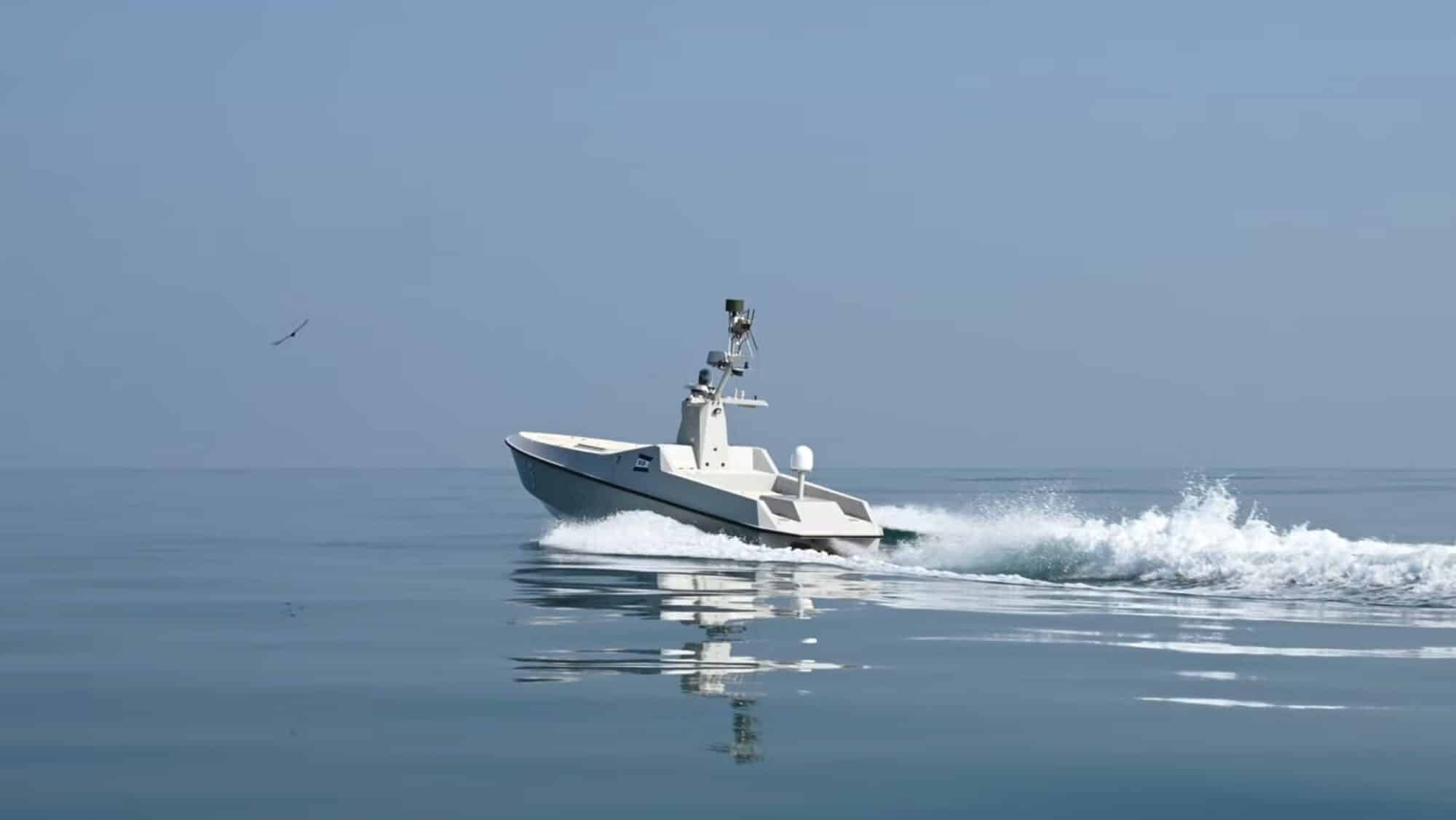
The USV belongs to Task Force 59 (TF 59), the unmanned systems and artificial intelligence unit under the U.S. Navy's Bahrain-based Fifth Fleet. The task force's unmanned surface vessels have traditionally served as sensors, cameras, and persistent surveillance platforms — providing continuous reconnaissance across contested waters at low cost. Personnel rescue was never part of the design brief. Yet on Monday, a surveillance asset executed a search-and-rescue mission, potentially faster than any crewed vessel could have responded.
U.S. President Donald Trump, speaking to reporters at New York's JFK International Airport, was the first to confirm the crew was safe. "The pilots are fine," he said on the tarmac after Game 3 of the NBA Finals. "Nobody was hurt." He indicated that an incident report would be released on Tuesday, but as of press time the report had not been made public and the cause of the Apache crash remains unknown.
Task Force 59 USV Executes Rescue Off Oman
The vessel that carried out the rescue is a USV assigned to Task Force 59, which was established in September 2021 to integrate unmanned systems and AI into Middle Eastern maritime operations. CENTCOM told Reuters that a Navy unmanned surface vessel located the two crew members in the water and performed the rescue. CENTCOM described a broader operation led by U.S. Naval Forces Central Command and the 82nd Airborne Division with Air Force and Navy support, but the USV was the first asset to reach the downed aviators.
CBS News, citing military officials, reported that the USV was operated by TF 59 and that this was the first time an unmanned vessel had conducted an at-sea rescue for the U.S. military. CBS noted it could not confirm which specific system type carried out the rescue, and CENTCOM did not disclose the platform model. That information gap matters because TF 59 operates several different unmanned vessels in the Persian Gulf, and their capabilities vary widely.
The unit's best-known high-speed intercept craft is the L3Harris Arabian Fox MAST-13, a 13-meter (43-foot) vessel built for intelligence, surveillance, and reconnaissance missions with a top speed exceeding 40 knots. In April 2023, a MAST-13 completed the Navy's first unmanned transit of the Strait of Hormuz, drawing attention from an Iranian drone and a Houdong-class fast attack craft along the way. TF 59 has also operated the wind- and solar-powered Saildrone Explorer, an endurance platform capable of months-long deployments but limited to walking-pace speeds, as well as the Ocean Aero Triton. A long-endurance Saildrone and a 40-knot intercept boat solve very different problems. Which type happened to be nearest when the Apache went down determines whether Monday's outcome is repeatable.
Crash Cause Still Under Investigation
Officials have not determined whether the Apache was struck by Iranian fire, suffered a mechanical failure, or encountered another issue. The investigation is ongoing. The New York Times first reported the incident on Monday evening, citing two people familiar with the matter and likewise noting the unknown cause. When pressed directly on the reason for the crash, Trump said a report would follow.
Iran has not claimed to have shot down the Apache. The semi-official Mehr News Agency acknowledged the incident on Tuesday but noted there had been no claim of responsibility, and the Islamic Revolutionary Guard Corps issued no statement. That silence is itself a signal. When Iran shoots down a U.S. aircraft, it typically says so publicly — as it did when it downed an RQ-4A Global Hawk drone over the same strait in June 2019.
This is the first Apache lost since the U.S. and Israel launched military operations against Iran on February 28. Attrition elsewhere has been far heavier. Iran claims to have shot down approximately 30 MQ-9 Reaper drones during the same period, and a mid-May report submitted to Congress put the total number of U.S. aircraft lost or damaged at 42 — most of them Reapers, but also including rescue helicopters, fighter jets, and tankers. Apache helicopters have been flying dangerous close-in missions, hunting Iranian small boats and suicide drones over the strait and pushing closer to the Iranian coast as CENTCOM has adopted a more aggressive posture.
Rescue Comes as Ceasefire Teeters
The Apache crash came one day after the first direct exchange of fire between Israel and Iran since their April 8 ceasefire — the most serious test of a nominal truce that has barely held. At Trump's urging, Iran and Israel halted direct strikes on Monday, but Tehran warned it would resume attacks if Israel continued striking Hezbollah in Lebanon. On Tuesday, Israeli airstrikes hit the southern Lebanese port city of Tyre, killing at least eight people according to Lebanon's health ministry — the deadliest strike there since fighting erupted in Lebanon on March 2.
Iran continues to blockade most shipping through the Strait of Hormuz. Before the war, the waterway carried nearly one-fifth of the world's seaborne oil and significant volumes of liquefied natural gas; Washington has imposed a counter-blockade on Iranian ports. CENTCOM's offensive built around Apaches, Reaper drones, and F/A-18 and F-35 fighter jets is designed to break the chokepoint blockade. In the days before the crash, CENTCOM shot down four Iranian suicide drones heading toward the strait and struck Iranian coastal radar sites in response — part of a recurring pattern of defensive strikes since the ceasefire took effect.
Analysis
Task Force 59's unmanned surface vessels have long been used primarily for detection missions. When the MAST-13 first transited the Strait of Hormuz in 2023, the Navy positioned it as "deterrence through surveillance" — deploying low-cost sensors in hostile waters to spot anomalies and alert crewed ships, freeing the manned fleet to focus elsewhere. Rescue was never on the feature list. Monday's incident rewrote the script: a platform procured to "watch the water" pulled two soldiers out of it.
The contrast with other personnel recoveries in this conflict is stark. The only other major rescue operation of the war — recovering the crew of an F-15E Strike Eagle shot down over Iranian territory (callsign "Dude 44") — cost several additional aircraft. That is the traditional model: to save a downed crew, more crewed platforms must be sent into the threat envelope, and sometimes those are lost too. The USV rescue broke that cycle. No additional pilots were placed at risk for the recovery mission. For a strait just 21 miles wide and ringed by Iranian missiles and an expanding drone arsenal, that is the core argument for unmanned systems — proven by an actual mission rather than a briefing slide.
Two things need clarification before any celebration, however. First, which USV type performed the rescue. A long-endurance Saildrone that happened to be cruising nearby and a purpose-dispatched 40-knot intercept boat represent very different capability claims, and CENTCOM has not said. Second, the crash investigation report Trump promised. Whether the Apache was brought down by Iranian fire or mechanical failure determines whether this incident is an inspiring search-and-rescue success story or the beginning of a new loss category in a war that has already cost 42 aircraft. Both answers can be established, but neither has been made public.
Sources: Original reporting by Reuters' Phil Stewart, Maya Gebeily, and Tala Ramadan; CBS News; The New York Times; U.S. Central Command.
原文來源: 查看原文
FAQ
Reviewed and published by the LAETimes editorial desk ·