Pentagon Plans to Procure Dozens of Unmanned Surface Vessels to Bolster Indo-Pacific Contested Logistics
The U.S. Department of Defense, through the Defense Innovation Unit (DIU), has issued a solicitation to procure dozens of Autonomous Resupply Vehicles (ARV-S) — unmanned surface vessels designed to deliver containerized cargo to forward-deployed Army units across the Indo-Pacific under contested conditions, with a required range of 1,600 nautical miles.
Highlights
- The U.S. Defense Innovation Unit (DIU) has issued a solicitation to procure dozens of Autonomous Resupply Vehicles (ARV-S) — unmanned surface vessels — for Army logistics in the Indo-Pacific.
- The ARV-S must achieve a round-trip range of 1,600 nautical miles in Sea State 4–6 and carry at least two 20-foot cargo containers autonomously.
- The DoD states that USVs eliminate risk to embarked personnel, reduce reliance on trained mariners, and improve survivability through dispersed, low-cost deployment.
- Since 2023, the U.S. Army and Marine Corps have annually deployed missile launchers to Philippine island chains, underscoring the strategic importance of maritime logistics in Taiwan-related contingencies.
- The House Armed Services Committee included a provision in FY2027 authorization legislation recommending procurement of dedicated USVs to escort and protect crewed Army watercraft.
Pentagon Eyes Unmanned Surface Vessels to Strengthen Indo-Pacific Contested Logistics
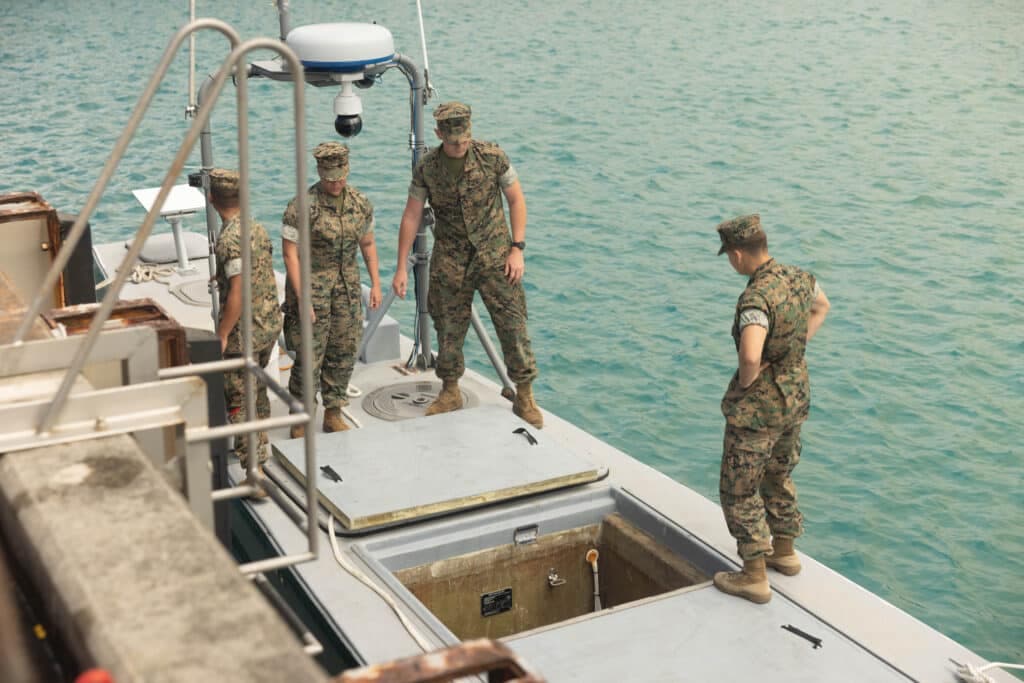
The U.S. Department of Defense is planning to procure dozens of unmanned surface vessels (USVs) to support U.S. Army logistics operations in contested Indo-Pacific environments.
DIU Issues Solicitation
According to a solicitation published last month by the Defense Innovation Unit (DIU), the DoD seeks to enhance the Army's maritime logistics branch and significantly expand its fleet's cargo-carrying capacity.
The announcement states: "In the Indo-Pacific contested logistics environment, unmanned surface vessels can provide significant operational advantages by eliminating risk to embarked personnel and reducing the need for trained mariners. Furthermore, their dispersed deployment and relatively low cost increase the difficulty of targeting by adversaries, improving survivability in contested environments."
ARV-S Technical Requirements
Designated the Autonomous Resupply Vehicle (ARV-S), the USV will be tasked with delivering 20-foot cargo containers to forward-deployed units. Key technical requirements include:
- Round-trip range: 1,600 nautical miles in Sea State 4–6 conditions
- Payload capacity: At least two containers
- Autonomous operation: Capable of autonomous navigation and maneuvering
While DIU did not specify an exact procurement figure, the solicitation notes that "ultimate demand may require rapid production of dozens or more ARV-S," and that any prospective vendor "must have a credible path to scalable mass production."
Strategic Rationale: Responding to the China Threat
The solicitation underscores that the Army's existing maritime assets are insufficient to meet the materiel transport demands of combatant forces. As U.S. forces prepare for potential contingencies involving China in the region, conventional logistics methods face serious threats from Beijing's modernized naval, missile, and air forces.
In recent years, the aging and under-capacity Army watercraft fleet has been highlighted in multiple exercises. Since 2023, the Army and Marine Corps have annually deployed missile launchers to strategic island chains in the Philippines, demonstrating the potential role of such vessels in South China Sea and Taiwan-related contingencies. Both services have also collaborated in Hawaii to test new maritime mobility concepts.
Distributed Logistics as a Critical Enabler
Beyond enabling maneuver for combat forces, a potential Indo-Pacific conflict between the U.S. and China would require commanders to rely on distributed logistics to sustain units operating in or near the First Island Chain. The limited number of accessible bases and allied facilities available to Washington, combined with the vast distances from the U.S. homeland, would make wartime resupply an acute challenge.
Congressional Support
U.S. lawmakers have echoed these concerns. The House Armed Services Committee included a provision in the chairman's mark for FY2027 authorization legislation recommending the procurement of USVs to escort Army watercraft.
The draft legislation states: "The committee believes that crewed Army watercraft could be assisted by dedicated unmanned surface vessels (USVs) that provide enhanced force protection, early warning, sensing, and defensive effects while reducing risk to personnel."
This procurement initiative marks a significant shift in U.S. military logistics strategy in the Indo-Pacific, leveraging unmanned systems to address an increasingly complex security environment.
原文來源: 查看原文
FAQ
Reviewed and published by the LAETimes editorial desk ·