Stars and Signals: Why the Tactical Edge from Satellites and Drones Fades Faster Than Expected
From Finland's 1944 defense of Helsinki to the commercial SATCOM disputes, electromagnetic warfare, and FPV drone innovation cycles of the Russia-Ukraine war, this analysis examines how information advantages decay rapidly on the modern battlefield — and why decision quality, not technology alone, determines the outcome.
Highlights
- In Finland's February 1944 defense of Helsinki, only a few hundred of 16,500 Soviet bombs struck the city — achieved through decoy fires, blackouts, radar-directed AA fire, and dummy target arrays that manipulated the attacker's kill chain.
- Russian forces used smuggled Starlink terminals on drones to enable BVLOS strikes on Ukrainian logistics near Pokrovsk in February 2026; SpaceX responded by deactivating unauthorized terminals and whitelisting Ukrainian units.
- Ukraine's EW operations in January 2024 claimed to neutralize more than 20 Russian missiles, disrupting strike effectiveness without relying solely on kinetic interceptors.
- By end of 2024, Ukrainian EW had diverted large numbers of Russian drones off-course via electronic jamming, prompting Russia to adopt fiber-optic guided drones, increased decoys, and mass production of low-cost expendable UAVs.
- Ukraine's 'gamification' of drone warfare — awarding small units points and equipment for confirmed kills — stems from over a decade of Western-style military reform since Russia's 2014 invasion, fostering bottom-up innovation over Soviet-era top-down command structures.
Stars and Signals: Why the Tactical Edge from Satellites and Drones Fades Faster Than Expected
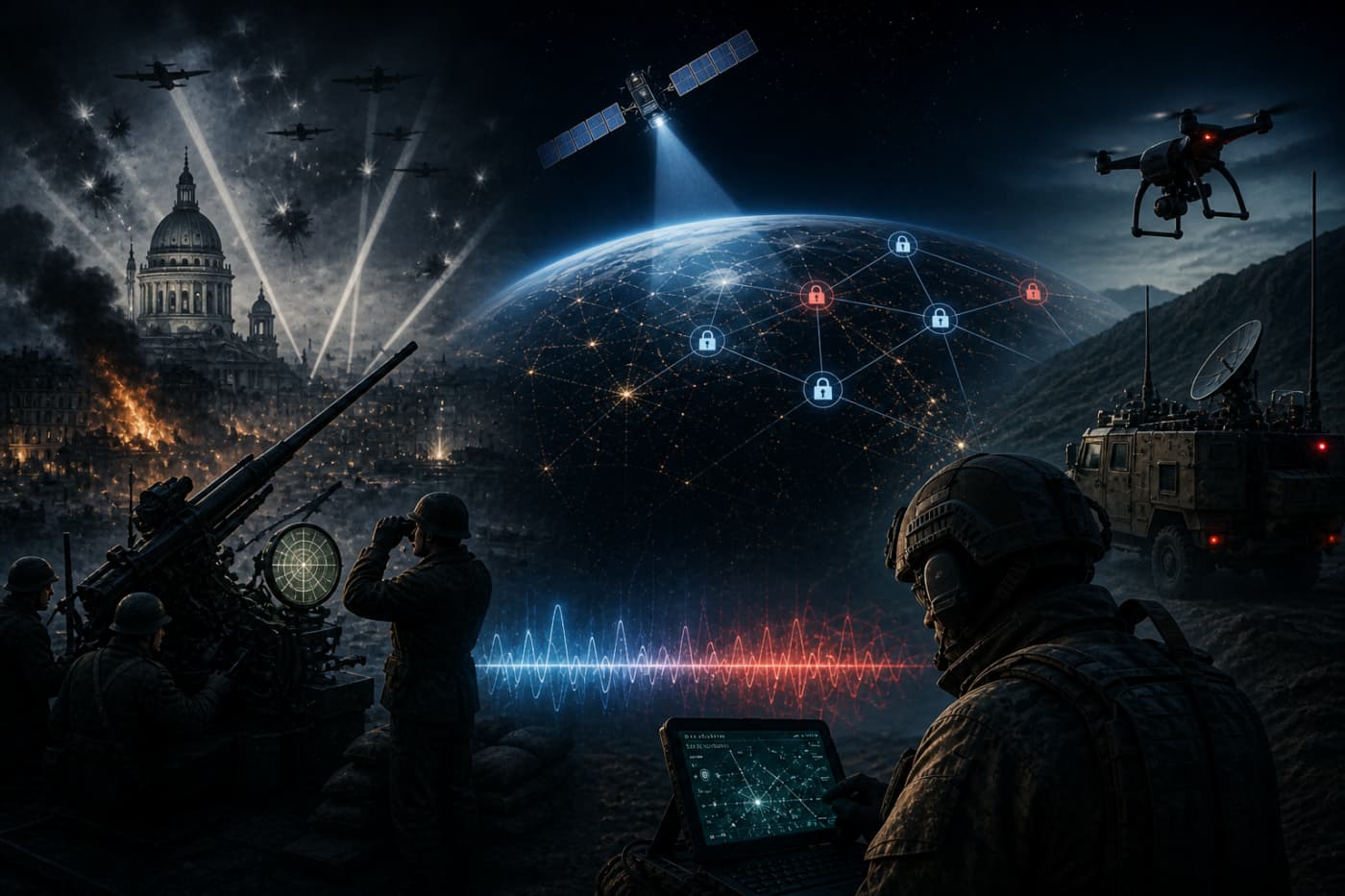
In February 1944, Soviet bombers launched one of the largest air raids of the Continuation War against Helsinki. Yet Finnish defenders, through active and deceptive countermeasures, ensured that most of the damage fell outside the city center. Clever Finnish defenders lit decoy fires on the city's outskirts, enforced strict blackout discipline, and employed radar-directed anti-aircraft fire and dummy target arrays to mislead Soviet navigation and bombing patterns. Of the 16,500 bombs dropped, only a few hundred struck the urban core. The Finns did not merely defend against the attack from the air — they shaped what the attackers saw and believed at the final stage of the kill chain.
Shortly after the Helsinki raid, Finnish bombers launched a bold counterstrike against Soviet air bases near Leningrad. While Finnish territory still burned, Finnish aircraft took off and merged with returning Soviet bomber formations. Soviet forces, unaware, led the enemy back to their own bases. The Finns then struck parked aircraft and infrastructure, exploiting predictable recovery cycles to disrupt follow-on operations. This sequence — from initial deception to counterattack — illustrates a recurring operational truth: victory is often determined not by destroying platforms, but by shaping the conditions under which the adversary must make decisions.
The Information Decay Problem on the Modern Battlefield
Today's wars present modern practitioners with an updated version of the same problem. Modern militaries rely on satellites, networks, and precision navigation rather than the visual bombing cues of World War II. Yet combat outcomes still hinge on how long information remains actionable before it is degraded, denied, or called into question.
After two decades of operations in Afghanistan and Iraq, U.S. and NATO forces grew accustomed to continuous access to space-enabled services — communications, positioning, navigation and timing (PNT), and intelligence, surveillance, and reconnaissance (ISR). The Russia-Ukraine war has demonstrated that these capabilities remain critical, but are highly vulnerable in contested combat. The decision-making value of space-enabled systems erodes under electromagnetic competition, governance constraints, and rapid cycles of adaptation and counter-adaptation. U.S. military doctrine defines space capabilities as providing "time-sensitive effects" — not guaranteed permanence. Meanwhile, joint forces depend on a contested electromagnetic spectrum to connect space assets, making that invisible conduit an indispensable but fragile battlespace.
Commercial SATCOM as a Policy Instrument, Not Just Bandwidth
Commercial satellite communications — particularly through SpaceX's Starlink — have proven to provide "governed" rather than "guaranteed" access, with direct operational consequences. After Russian attacks severely damaged Ukraine's terrestrial networks, Starlink became a critical component of Ukrainian infrastructure. However, the war revealed that commercial SATCOM provides an essential but regulated channel.
A battlefield case from February 2026 illustrates how commercial decisions can shape armed conflict. Russian forces began using smuggled Starlink terminals mounted on drones to extend their strike range, enabling attacks on Ukrainian logistics routes around Pokrovsk. Stolen terminals enabled Russian beyond-visual-line-of-sight (BVLOS) drone operations that disrupted Ukrainian supply lines and casualty evacuation. When SpaceX learned of this, it deactivated the unauthorized terminals and implemented a whitelist system for Ukrainian units.
Ukraine further exploited the resulting confusion — pressuring Russian users to seek alternatives, extracting false charges from those transactions, collecting targeting location data from the exchanges, and subsequently conducting precision strikes. The operational effect was immediate: Russian drone activity along key routes dropped sharply, and Ukraine's freedom of maneuver improved significantly within days.
SpaceX President Gwynne Shotwell stated that Starlink was "never meant to be weaponized," underscoring the tension between commercial policy and battlefield use. The key lesson for military planners: access to commercial SATCOM is as subject to shareholder attention and policy decisions as it is to technical performance. Military forces should treat commercial SATCOM as an operationally critical national security capability — not a constant, neutral utility.
Electromagnetic Warfare as a Temporal Maneuver Tool
Ukraine's electromagnetic warfare (EW) operations function less as continuous spectrum dominance and more as a temporal maneuver tool — shaping the timing and effectiveness of strike packages. In January 2024, Ukrainian officials claimed their electronic countermeasures neutralized more than 20 Russian missiles, effectively disrupting strike effectiveness without relying solely on dwindling kinetic interceptors.
Russian strike packages frequently combine cruise missiles, ballistic missiles, and drones in layered salvos designed to saturate Ukrainian defenses. Ukrainian forces have increasingly integrated electronic attack to disrupt navigation, degrade data links, and jam guidance systems — much as Finnish defenders in 1944 disrupted the coordination and timing of incoming strikes.
In practice, EW rarely produces sustained denial across the entire spectrum. Instead, it generates intermittent, localized effects that disrupt timing and coordination. When systems fail unpredictably, operators cannot easily determine whether the cause is equipment malfunction, human error, or electronic interference. This ambiguity complicates troubleshooting, erodes confidence in equipment, and forces decision-makers to act without fully trusting the information or systems available to them.
Well-timed electronic interference need not completely blind a weapons system — it only needs to displace an adversary's decision cycle long enough for their actions to become ineffective. Under EW-degraded conditions, decision-makers are pushed away from careful analytical reasoning toward what cognitive psychologist Daniel Kahneman terms "System 1" thinking — fast, intuitive judgments that are more prone to error, further compounding the operational effects of electromagnetic warfare.
Drone Warfare and Rapid Adaptation Cycles
The evolution of Russia's first-person view (FPV) drone offensive demonstrates how ISR, PNT, and EW interact in rapid adaptation cycles. Analysts have noted that dense Russian FPV drone networks have created near-continuous observation and compressed kill chains, enabling persistent targeting of Ukrainian military and civilian assets.
Ukraine adapted to Russian FPV drones and Shahed UAVs with increasingly effective EW and small-arms fire. By the end of 2024, Ukrainian EW efforts had caused large numbers of Russian unmanned systems to go off-course or disappear due to electronic jamming — some drifting into Russian or Belarusian airspace. Russia responded by improving drone designs (including the addition of fiber-optic cable guidance), increasing decoy use, and scaling up production of low-cost expendable drones to overwhelm defenses through sheer volume. The U.S. Pentagon took note of this trend and began procuring cheaper "attritable" drones.
This dynamic reflects a broader pattern: the key to success lies not in any single technology, but in the ability to rapidly adapt and iterate new systems and tactics within a continuous cycle of innovation. The proliferation of low-cost expendable drones reflects an ongoing structural shift in military force design — from sophisticated, expensive equipment toward lower-cost, adaptable tools.
Ukraine's Innovation Culture: The "Gamification" of Drone Warfare
Ukraine's success in radical adaptation has been enabled by the Ukrainian military's shift away from Soviet/Russian top-down command structures. Since Russia's first invasion of Ukraine in 2014, the United States — notably through the National Guard State Partnership Program — has helped the formerly Soviet-era Ukrainian military understand the advantages of a Western-style non-commissioned officer corps and bottom-up innovation. More than a decade of engagement and transformation produced battlefield problem-solving creativity that stands in stark contrast to Russia's blunt mass-assault approach.
Most notable is the "gamification" of drone warfare — small units earn points for confirmed kills and are rewarded with additional equipment. This approach encourages competition and calculated risk-taking while fostering a sense of achievement, creating a virtuous cycle that compounds success by inverting the old Soviet command hierarchy.
Key Conclusions
From the defense of Helsinki in 1944 to electromagnetic and drone warfare in Ukraine today, an enduring operational truth persists: true operational advantage lies not in possessing the most advanced technology, but in maintaining one's own decision-making coherence while degrading the adversary's decision quality. The edge provided by satellites and drones fades far faster than we expect — only forces that can rapidly adapt, decide flexibly, and understand the time-sensitive nature of information will hold the advantage on the modern battlefield.
原文來源: 查看原文
FAQ
Reviewed and published by the LAETimes editorial desk ·