Award-Winning Researcher Yen-Ling Kuo Trains Robots to Make 'Educated Guesses'
Yen-Ling Kuo, a Taiwan-born assistant professor at the University of Virginia, has received the inaugural IEEE Robotics and Automation Society WiRA Paper Award. Her research paper 'Diff-DAgger' introduces a novel method enabling robots to self-assess uncertainty in untrained scenarios, boosting failure prediction by 39% and task completion by 20%. She has also received a five-year, $665,000 NSF CAREER Award.
Highlights
- Yen-Ling Kuo, assistant professor at the University of Virginia, won the inaugural IEEE Robotics and Automation Society WiRA Paper Award for her Diff-DAgger research.
- Diff-DAgger improves robot failure prediction by 39%, task completion rate by 20%, and task completion speed by nearly 8× compared to prior methods.
- Kuo received a five-year, $665,000 NSF CAREER Award to build computational models for human-robot interaction using Theory of Mind reasoning.
- Diff-DAgger reuses the diffusion loss signal from training as a real-time confidence indicator, enabling robots to self-assess uncertainty without training multiple model copies.
- Before her academic career, Kuo worked at Google for nearly four years, leading the 'Shop the Look' initiative — a precursor to Google's current AI shopping experience.
From Taiwan to Silicon Valley to the Robotics Research Frontier
Yen-Ling Kuo has always been curious about how things work. Growing up in Taiwan, she read about Michael Faraday in elementary school, sparking a passion for exploring the natural world. Around the same time, she encountered Logo — the programming language that uses a turtle cursor to teach children basic coding concepts — marking her first encounter with computational logic.
By high school, she had discovered the limitless potential of computers. "Once I realized how powerful computers could be, I knew I wanted to focus on using them to solve real-world problems," she said.
Profile
- Current position: Assistant Professor of Computer Science, University of Virginia (Charlottesville)
- IEEE membership grade: Member
- Education: National Taiwan University; Massachusetts Institute of Technology (MIT)
Forged in Silicon Valley
Kuo earned her bachelor's and master's degrees in computer science from National Taiwan University in 2009 and 2012, respectively. Just before completing her master's, she interned at Google's campus in Kirkland, Washington, in the summer of 2011, working on a comparative advertising project.
Afterward, she joined the MIT Media Lab as a visiting student, collaborating with Henry Lieberman on the Open Mind Common Sense project. Just as she was considering doctoral studies, a full-time engineering offer from Google changed her plans.
"I saw the job offer as a positive development," she said. "Gaining real industry experience before an academic career is almost always beneficial."
Joining Google in 2012, she led efforts to integrate computer vision and natural language processing to improve shopping search, and spearheaded the company's "Shop the Look" initiative — a forerunner to Google's current AI-powered shopping experience — successfully connecting social media content with search results.
Yet working with neural network tools left her with a nagging question: she could never be entirely sure how those tools actually worked. That uncertainty drove her to return to MIT for a PhD in 2016, after nearly four years at Google.
The Question That Changed Everything
One of Kuo's doctoral advisors was Boris Katz, a principal research scientist at MIT's Computer Science and Artificial Intelligence Laboratory (CSAIL) InfoLab and creator of START, the world's first web-based natural language question-answering system.
At their first meeting, Katz encouraged her to attend MIT's Center for Brains, Minds and Machines (CBMM) summer course. CBMM (2013–2025) brought together computer scientists, cognitive scientists, and neuroscientists to investigate the mechanisms of human intelligence and apply those insights to AI engineering.
"It was an opportunity to understand how people learn, comprehend, and perceive the world," Kuo said. "I wove those insights into my research — both practically and inspirationally."
Her doctoral work focused on building AI systems capable of transferring past learning to new contexts, supported by machine learning models for language understanding and social interaction. She completed her PhD in computer science with a minor in cognitive science in 2022.
Theory of Mind Drives Innovation
After graduation, Kuo continued research at CSAIL on Theory of Mind — a concept originating from late-1970s primatology research on chimpanzees. At its core, Theory of Mind involves understanding that others possess their own thoughts, beliefs, and perspectives — the human capacity to infer intent and predict behavior without relying on language.
"It's like two college roommates moving into a dorm," she said. "Even without much conversation, they coordinate naturally and accomplish shared goals. They infer each other's behaviors and signals and make decisions without words."
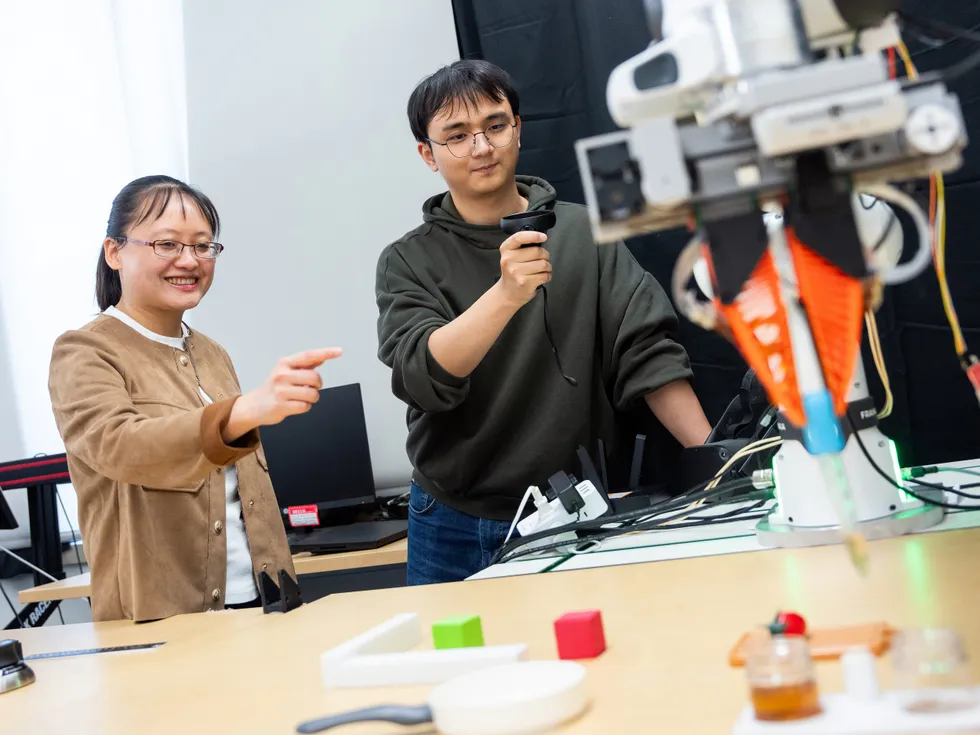
In 2023, Kuo joined the University of Virginia as an assistant professor, conducting research at the interdisciplinary Link Lab within the UVA School of Engineering. Her goal is to develop computational models that enable robots to interpret both explicit and implicit cues — language, motion, and even human gaze — endowing machines with human-like physical and social mental reasoning.
The Evolution of Robot Learning
Traditional robot learning relies heavily on imitation from demonstration: researchers physically guide a robot through a task (such as slicing an apple), and the robot reproduces those motions. However, when conditions change — a different arm position, or an apple at a new angle — the robot encounters situations it was never trained on. Small errors accumulate, and the system eventually breaks down.
To address this, researchers developed Dataset Aggregation (DAgger), in which a human expert stands by during task execution to provide real-time corrections. This later evolved into a version where the robot autonomously triggers a request for human input when uncertain.
The most popular approach — using consensus among multiple models — has its limits: as models grow more complex, training multiple copies becomes increasingly difficult. More fundamentally, disagreement among models does not necessarily indicate uncertainty; it may simply reflect that there are multiple valid ways to complete a task.
Diff-DAgger: Teaching Robots to Make 'Educated Guesses'
Kuo's research team addressed this gap with Diff-DAgger. The method builds on Diffusion Policy — a technique that helps robots consider multiple ways of executing a task.
The key innovation is repurposing the diffusion loss signal used during training as a real-time confidence indicator. As the robot acts, it computes this signal and statistically compares it against values from its training data:
- Signal spikes: The robot encounters an unfamiliar situation and is uncertain how to proceed → human intervention is triggered
- Signal is stable: The current action closely resembles what was learned during training → the robot proceeds autonomously
This effectively gives the robot the ability to self-diagnose and predict impending failure, with human supervision intervening only when genuinely necessary.
Research Results
- 39% improvement in failure prediction
- 20% improvement in task completion rate
- Nearly 8× improvement in task completion speed
Recognition and Future Directions
Kuo's work has earned recognition from multiple quarters:
- IEEE Robotics and Automation Society inaugural WiRA (Women in Robotics and Automation) Paper Award for outstanding early-career contributions
- NSF CAREER Award: A five-year, $665,000 grant supporting her development of computational models for human-robot interaction through Theory of Mind reasoning
- Toyota Research Institute Young Faculty Researcher Award: Funding research into how vehicles can understand road interactions and relationships with drivers
As service robots and autonomous vehicles become increasingly prevalent, Kuo's research direction promises to make human-robot interaction more intuitive and practical.
"There is currently no computational framework that efficiently translates this kind of understanding to robots," she said. But her ultimate goal is to build robust robots that can genuinely integrate into human social spaces and coexist with us through grounded interaction.
The Role of IEEE
Kuo's relationship with IEEE began during her student years. In 2018, while pursuing her MIT PhD, she submitted her first IEEE paper — "Deep Sequential Models for Sampling-Based Planning" — to the IEEE/RSJ International Conference on Intelligent Robots and Systems (IROS). Her engagement with IEEE has deepened steadily as her career has grown; she is now an active volunteer and paper reviewer for the IEEE Robotics and Automation Society, as well as a speaker and panelist at major conferences.
"Sharing knowledge and learning from others is essential to anyone's professional growth," she said. "IEEE provides excellent opportunities for both."
原文來源: 查看原文
FAQ
Reviewed and published by the LAETimes editorial desk ·