US Scientists Achieve 10,000x Optical Magnification Breakthrough with New Cryo-EM System
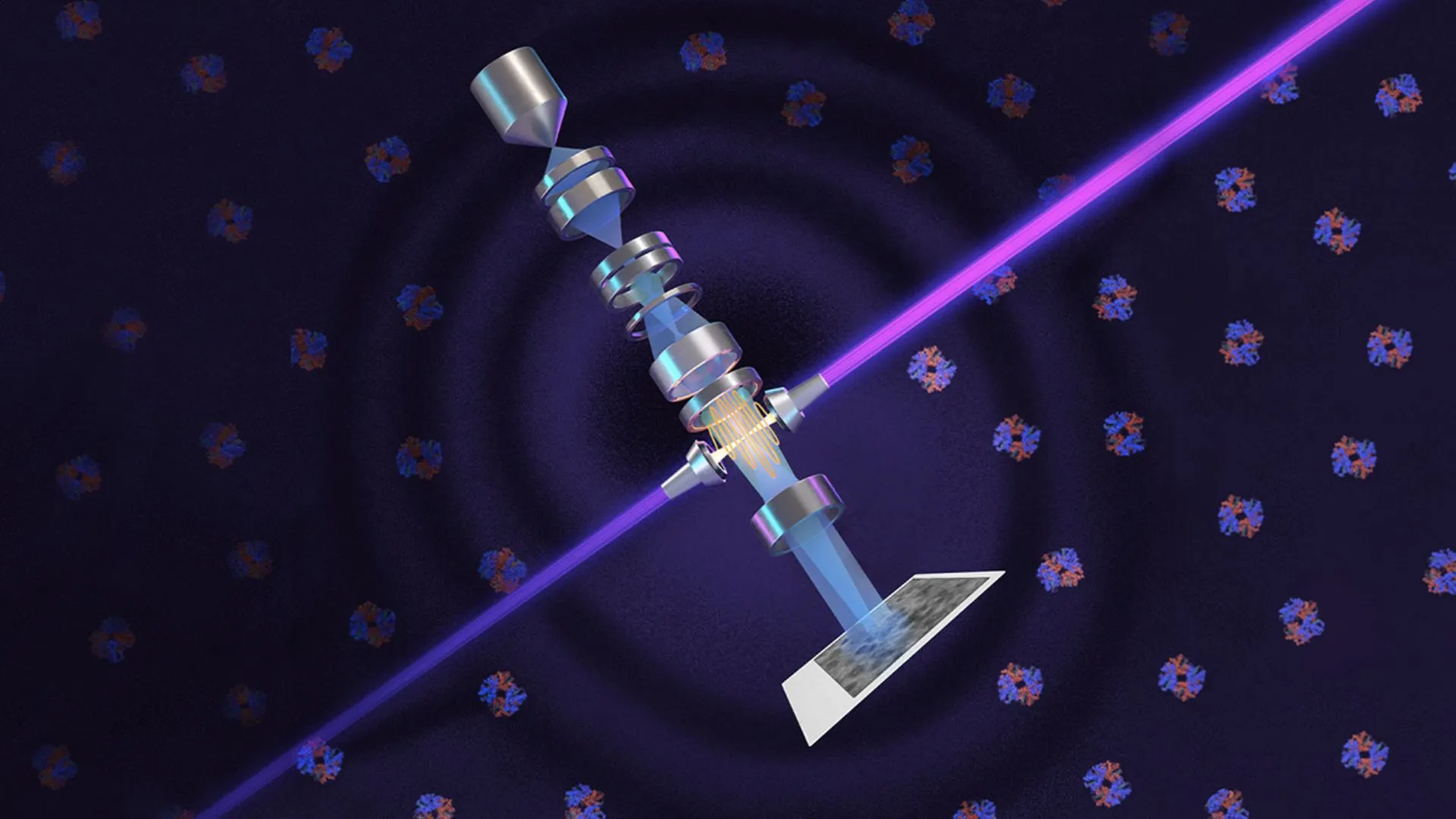
Physicists at Lawrence Berkeley National Laboratory and UC Berkeley have developed a laser-based phase plate technology for cryo-electron microscopy (cryo-EM), achieving magnification roughly 10,000 times that of optical microscopes. Paired with a custom Thermo Fisher Scientific microscope called 'Theia', the system delivers sharper molecular images, enabling more precise atomic models for biology and disease research.
Highlights
- Berkeley Lab and UC Berkeley physicists developed a laser-based phase plate cryo-EM system achieving magnification approximately 10,000 times that of optical microscopes.
- The custom microscope 'Theia', built by Thermo Fisher Scientific, delivers sharper molecular images than current leading cryo-EM instruments even without the laser phase plate enabled.
- The laser phase plate measurably improved imaging resolution for both aldolase and hemoglobin, with the most significant gains recorded for the smaller, more challenging hemoglobin protein.
- The technology took more than 15 years of research to develop, supported by Biohub and close collaboration with specialist engineers.
- The research team plans to expand Theia's use from single-particle analysis to cryo-electron tomography (cryo-ET) for 3D imaging of molecules within living cells.
US Scientists Achieve 10,000x Optical Magnification Breakthrough with New Cryo-EM System
Physicists at Lawrence Berkeley National Laboratory (Berkeley Lab) and the University of California, Berkeley (UC Berkeley) have developed a breakthrough technology that significantly enhances electron microscope performance. The new approach applies phase-contrast imaging to cryo-electron microscopy (cryo-EM), achieving magnification approximately 10,000 times that of optical microscopes and delivering high-resolution images of small molecules and cellular structures critical to biology and disease research.
The team's laser-based phase plate produces sharper, more defined molecular images — a capability that has eluded even today's leading cryo-EM systems. Researchers note the technology is the result of more than 15 years of theoretical and experimental work, close collaboration with skilled engineers, and support from Biohub.
Generating More Accurate Atomic Models of Molecules
The phase plate works in tandem with a custom-built microscope called Theia, developed specifically by Thermo Fisher Scientific to maximize the advantages of the laser's exceptional brightness. According to an official press release, images captured by the system are noticeably clearer and sharper, containing richer detail that structural analysis software can process to generate more accurate atomic models of molecules.
Holger Müller, professor of physics at UC Berkeley and faculty scientist in the Biosciences Area at Berkeley Lab, who led the research, described the system in vivid terms: "Theia is the Formula 1 car of microscopes. Even without the laser, its resolution surpasses that of a standard cryo-EM. With the laser phase plate added, we expect it to truly become one of the best instruments in the world."
He offered a compelling analogy to illustrate the significance: "Previously, studying structures with cryo-EM was like trying to appreciate paintings in a darkened gallery. With Theia, it's as if the lights have been switched on for the first time."
Successful Imaging of Aldolase and Hemoglobin
The team demonstrated the system's capabilities by imaging two proteins: aldolase, a muscle protein that is relatively straightforward to capture, and hemoglobin, the oxygen-carrying protein found in blood. Hemoglobin is a smaller protein that sits near the lower limit of what existing instruments can handle, and is commonly used as a benchmark target for evaluating cryo-EM performance.
The laser phase plate improved resolution for both proteins, with the most notable gains seen for hemoglobin. Müller explained: "We covered the full spectrum — from larger particles with excellent sample preparation, where the challenge is low, to smaller particles with poor sample preparation, where the challenge is high. Naturally, the better the sample quality, the less critical the microscope becomes. The most significant improvements were seen in precisely those cases that were most challenging."
Team Plans Expansion into Cryo-Electron Tomography
The system is currently installed at UC Berkeley, and the research team is working to extend the microscope's application from single-particle analysis to a newer technique: cryo-electron tomography (cryo-ET).
Analogous to how hospital CT (computed tomography) scans reconstruct images of body parts from multiple angles, cryo-ET combines images taken from different angles of molecular or cellular structures into a three-dimensional model. Unlike single-particle cryo-EM, cryo-ET can capture molecules in their natural state within cells while still providing resolution far superior to that of optical microscopes — a capability expected to substantially advance scientists' ability to study cellular processes.
原文來源: 查看原文
FAQ
Newsletter
Subscribe to our Low-Altitude Industry Newsletter
Daily curated news on low-altitude economy and drone industry, delivered to your inbox.
Reviewed and published by the LAETimes editorial desk ·