Ukraine's 'Wild Drones' Competition: The Slowest Pilot Wins by Flying Smart
At the fourth 'Wild Drones' military drone competition held in Truskavets, western Ukraine, Sergeant Zakhar Korol of the 47th Independent Mechanized Brigade 'Magura' took 11 minutes to complete a course designed for 5-minute sprints — and won. His steady, obstacle-free flying outlasted faster competitors who crashed, earning his unit three Skyfall Vampire heavy-bomber drones. The event also served as a critical feedback loop between frontline pilots and weapons manufacturers.
Highlights
- Sergeant Zakhar Korol of Ukraine's 47th Mechanized Brigade 'Magura' won the 2026 Wild Drones competition by completing the FPV course in 11 minutes without crashing, while faster rivals were eliminated after hitting obstacles.
- The winning brigade received three Skyfall Vampire heavy-bomber drones valued at $8,500 each; Skyfall produces 100,000 Vampires per year and has reduced the unit price from an initial $20,000.
- The Vampire six-rotor drone carries payloads up to 15 kg, has completed over 2.5 million combat sorties, and was named Ukraine's most effective strike platform of 2025.
- Ukrainian drone units have integrated Starlink terminals to achieve control ranges of approximately 64 km (40 miles); in early 2026 Russia began using Starlink on attack drones, prompting SpaceX to whitelist authorized terminals.
- Nearly 15 weapons manufacturers exhibited at the Truskavets event, illustrating how Ukraine's drone competitions function as a direct feedback loop between frontline pilots and weapons designers.
Ukraine's 'Wild Drones' Competition: The Slowest Pilot Wins by Flying Smart
A Ukrainian sergeant has won his country's 'Wild Drones' military drone competition by flying as slowly and carefully as possible — taking 11 minutes to complete a course designed as a 5-minute sprint, while faster rivals crashed out one by one. Sergeant Zakhar Korol, 37, of the 47th Independent Mechanized Brigade 'Magura,' claimed victory on May 19–20, 2026, at a theme park in Truskavets, western Ukraine, earning his unit three Vampire heavy-bomber drones supplied by the event's primary sponsor.
Now in its fourth year, the competition drew 19 teams from Ukrainian brigades and the National Guard, plus a separate category for four operator training centers. Events covered both light FPV quadcopters and heavy bombers, judged on speed and aerial target accuracy. Because Korol advanced at a crawl throughout, emcees gave him the ironic call sign "Mr. Speed." "My tactics may look strange," Korol said.
The venue sits hundreds of kilometers from the front line, and the atmosphere was carnival-like — parents walked children between brightly colored tents, barbecue smoke drifted through the air, and giant screens streamed live FPV footage. Soldiers toasted each other with juice instead of alcohol before returning to their respective frontline positions.
Skyfall's Vampire Bomber Takes Center Stage as the Truskavets Grand Prize
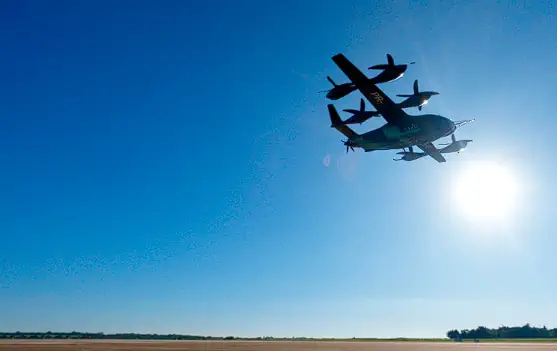
Prizes were provided by the secretive Ukrainian manufacturer Skyfall, both the event's title sponsor and maker of the Vampire heavy bomber. The Vampire is a six-rotor aircraft that has earned a fearsome reputation among Russian forces, who call it "Baba Yaga" after the witch of Slavic folklore. Following Korol's victory, his brigade received three complete Vampire systems along with batteries and accessories.
According to results published by the organizers on Censor.NET, second place went to the 71st Independent Jäger Brigade, awarded two Vampire systems; the brigade's pilot with the call sign "Monk" recorded the fastest individual time of the competition. Third place and one Vampire system went to the 4th Independent Heavy Mechanized Brigade.
The Vampire can carry payloads of up to 15 kg (approximately 33 lbs) and is used to strike fortified positions as well as to deliver drinking water and ammunition to contested areas where vehicle resupply is near-certain to result in casualties. Skyfall told Militarnyi that the Vampire has completed more than 2.5 million combat sorties and was named the most effective strike platform of 2025 at Ukraine's 'Drone Army' awards ceremony.
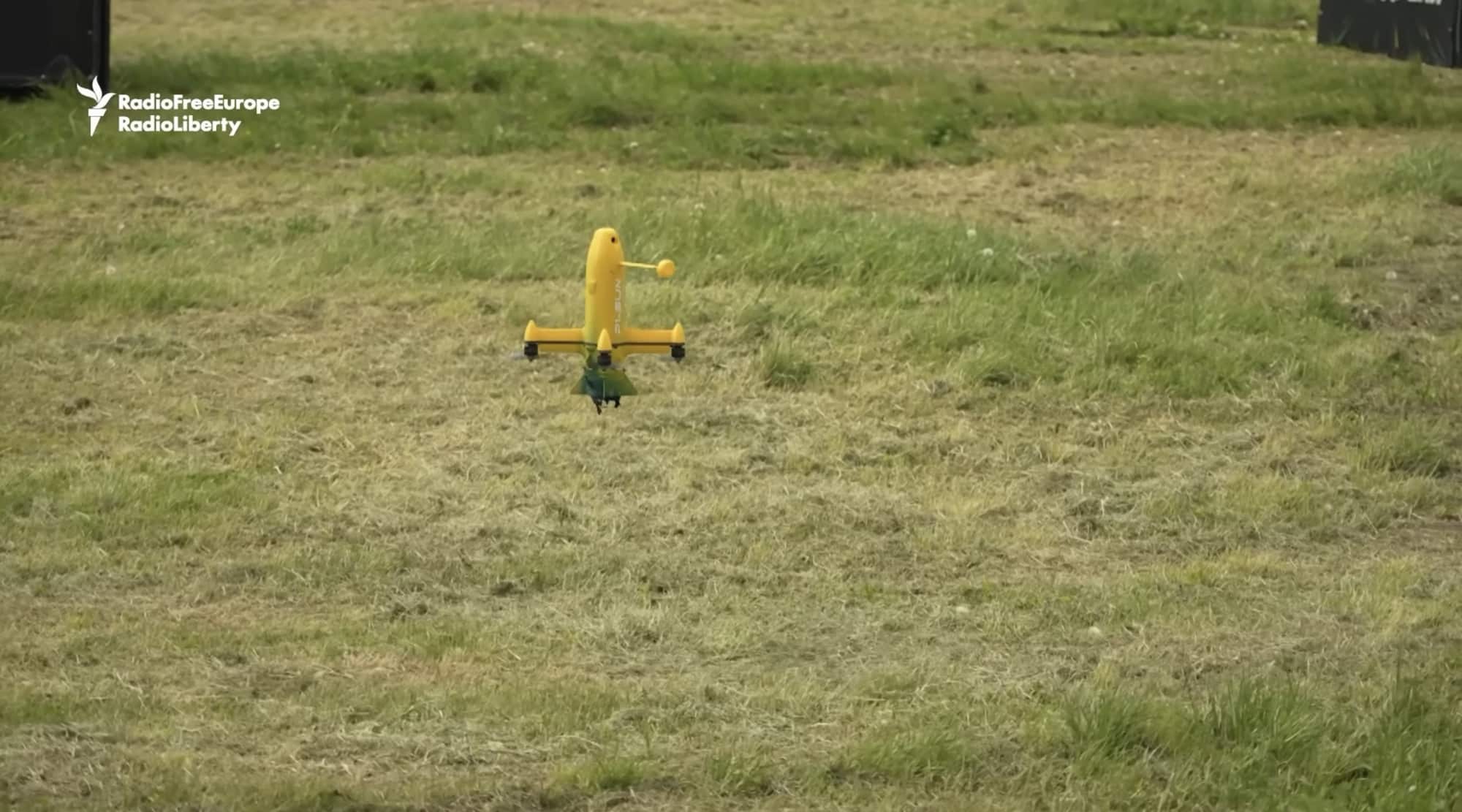
Skyfall deliberately maintains a low profile, concerned about Russian strikes on its factories. Speaking to the Oboronka project at World Defence Show 2026, a company representative using the pseudonym "Nirmata" said the company employs approximately 4,000 people, produces 100,000 Vampire drones per year, and has cut the unit price from a peak of $20,000 at launch to $8,500. The company also produces the Shrike FPV line and the P1-SUN interceptor drone — a bullet-shaped aircraft priced at just under $1,000 that dives into incoming Russian Shahed attack drones.
Image credit: RadioFreeEurope
Steady Flying Beats a Fast Crash
Korol won the FPV category through precision rather than pace, completing the course cleanly while full-throttle rivals clipped obstacles and went down. The tortoise-and-hare outcome illustrated one of the hardest lessons for combat drone operators to internalize: keeping the aircraft alive long enough to reach its target is the prerequisite for everything else. The fact that "the fastest pilot crashed first" gave the manufacturers watching from the sidelines reason to reflect.
During the competition, Korol managed a two-hour visit with his pregnant wife and 10-year-old son before returning to the front. He also made contact on-site with a manufacturer that integrates Starlink terminals into drones to extend control range — a company that likewise declined to give its name for fear of factory strikes. "Even other companies came and asked: 'Bro, how did you sort out the Starlink thing?'" said a representative who gave only his first name, Andriy. Starlink did not respond to a request for comment.
Other soldiers used the event to decompress. "Zippo," a 24-year-old sergeant and drone pilot-scout from the Khartia Brigade near Kharkiv, had spent five consecutive weeks in a frontline position and spent most of his downtime sleeping on a green wooden sled painted with snowflakes. "For me, this is first of all a rest," he said. Private Mykola, 26, from the 93rd Mechanized Brigade with the call sign "Dobry," wore a camouflage top hat. "My comrade and I found a top hat and felt we had to buy it, because we are magicians — we make Russians disappear," he said, before preparing to return to the front the following morning.
Ukraine's Most Battle-Hardened Units Send Their Best Crews
The units assembled in Truskavets read like a roster of Ukraine's most heavily engaged formations — led by the victorious 47th Magura Brigade, with air assault and mechanized brigade crews arriving directly from frontline positions for a rare weekend's leave. The 47th Brigade began the war as the 47th Assault Battalion before expanding to brigade strength, and is equipped with U.S.-supplied M2 Bradley infantry fighting vehicles and M1 Abrams main battle tanks.
The 71st Jäger Brigade, redesignated as an air mobile brigade in January 2026, took second. The Black Ravens drone battalion of the 93rd Mechanized Brigade 'Kholodnyi Yar' helped organize the event and competed alongside the National Guard's 13th Khartia Operational Brigade — the Kharkiv-area unit that conducted the first fully robotic ground assault in late 2024. The wives of two 71st Brigade pilots, Alina Arsenenko, 24, and Nika Poluliakh, ran into the tent to embrace their husbands after a flight and took rides on ground drones operated by soldiers, including a vehicle used for casualty evacuation. "They are top pilots," Arsenenko said.
Starlink Integration Gives Ukrainian Drones a Long-Range Edge Russia Struggles to Match
The Starlink discussion at Truskavets reflects an ongoing technology race running through the war: satellite internet connectivity can push drone control ranges far beyond what radio links susceptible to jamming can achieve, allowing pilots in rear positions to guide aircraft deep into contested areas while maintaining a stable signal. Ukrainian heavy-bomber units were among the first to mount Starlink terminals on airframes, enabling control ranges of approximately 64 km (40 miles).
That capability took on a dual-use dimension in early 2026, however, when Russian forces began installing Starlink terminals on their own attack drones. SpaceX responded with speed restrictions and whitelisting measures to take unauthorized terminals offline at the front. The episode illustrated how deeply both militaries have come to depend on the same commercial network — and explains why a manufacturer that had solved the Starlink integration problem was drawing a crowd of curious competitors in Truskavets.
Drone Competitions Form Ukraine's Rapid Feedback Loop for Weapons Development
Events like 'Wild Drones' mean considerably more than hardware prize distribution. Organizers say they bring weapons designers and the pilots who fly combat missions every day under the same tent, letting frontline operators explain in plain language which design choices keep crews alive and which get them killed. Nearly fifteen weapons manufacturers exhibited at the event, spanning UAV, unmanned ground vehicle (UGV), and medium- and long-range strike system producers.
When Russia launched its full-scale invasion in 2022, only a handful of enthusiasts were pushing the idea of weaponizing FPV drones. Ukraine has since industrialized the production of interceptors, heavy bombers, maritime drones, and UGVs, with aerial drones now accounting for the large majority of casualties on both sides. The Ukrainian military has gamified combat through a points-based system that lets units redeem verified kills for new equipment on the Brave1 marketplace. Dozens of such competitions are held each year, cultivating a militarized community culture far from the trenches. According to The New York Times, at the end of the day's events, ground drone operators used their machines to help clean up barbecue equipment in the park.
DroneXL Editor's Perspective
I have been tracking Ukraine's drone war since the first crude quadcopter modifications of 2023, watching the gamification of the Drone Army points economy and the rise of cheap interceptors — systems that Gulf states and the Pentagon now covet. Truskavets is the social layer of that machine.
The slow-flying sergeant matters because this competition is fundamentally a procurement tool disguised as a carnival, and it signals to designers that on a course built around real combat tasks, survivability scores higher than raw speed.
Skyfall's ability to cut the Vampire's unit price from $20,000 to $8,500 while scaling to 100,000 units per year was not achieved by guessing — it was achieved by listening to crews camping in tents like these. That dynamic is the same one driving Ukrainian fixed-wing FPV drones past 100 km (62 miles) in range and ground robots past 9,000 monthly sorties. Western defense primes that need years to ramp a single platform should study what a feedback cycle measured in weeks compounds to over four years of war.
Two open questions are worth watching: first, whether the prize hardware at the two additional Wild Drones competitions planned for this year will shift from Vampire bombers toward interceptors and ground robots — President Zelensky signed the 'Drone Deals' export framework on April 28, 2026, and Kyiv is actively marketing these systems abroad. Second, the Starlink question that the anonymous manufacturer could not fully answer still hangs over the entire industry: can a commercial satellite connection controlled by a single company continue to serve as the backbone of Ukraine's long-range drone capability? No one can predict the answer, but it will determine how far these aircraft can reach.
Source: The New York Times, reporting by Maria Varenikova, photography by Brendan Hoffman.
原文來源: 查看原文
FAQ
Reviewed and published by the LAETimes editorial desk ·