Europe Builds Robotic Arm with Vision and Touch Sensing for Lunar Sample Handling
The European Space Agency (ESA) is assembling the Sample Transfer Arm (STA), one of Europe's most advanced robotic arms. Stretching up to 2.4 metres with seven degrees of freedom, the STA features cameras, sensors, and torque sensing for autonomous, millimetre-precision object manipulation. Originally designed for the NASA-ESA Mars Sample Return mission, the technology has been redirected toward broader applications including future lunar exploration.
Highlights
- ESA's Sample Transfer Arm (STA) extends up to 2.4 metres and has seven degrees of freedom, enabling human arm-like range of motion for space operations.
- The STA uses onboard torque sensors for tactile feedback and cameras for visual perception, allowing millimetre-precision autonomous object manipulation.
- Originally designed for the NASA-ESA Mars Sample Return mission to handle Perseverance rover samples, the STA has been repurposed for lunar exploration amid mission uncertainty.
- Leonardo is leading system integration at its Nerviano, Italy facility, with testing in simulated space conditions planned within weeks.
- The STA programme involves a pan-European industrial consortium including partners from Spain, Switzerland, France, Romania, Denmark, Greece, and Germany.
Europe Builds Robotic Arm with Vision and Touch Sensing for Lunar Sample Handling
ESA engineers are assembling one of Europe's most sophisticated robotic arms, a system designed to handle samples and perform complex operations during future lunar and Mars missions.
Known as the Sample Transfer Arm (STA), the unit can extend up to 2.4 metres and offers seven degrees of freedom — a range of motion comparable to the human arm. Onboard cameras, sensors, and electronics allow it to perceive its surroundings and execute tasks with a high degree of autonomy.
The arm was originally developed as part of the joint NASA-ESA Mars Sample Return programme, where it was intended to transfer samples collected by NASA's Perseverance rover for eventual return to Earth.
With the future of the Mars Sample Return mission still uncertain, the technology has been repositioned for a broader set of applications, including upcoming lunar exploration missions.
A Human-Like Space Assistant
The STA mirrors the structure of a human arm, incorporating shoulder, elbow, and wrist joints, and is fitted with a gripper capable of handling objects with millimetre-level precision.
The system also integrates sophisticated torque sensors that serve as a form of mechanical touch. These sensors measure how an object is being pushed, pulled, or twisted in three-dimensional space, enabling more accurate manipulation.
Position sensors embedded in the joints continuously calculate the position of the arm's end-effector, helping maintain precise control throughout operations.
Engineers note that this level of precision is valuable for a range of space activities, including geological sample collection, equipment transfer, and astronaut support during surface missions.
A dedicated electronics control unit housed within the arm serves as the system's central processing hub. Onboard cameras provide visual perception, enabling the robotic system to detect and interact with objects in its environment.
Entering the Test Phase
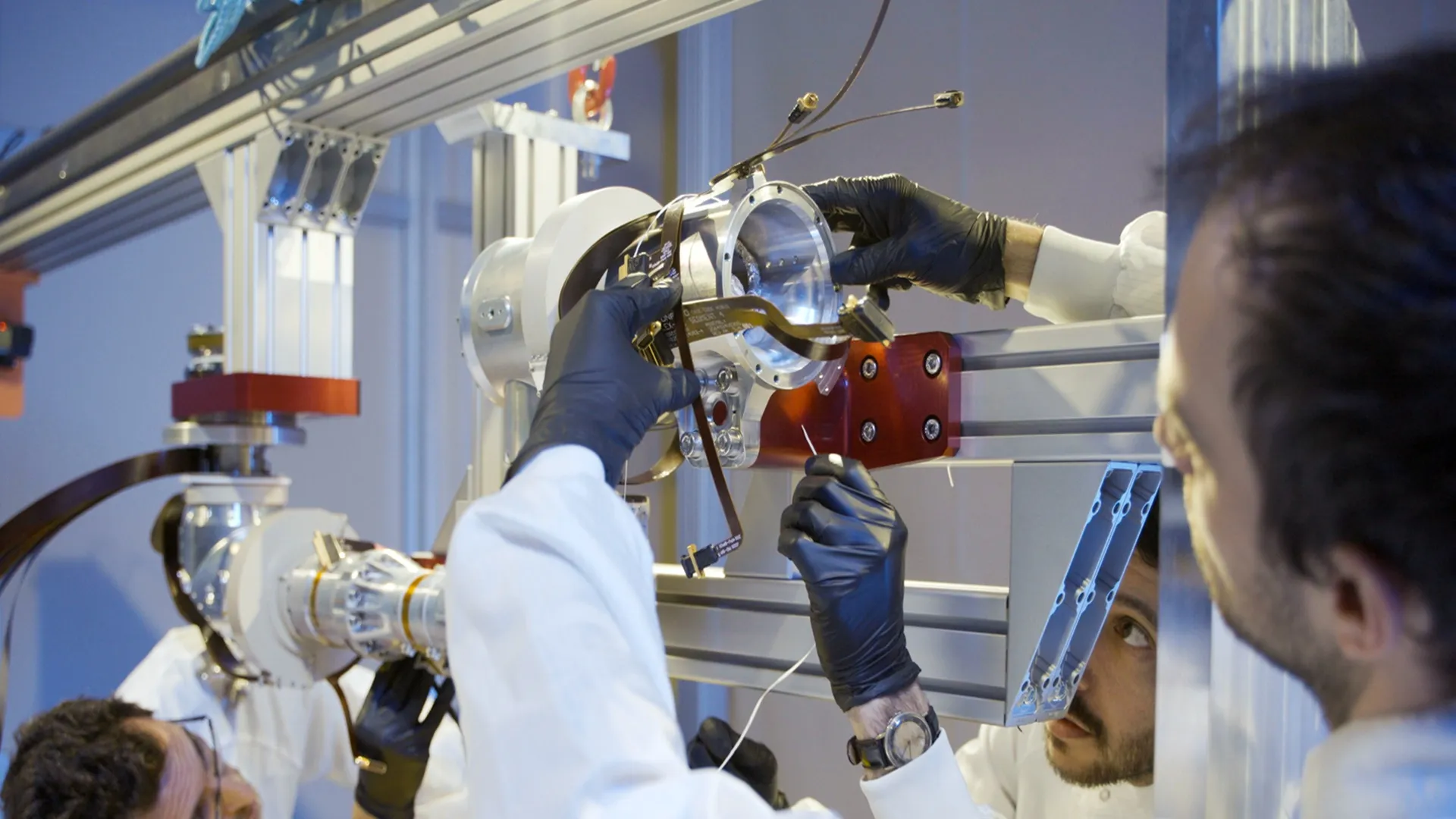
A team from Italian aerospace company Leonardo is currently completing system integration at its facility in Nerviano, near Milan.
In the coming weeks, engineers will begin testing the arm in simulated space conditions to evaluate performance ahead of eventual deployment.
The programme brings together companies and suppliers from across Europe. The industrial consortium led by Leonardo includes GMV and AVS from Spain, Maxon from Switzerland, 3DPlus from France, COMOTI from Romania, and suppliers from Denmark, Greece, and Germany.
The arm incorporates several systems specifically engineered for spaceflight, including a compliant wrist mechanism that allows for soft contact with objects, a flat electrical harness capable of carrying hundreds of signals, and structural mechanisms designed to absorb the shock loads experienced during launch and landing.
European space agencies regard advanced robotics as a core capability for future exploration missions — particularly as astronauts prepare for long-duration stays on the Moon and humanity looks toward an eventual crewed mission to Mars.
With its vision sensing, tactile feedback, and autonomous object-handling capabilities, the Sample Transfer Arm is positioned to become a critical tool for sample management and scientific operations beyond Earth.
原文來源: 查看原文
FAQ
Newsletter
Subscribe to our Low-Altitude Industry Newsletter
Daily curated news on low-altitude economy and drone industry, delivered to your inbox.
Reviewed and published by the LAETimes editorial desk ·