From Sea Denial to Market Shock: Maritime Swarm Tactics and the Weaponization of Global Energy Logistics
This analysis examines how maritime swarm tactics enable weaker actors to transform global energy chokepoints into strategic battlegrounds. Using Iran's IRGC Navy as a primary case study, it argues that low-cost 'mosquito fleets' can bypass conventional naval engagements to directly threaten global energy supply chains. Drawing on recent disruptions in the Strait of Hormuz and Red Sea, the article contends that swarm tactics represent not merely a sea-denial tool, but a systematic instrument of economic coercion targeting global energy logistics.
Highlights
- Approximately 50% of globally traded seaborne oil transits a handful of narrow chokepoints, with the Strait of Hormuz alone accounting for roughly 20% of world oil trade, creating concentrated systemic vulnerability.
- Iran's IRGCN fielded at least 40 fast attack craft near Sirik in February 2026, positioning them approximately 14 nautical miles from major tanker lanes as a demonstration of sea-denial capability.
- Houthi swarm attacks in the Red Sea from 2023 to 2026 forced major shipping companies to reroute around the Cape of Good Hope, adding about two weeks to voyages and sharply raising war-risk insurance premiums.
- Attacks on the U.S.-owned tanker Safesea Vishnu and the Maltese tanker Zefyros on March 11–12, 2026, triggered global oil market volatility, illustrating how strikes on a small number of vessels can reshape broader market expectations.
- Layered defensive architectures combining electronic warfare, directed-energy weapons, and autonomous intercept systems are identified as the most scalable response to maritime swarm saturation attacks.
Abstract
This article examines how maritime swarm tactics enable weaker actors to convert global energy chokepoints into strategic battlegrounds. Through numerical superiority, speed, and dispersed deployment, asymmetric armed forces—most notably Iran's Islamic Revolutionary Guard Corps Navy (IRGCN)—can overwhelm conventional naval defenses and strike poorly protected commercial tankers. These low-cost 'mosquito fleets' bypass traditional fleet engagements to strike directly at the center of gravity of global economic logistics. Through an analysis of recent disruptions in the Strait of Hormuz and the Red Sea, this article demonstrates that swarm tactics not only shape market expectations but amplify systemic risk. It argues that these tactics serve simultaneously as a tool of sea denial and as an instrument of economic coercion targeting the global energy supply chain, with profound implications for convoy adaptation and multinational coordination.
Introduction
Global energy markets depend on unimpeded maritime transportation. The majority of internationally traded oil moves by sea, with a significant share required to transit a handful of narrow chokepoints. These passages concentrate enormous volumes of tanker traffic along narrow and predictable routes, creating systemic vulnerabilities.
The geographic constraints of chokepoints reduce maneuver space and compress reaction time, favoring asymmetric strategies—of which maritime swarm tactics are among the most operationally significant in this environment. Small vessels, unmanned systems, and missiles can operate effectively in congested coastal waters, enabling weaker actors to threaten commercial shipping without directly confronting superior naval forces. Large numbers of low-cost platforms can saturate defenses, disrupt shipping patterns, and trigger broader economic consequences. This article argues that maritime swarm tactics constitute a systematic instrument of economic coercion whose strategic implications extend well beyond mere sea denial.
The Vulnerability of Global Energy Logistics: Why Chokepoints Matter
Global oil transportation depends on a small number of maritime chokepoints. According to estimates from the U.S. Energy Information Administration (EIA), the Strait of Hormuz carries approximately 20% of global oil trade. Other critical passages—including the Bab el-Mandeb strait, the Strait of Malacca, and the Suez Canal—account for an additional 30% of daily flow. In aggregate, roughly 50% of seaborne oil transits a handful of narrow waterways—a concentration that presents a significant systemic concern.
This traffic concentration creates predictable shipping patterns. Tankers must follow established traffic separation schemes, operating in environments with limited space and restricted maneuverability. This allows nearby hostile actors to track and intercept vessels with relative ease. These physical constraints are not merely operational concerns; when disruption occurs, they translate directly into systemic economic risk.
Recent events have clearly illustrated how localized threats can rapidly affect global markets. From 2023 to 2026, Houthi attacks in the Red Sea forced several major shipping companies to reroute vessels around the Cape of Good Hope, adding approximately two weeks to transit times and increasing fuel consumption accordingly. Insurance markets responded in kind—war-risk premiums for vessels entering sensitive waters rose sharply, reflecting a reassessment of risk by underwriters including the Lloyd's Market Association. Even isolated incidents generated economic impacts far beyond the immediate site of attack.
Swarm Tactics: The Strategy of the Weak
Modern naval conflict reflects broader evolutions in maritime strategic thought. Classical sea power theory—most prominently that of Alfred Thayer Mahan—emphasized decisive fleet engagements and control of sea lines of communication. Julian Corbett, by contrast, stressed the strategic value of sea denial and limited control in constrained environments. Contemporary maritime swarm tactics build directly on this tradition, extending the reach and effectiveness of dispersed, low-cost forces through modern anti-access/area-denial (A2/AD) systems.
Swarm tactics offer weaker actors a practical means of exploiting chokepoint vulnerabilities. Their operational logic rests on four characteristics: mass, speed, dispersion, and simultaneous attack. Rather than seeking decisive engagement, attackers generate confusion by presenting multiple threats simultaneously. Radar networks, missile intercept systems, and command structures that can manage individual threats struggle against swarm attacks, and decision-making processes become paralyzed.
Recent conflicts have validated the practical effectiveness of swarm tactics. Ukrainian unmanned surface vehicles (USVs) struck several Russian warships in the Black Sea through coordinated attacks, breaching conventional naval defenses. In the Red Sea, Houthi drone and missile attacks severely disrupted commercial transit along the Suez route at peak intensity, prompting multiple shipping companies to divert vessels to the African route. These cases demonstrate that cheap platforms can generate strategic effects disproportionate to their cost.
However, the effectiveness of swarm tactics is not absolute. Advances in surveillance technology, unmanned systems, and data fusion are enabling naval forces to detect, track, and engage multiple small targets simultaneously. In sensor-dense environments, the advantages of dispersion and speed may erode as defenders improve target identification and response times. This suggests that swarm tactics are most effective under conditions of congestion, ambiguity, and limited detection windows.
Iran's Maritime Swarm Tactics in Practice
Iran is among the most developed practitioners of maritime swarm warfare among regional powers. The primary unit responsible for executing this mission is the IRGCN, whose operational focus centers on littoral combat in the Persian Gulf and the Strait of Hormuz. The IRGCN relies on large numbers of inexpensive small platforms—fast attack craft, missile boats, naval mines, and unmanned systems form the core of its force structure. Analysts commonly describe this force as a 'mosquito fleet,' deriving its effectiveness from mass rather than the performance of individual platforms. The command architecture reinforces this model: units operate with decentralized authority and can respond rapidly to local conditions; coastal bases, islands, and dispersed forward positions provide multiple maritime launch points.
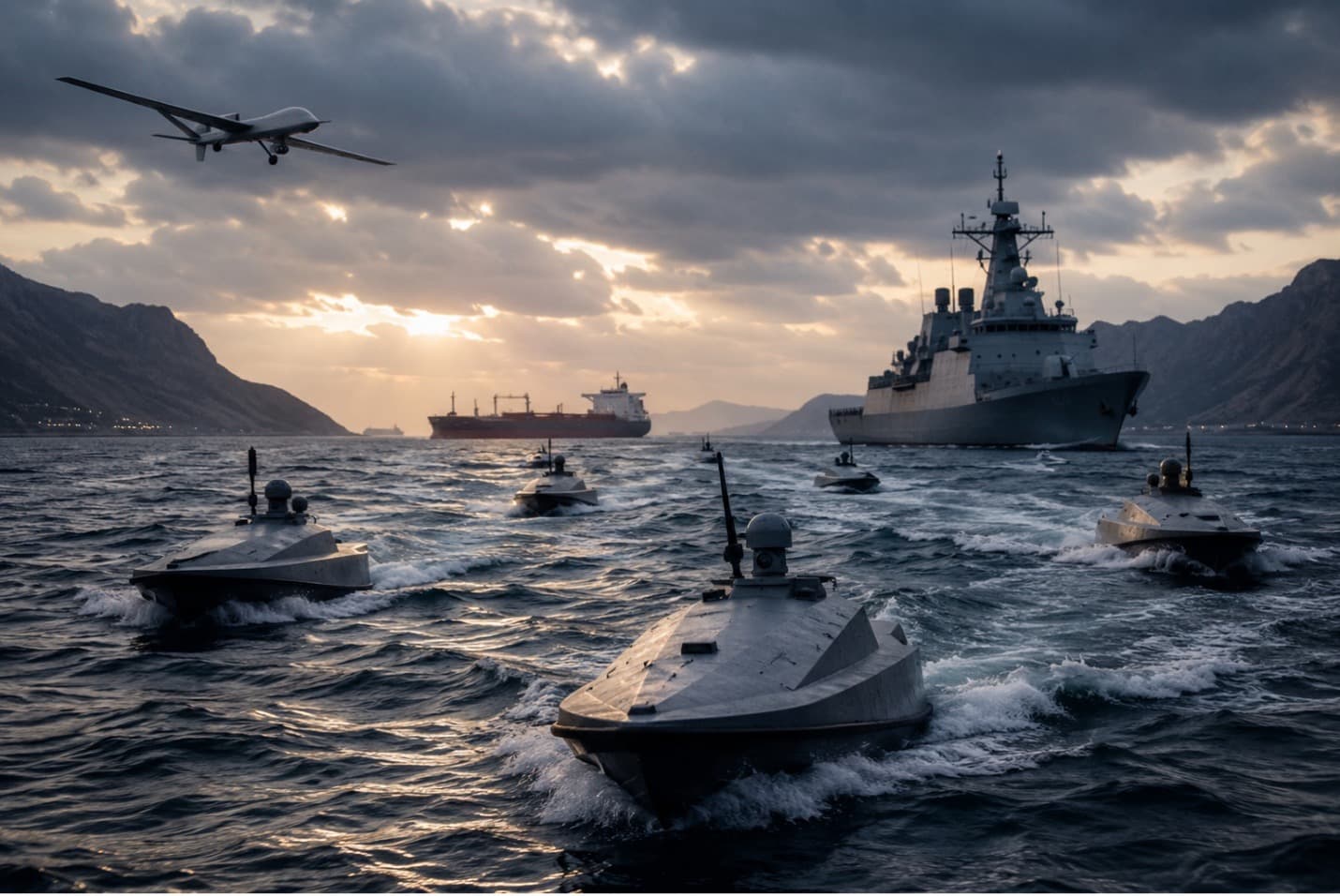
Recent deployment activity has clearly illustrated this operational concept in practice. In February 2026, satellite imagery revealed an IRGCN concentration of at least 40 fast attack craft near the Shahid Seyyed Majid Base at Sirik, in the western Strait of Hormuz—positioned approximately 14 nautical miles from major tanker lanes. Such deployments simultaneously demonstrate readiness and raise the perceived risk for commercial shipping. Iran's objective is sea denial—disrupting or constraining an adversary's use of maritime space—rather than fleet destruction. Even limited disruption, short of sustained combat, is sufficient to affect global markets.
Why Energy Tankers Are Highly Vulnerable Targets
Commercial oil tankers present highly attractive targets for swarm tactics. Their large size generates a prominent radar cross-section, yet their defensive capabilities are extremely limited. Most vessels transit fixed routes at speeds of 12 to 15 knots, with minimal maneuverability against rapidly approaching threats. Crew sizes further constrain on-board response capacity—tankers are typically operated by civilian mariners who are ill-equipped to mount coordinated defenses against swarm attacks.
Economic factors further amplify the consequences of striking commercial shipping. The 'tanker war' of the 1980s Iran-Iraq War demonstrated that limited strikes were sufficient to trigger sharp premium increases. Similar patterns emerged during the Red Sea disruptions. When costs exceed acceptable thresholds, shipping companies suspend operations in high-risk areas, allowing even small-scale attacks to disrupt broader trade flows.
Strategic and Economic Consequences
The economic effects generated by swarm attacks extend well beyond the direct strike. Because a significant share of global oil supply depends on unobstructed maritime transit, energy markets respond rapidly to threats against major chokepoints. Even limited disruption can trigger price volatility and heighten uncertainty across shipping and energy markets.
The attacks on the Marshall Islands-flagged, U.S.-owned tanker Safesea Vishnu and the Malta-flagged tanker Zefyros on March 11–12, 2026, as reported at the time, clearly illustrated this dynamic. Following news of the attacks, global oil markets experienced volatility as traders reassessed the security of Persian Gulf export routes and uncertainty rose. The incident demonstrated that attacks on a small number of vessels can do more than disrupt physical flows—they shape market expectations, amplify uncertainty, and prompt pre-emptive action by shipping companies and energy importers.
If disruption is sustained, the consequences become more severe. Many Persian Gulf producers rely on a limited number of export terminals for seaborne exports; if tanker loading slows or halts, global supply could tighten rapidly. Large economies heavily dependent on imports—including China, India, and several European nations—would face immediate pressure to secure alternative supplies at higher prices. Consumers would ultimately absorb these impacts through higher fuel costs, increased transportation expenses, and rising prices for goods and services, with inflationary pressure potentially spreading rapidly through domestic economies.
Insurance markets further compound these pressures. War-risk premiums rise quickly following attacks near shipping lanes, and some underwriters suspend coverage entirely until security conditions stabilize. These financial responses amplify the economic impact of relatively limited military action. Swarm tactics thus function effectively as a form of economic coercion—a small number of inexpensive platforms can trigger market instability, disrupt energy logistics, and impose broad costs on the global economy without deploying large-scale conventional forces.
Implications for Naval Strategy and Logistics Security
Naval strategy must adapt to this evolving threat environment. Traditional theory emphasized fleet engagements and control of open sea space, but recent conflicts have demonstrated that commercial logistics networks have become more vulnerable and strategically valuable targets; protecting maritime supply chains is now a core operational requirement.
Convoy systems may regain relevance in high-risk areas. Concentrated convoy protection reduces individual merchant vessel exposure and enables naval forces to allocate defensive resources more efficiently. While this approach cannot eliminate risk, it improves resilience against dispersed, fast-moving threats.
Enhancing maritime domain awareness is equally critical. Satellite surveillance, unmanned aerial systems, and surface USVs can extend monitoring coverage over congested transit corridors, support earlier detection of suspicious activity, and accelerate response to emerging threats. Defensive adaptation must also address saturation dynamics—traditional shipborne defense systems are poorly suited to countering large numbers of low-cost, fast-moving platforms. Layered defensive architectures combining electronic warfare, directed-energy weapons, and autonomous intercept systems can provide more scalable responses to swarm attacks.
International cooperation reinforces these efforts. Multinational patrols in contested areas demonstrate how coalition action can share the burden of securing critical trade routes; coordinated operations improve coverage, facilitate intelligence sharing, and enhance deterrence.
Conclusion
Modern maritime conflict increasingly targets logistics rather than fleets. Global energy supply depends on a small number of maritime chokepoints that concentrate enormous economic value along narrow and predictable waterways, offering weaker actors the opportunity to exploit structural vulnerabilities.
Maritime swarm tactics leverage mass, speed, and dispersion to saturate defenses and disrupt commercial shipping. Iran's approach—particularly through the IRGCN—clearly demonstrates how a state can institutionalize this operational method. Vulnerable tankers and sensitive insurance markets amplify the effects of even limited attacks, creating a strategic environment in which relatively small-scale actions can generate global consequences.
The implications for naval forces are clear: maritime logistics have become the primary operational center of gravity in modern conflict. Protecting commercial shipping requires sustained vigilance, advanced surveillance capabilities, and coordinated defensive measures. The strategic importance of protecting logistics networks now rivals that of traditional naval missions. Prolonged disruption to seaborne oil transportation would carry consequences far beyond temporary price fluctuations—strategic petroleum reserves can stabilize markets during short-term emergencies but cannot substitute for the sustained flow of large volumes of oil through maritime chokepoints. If tanker route attacks persist, supply shortfalls could exceed the compensatory capacity of existing reserves, at which point energy security would become a core strategic concern for major powers.
原文來源: 查看原文
FAQ
Reviewed and published by the LAETimes editorial desk ·