Hubble Space Telescope Captures Merging Galaxy Cluster
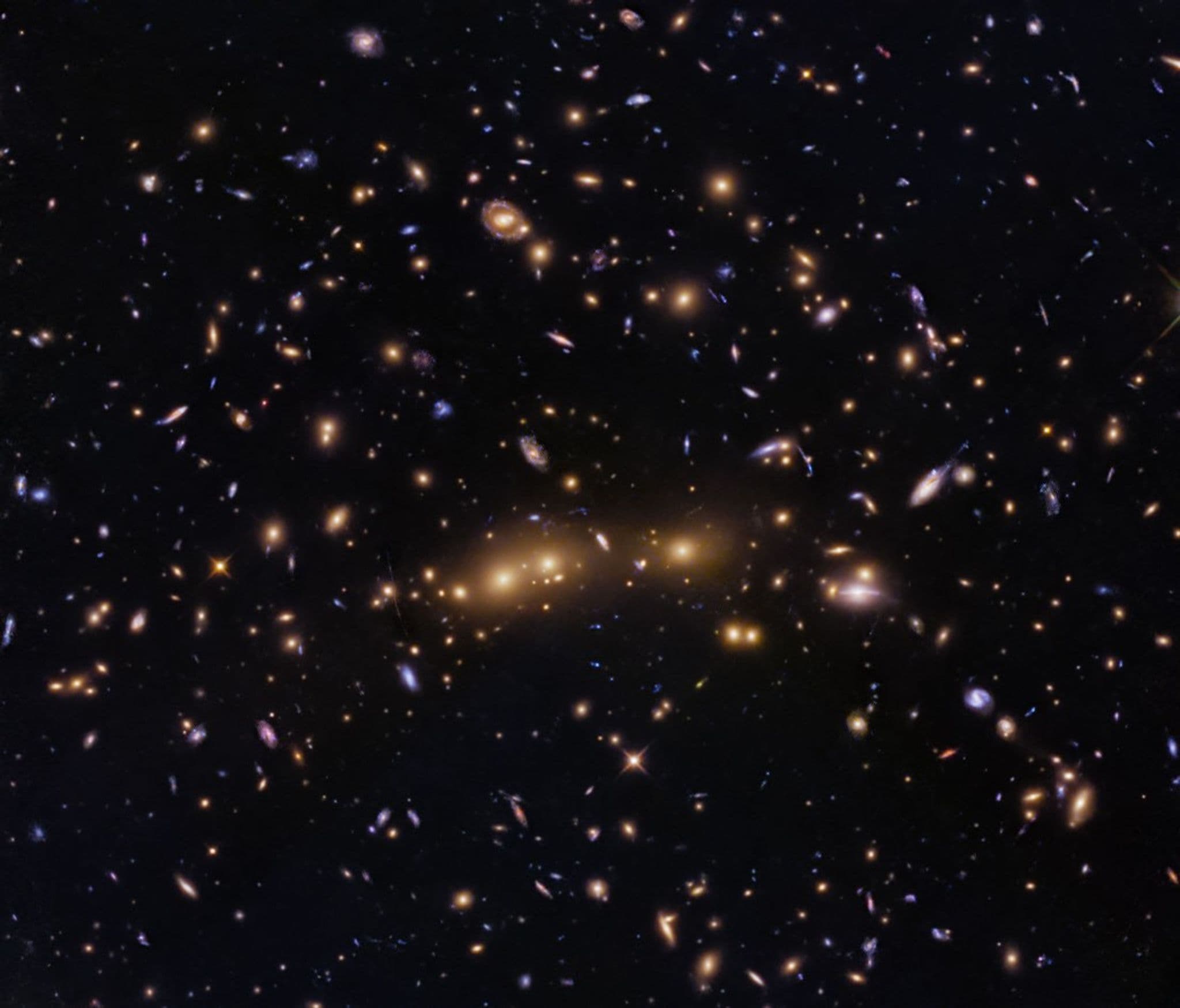
NASA's Hubble Space Telescope has imaged galaxy cluster CL0016+1609 (also known as MACS J0018.5+1626), revealing it to be two clusters merging along the line of sight. Researchers used Hubble data to map dark matter distribution via gravitational lensing, and the RELICS survey identified approximately 300 high-redshift candidate galaxies amplified by the cluster.
Highlights
- NASA's Hubble Space Telescope imaged galaxy cluster CL0016+1609 (MACS J0018.5+1626), one of the most studied clusters in X-ray and radio wavelengths.
- X-ray observations confirm CL0016+1609 is formed by two galaxy clusters merging along the line of sight.
- Hubble's Advanced Camera for Surveys data enables precise mapping of CL0016+1609's dark matter distribution through gravitational lensing.
- The RELICS (Reionization Lensing Cluster Survey) covered 46 massive galaxy clusters and discovered approximately 300 high-redshift candidate galaxies.
- Gravitational lensing arcs from distant background galaxies are visible in the Hubble image, appearing to the left and upper right of the cluster's central elliptical galaxy.
A new image from NASA's Hubble Space Telescope reveals the densely packed galaxy cluster CL0016+1609, also known as MACS J0018.5+1626.
Image credit: NASA, ESA, H. Ebeling (University of Hawaii), D. Coe (STScI, ESA, JWST); Image processing: G. Kober (NASA/Catholic University of America)
Two Clusters in Merger
CL0016+1609 is exceptionally luminous in X-ray wavelengths and is among the most extensively studied galaxy clusters in both X-ray and radio observations. X-ray data reveal that the structure is actually formed by two galaxy clusters merging along our line of sight.
Hubble's Observing Campaign
Researchers requested time on Hubble's Advanced Camera for Surveys to observe CL0016+1609. The resulting data enable precise mapping of the cluster's dark matter distribution, shedding light on the merger process and CL0016+1609's role within the large-scale structure of the universe.
While Hubble cannot directly image dark matter, its infrared and visible-light observations can detect the influence dark matter exerts on ordinary matter through gravitational lensing.
The RELICS Survey
The image also incorporates data from Hubble's Wide Field Camera 3, gathered as part of a survey that obtained the first Hubble infrared images of 46 massive galaxy clusters and searched for distant galaxies magnified by their gravitational lensing effect.
This program, known as RELICS (Reionization Lensing Cluster Survey), identified approximately 300 high-redshift candidate galaxies magnified by gravitational lensing.
Image Highlights
In the image above, an elongated vertical arc formed by a distant background galaxy is visible to the left of a large elliptical galaxy near the center. A second, shorter but brighter arc appears to the upper right of the same central elliptical galaxy.
Media Contact: Claire Andreoli NASA Goddard Space Flight Center, Greenbelt, Maryland claire.andreoli@nasa.gov
原文來源: 查看原文
FAQ
Reviewed and published by the LAETimes editorial desk ·