U.S. Navy Carriers Face a Range Dilemma — and China Is Betting Everything on It
The U.S. Navy's carrier-based aircraft can no longer strike targets in the Western Pacific without first bringing the carrier within range of China's anti-ship missiles. China has deployed a layered missile network — DF-27, DF-26, DF-21D, and DF-17 — forming concentric rings of threat. The Navy's answer, the sixth-generation F/A-XX carrier fighter, is years behind schedule, while missile technology continues to outpace aircraft development in speed and cost.
Highlights
- The Pentagon's 2024 China Military Power Report confirmed for the first time that China has deployed the DF-27 anti-ship ballistic missile, with a range of 5,000–8,000 km and a hypersonic glide vehicle, covering the entire Indo-Pacific and much of the U.S. West Coast.
- The F/A-18E/F Super Hornet's combat radius of 390–450 nautical miles means U.S. carriers must enter China's missile engagement zones before their aircraft can strike defended Western Pacific targets.
- The U.S. Navy's F/A-XX sixth-generation carrier fighter program missed its early-2025 contract-award target; Navy leadership now aims for an August 2026 decision, with some Pentagon officials seeking delays of up to three years.
- China's anti-ship missile network forms four concentric rings: the DF-27 (outermost), DF-26 (3,000–4,500 km, upgraded DF-26D debuted September 2025), DF-21D (the original 'carrier killer'), and terminal-phase hypersonic DF-17 plus cruise missile salvos.
- Extending missile range is faster and cheaper than developing longer-range manned aircraft, creating a structural asymmetry that favors China's missile force over the U.S. Navy's carrier aviation modernization timeline.
U.S. Navy Carriers Face a Range Dilemma — and China Is Betting Everything on It
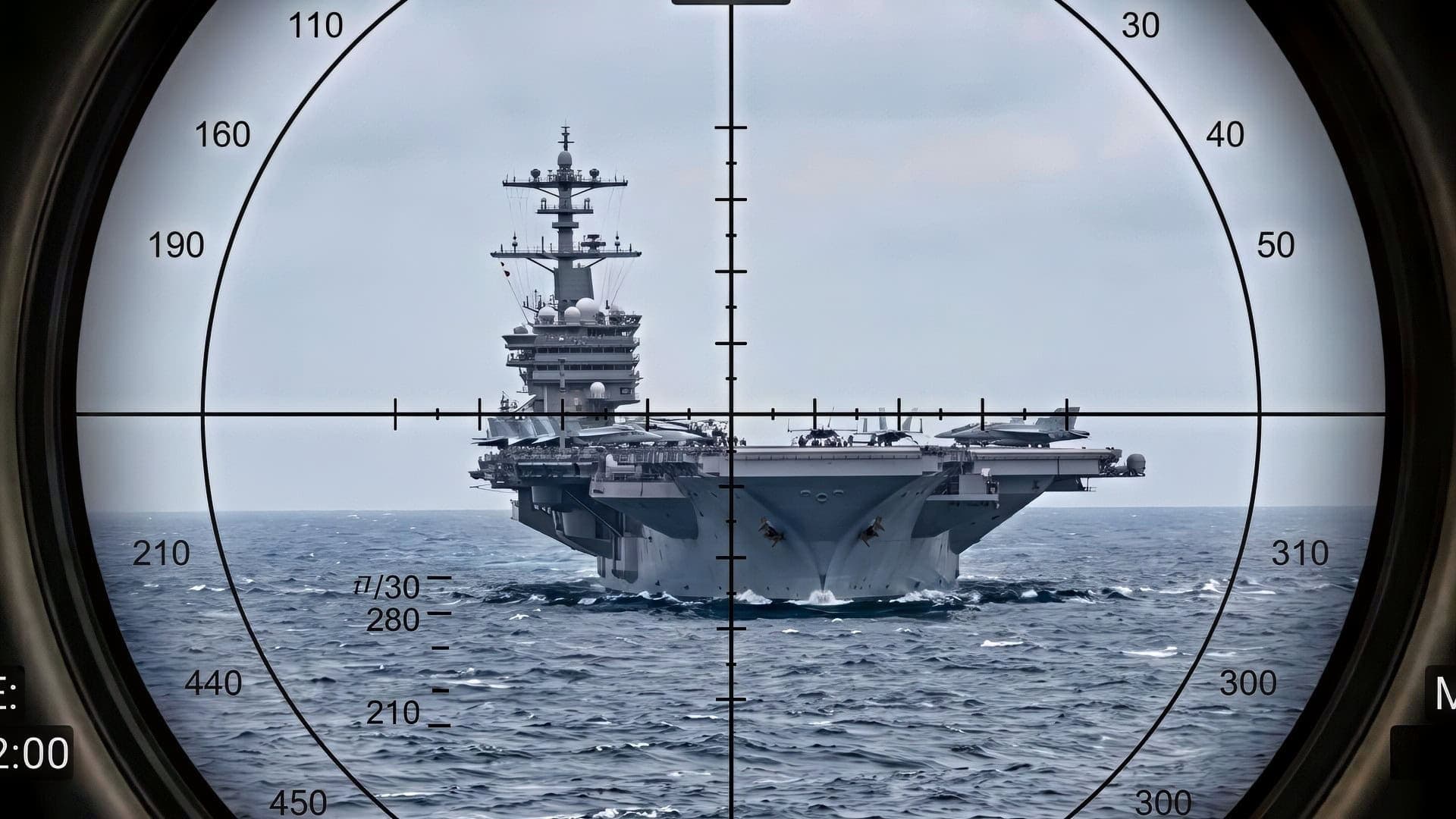
Aircraft carriers exist to project power from a safe distance. In the Western Pacific, that premise no longer holds. China's anti-ship missiles now outrange the strike aircraft on carrier decks, meaning that to bring those aircraft within range of a defended target, the carrier must first enter missile range. The ship designed to strike from outside the enemy's reach must now enter the danger zone to accomplish its mission.
This is a geometry problem, not a hardware problem — and it may be one the U.S. Navy cannot engineer its way out of, because extending missile range is faster and cheaper than developing longer-range aircraft, and China already holds the outermost ring. The Navy's answer is the F/A-XX, a sixth-generation fighter designed to push carrier air wing strike range back outside the missile envelope. It is seriously behind schedule. The missiles are not waiting.
The Geometry Problem: A Carrier's Strike Power Equals Its Aircraft's Reach
A carrier's strike range is not determined by how far the ship can sail, but by the combat radius of the aircraft on its deck — and those numbers are smaller than most people assume.
The F/A-18E/F Super Hornet, the workhorse of the carrier air wing, has a combat radius of roughly 390 to 450 nautical miles. The stealthier F-35C reaches farther — approximately 600 to 670 nautical miles — but the Navy has procured relatively few of them, leaving fourth-generation Super Hornets as the air wing's backbone. Organic aerial refueling via the MQ-25 Stingray unmanned tanker, expected to reach initial operational capability in late 2026, can extend that reach, but it stretches the radius rather than transforming it — and the tanker itself is a scarce and vulnerable asset.
Set those numbers against the threat: to put carrier aircraft over a defended target in the Western Pacific, the carrier must approach within hundreds of nautical miles of that target — hundreds of nautical miles that place the ship well within range of missiles designed specifically to destroy it.
The result is an impossible choice: stay far enough away to be safe and the air wing cannot reach the target; close to within strike range and the carrier becomes the target. Aircraft carriers exist to escape exactly this dilemma. In the most important theater today, they can no longer escape it.
Layered Threat: Four Concentric Rings, Not a Single Red Line
The popular image of a "carrier killer" is a single missile — one red line a carrier either crosses or avoids.
The reality is a series of concentric defensive rings, each firing at a different distance, confronting a carrier with compounding layers of risk from the moment it enters the Western Pacific. Andrew Erickson, professor of strategy at the U.S. Naval War College and one of the first analysts to document China's serious investment in anti-ship ballistic missiles, spent fifteen years recording the construction of this system — which is why the appearance of each new ring has been an anticipated step, not a surprise.
The outermost ring is the newest and most consequential. In its most recent annual report on Chinese military power, the Pentagon for the first time confirmed that China has deployed the DF-27 anti-ship ballistic missile, with a range of 5,000 to 8,000 kilometers, carrying a hypersonic glide vehicle and capable of both land-attack and anti-ship missions. The Pentagon's own graphics show DF-27 coverage encompassing the entire Indo-Pacific and much of the U.S. West Coast, with the report assessing that it enables Beijing to threaten vessels at distances beyond the range of its existing cruise, supersonic, and hypersonic missile inventory.
As Erickson has noted, that confirmation is among the report's most significant disclosures. China likely fields the DF-27 in limited numbers, but it does not need many to shift the strategic calculus: the outermost ring begins engaging at extreme range, potentially striking a carrier before its aircraft ever reach their launch point.
The second ring is the DF-26 — the "Guam Killer" — with a range of approximately 3,000 to 4,500 kilometers. It is road-mobile, solid-fueled, and capable of carrying both nuclear and conventional warheads, a combination that creates dangerous strategic ambiguity: a defender cannot determine the warhead type before deciding whether to intercept. An upgraded DF-26D made its public debut in September 2025.
Further inward sits the DF-21D, the original "carrier killer" and the most mature system in the envelope — the first to demonstrate that an anti-ship ballistic missile could target a moving carrier strike group from land. By the time carrier aircraft approach strike range, the ship is already deep within DF-21D coverage.
Below the ballistic layer lies a terminal saturation tier: the hypersonic DF-17 glide vehicle, which entered service around 2020, and dense salvos of cruise missiles launched from ships, submarines, and aircraft — including the YJ-21 hypersonic missile fired from Type 055 destroyers — designed to arrive low, fast, and from multiple directions simultaneously, overwhelming the finite number of interceptors carried by a carrier's escorts.
F/A-XX: The Navy's Answer, and Why It Matters So Much
The Navy understands the geometry problem clearly. The F/A-XX is its answer.
The program is the Navy's sixth-generation carrier fighter, the ultimate successor to the Super Hornet, designed around the variable that matters most here: range. Navy officials have described a combat radius roughly 25 percent greater than the F-35C, combined with more advanced stealth for deeper penetration and the ability to remotely control longer-range unmanned wingmen from the cockpit. Paired with the MQ-25 tanker, the logic is to push carrier air wing strike range back outside the missile defensive rings — restoring the geometric advantage carriers have lost. The Chief of Naval Operations has framed the tanker's purpose directly as enabling the air wing to be effective at distances where the carrier can operate safely.
This is why F/A-XX is arguably the most consequential naval aviation program of the era. It is not a better dogfighter; it is the central solution to the carrier survivability problem. And it is in trouble. The FY2026 budget eliminated funding needed to award the contract, forcing the Navy to place approximately $1.4 billion in requirements on the unfunded priorities list. Some Pentagon officials have sought to delay the program by as much as three years, citing concerns about the feasibility of simultaneously advancing both the Navy's F/A-XX and the Air Force's F-47 sixth-generation programs.
Contract award, originally anticipated in early 2025, has slipped repeatedly; Navy leadership now targets a decision by August 2026 — and even then, it will be years before the aircraft reaches a carrier deck.
The fighter designed to keep carriers safe from missiles is running behind schedule. The missiles are arriving on time, and their range keeps growing.
The Core Asymmetry: A Range Race the Carrier Cannot Win
There is an asymmetry here that makes the problem exceptionally difficult to solve. Extending missile range is faster and cheaper in engineering terms than extending the combat radius of a manned fighter. The F/A-XX is a decade-long, multi-billion-dollar, technically demanding program that was already years delayed before a contract was signed. A longer-range anti-ship ballistic missile has a shorter development timeline and lower cost — and China is not starting from zero. It has already fielded the DF-27 at intercontinental range and continues pushing the outermost ring further out, as the DF-26D's September 2025 debut demonstrated.
The timeline therefore favors the missile. By the time F/A-XX finally extends carrier air wing strike range enough to matter operationally, China can extend its outermost ring further for less money in less time, and the carrier is no further ahead than before.
The F-22 is the cautionary tale every naval planner cites: a program cut from hundreds of planned airframes to 187 due to institutional inertia and budget competition, leaving the most capable fighter ever built severely undersupplied. The carrier is in a range race against an adversary that can move the finish line more cheaply and more quickly — and that adversary already holds the outermost ring. That asymmetry, more than any single missile, is what is ending the era of the supercarrier in the Pacific.
Honest Assessment: A Maturing Threat, Not a Closed Verdict
The critical view of carriers can be overstated, and an accurate account requires one important caveat: possessing a missile with an 8,000-kilometer range is not the same as being able to hit a maneuvering aircraft carrier at 8,000 kilometers.
The longer the range, the harder the kill chain is to maintain — the complete, linked sequence of detecting the carrier, tracking its position, updating its location throughout the missile's flight time, and guiding the warhead onto a ship that is maneuvering, jamming electronics, blinding sensors, and actively shooting down the satellites, drones, and radars trying to locate it. China's 2020 South China Sea missile tests reportedly hit a target, but by the best available open-source assessment, that target was almost certainly stationary, with no electronic warfare jamming, no decoys, and no defensive missiles — proving the launch sequence works, not that the system can hit a maneuvering carrier under contested conditions.
This produces a genuine tension worth stating plainly: the outermost ring is strategically most alarming but least operationally proven against a maneuvering ship under contested conditions; the inner DF-21D is most mature but requires the carrier to have already closed the distance. The threat is a maturing trajectory, not a closed verdict. Carriers do not become obsolete tomorrow.
Erickson himself — the analyst who did more than anyone to establish the threat — is measured: the U.S. Navy takes the danger seriously and is responding with hard-kill and soft-kill systems, including Aegis ballistic missile defense, SM-6 interceptors, and electronic warfare systems capable of generating false targets to confuse incoming missiles. To use his framing: the enemy gets a vote, but so does the United States. And this geometry problem applies specifically to peer competition within the first and second island chains; carriers remain enormously valuable elsewhere — against Iran, against Houthi forces in the Red Sea, and in Atlantic and Mediterranean operations. What is being eroded is not the carrier's overall utility, but the supercarrier's primacy in the one conflict that matters most.
What Comes Next: Distributed Lethality
If concentrating five thousand personnel and seventy aircraft on a single ship and sailing it into a missile envelope is becoming a bad bet, the Navy's hedge is to distribute the firepower.
The concept — broadly called "distributed lethality" or Distributed Maritime Operations — disperses offensive capability across many smaller surface combatants, submarines, and unmanned vessels, presenting the adversary's targeting network with a dispersed, low-signature target set rather than a single enormous high-value asset. Submarines — still the hardest platform to detect, capable of operating within missile range undetected — and land-based anti-ship firepower that complicates China's own targeting calculus are central to this hedge. The Navy is already investing in electronic attack and electromagnetic control measures designed to break the kill chain at its weakest links, and in unmanned systems that allow combat operations without concentrating everything on a single deck.
This does not mean carriers are being retired. The United States continues to build Ford-class supercarriers and will operate them for decades. But the direction of travel is legible, and it is a hedge against the future this article describes — one in which the carrier's centrality to peer warfare is no longer guaranteed, and the smart bet is to diversify the risk.
Conclusion: Fading in the Pacific, and the Math Favors the Missile
The aircraft carrier is not obsolete, and anyone who says so overstates the case. In most of the world, it remains the most flexible instrument of American power, and the kill chain required to sink a carrier at extreme range under contested conditions remains unproven at scale.
But in the Western Pacific, against the one adversary that has built an entire system specifically for this purpose, the geometry is real, the asymmetry favors the missile, and the solutions — F/A-XX and Distributed Maritime Operations — are either behind schedule or unproven. The final assessment is clear and sobering: the carrier is not dead, but in the Pacific confrontation that matters most, its era is passing.
原文來源: 查看原文
FAQ
Reviewed and published by the LAETimes editorial desk ·