Drone Delivery vs. Ground Robot Delivery: Who Really Wins the Last Mile?
Drone delivery has long been touted as the future of last-mile logistics, but ground delivery robots are quietly gaining ground. This analysis examines the core differences, real-world deployments, regulatory hurdles, and likely outcomes for both technologies — and whether the competition is truly winner-take-all.
Highlights
- Drone delivery operators Zipline, Wing, and Amazon Prime Air have launched commercial services in select markets, primarily targeting medical supplies, food, and lightweight parcels.
- Ground robot companies Starship Technologies and Nuro have achieved scaled operations in certain city campuses and residential communities, demonstrating a competing last-mile model.
- BVLOS flight approvals remain a high regulatory barrier for drone delivery in many countries, while some cities have enacted laws restricting ground robots on public sidewalks.
- Neither drone nor ground robot delivery has achieved true mass-market penetration, and both technologies are still searching for a reliably profitable business model.
- Industry analysts broadly agree the two technologies will likely coexist — drones favoring suburban and low-density routes, ground robots better suited to dense urban and fixed-route scenarios.
For years, drone delivery has been positioned as the future of last-mile logistics. The vision of packages soaring through the air and arriving within minutes has attracted enormous capital and media attention. Yet as ground-based delivery robot technology matures, a quiet competition is taking shape.
Core Differences Between the Two Technologies
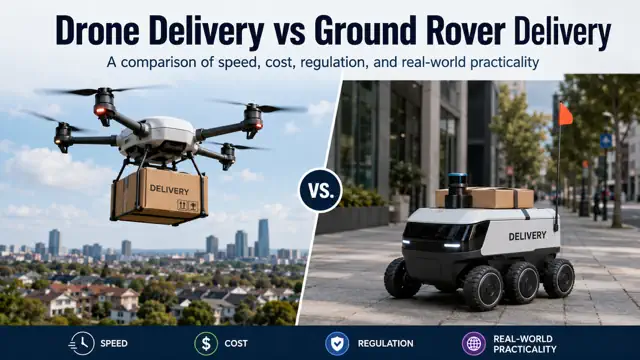
Drone delivery's greatest strengths are speed and terrain-crossing capability. Drones can bypass roads, rivers, and other ground-level obstacles, making point-to-point delivery highly efficient. However, the limitations are equally significant: payload capacity is restricted, performance is heavily weather-dependent, flight regulations in dense urban areas are complex, and concerns over noise and safety remain unresolved.
Ground delivery robots present an almost mirror-image profile. They travel on sidewalks or roadways, can carry heavier loads, are more tolerant of adverse weather, and integrate more naturally into existing urban infrastructure. That said, they face their own challenges: slower travel speeds, the need to navigate complex pedestrian and vehicle traffic, and reduced effectiveness in areas with rough terrain or underdeveloped road networks.
Real-World Deployments
Several operators have already launched commercial drone delivery services in select markets. Zipline, Wing (an Alphabet subsidiary), and Amazon Prime Air are among the leading players, focusing primarily on medical supplies, food, and lightweight parcels. On the ground robot side, companies such as Starship Technologies and Nuro have achieved scaled operations in certain city campuses and residential communities.
Neither model has yet achieved true mass-market penetration, and both are still searching for a reliably profitable business model.
Regulation: The Biggest Variable
For both drones and ground robots, the regulatory environment is the critical factor determining whether large-scale deployment is feasible. Drone delivery is subject to strict oversight by aviation authorities, and Beyond Visual Line of Sight (BVLOS) operating approvals remain a high bar in many countries. Ground robots, meanwhile, must contend with varying local traffic regulations — some cities have already enacted legislation restricting their use on public sidewalks.
Who Will Ultimately Win?
Industry analysts broadly agree that this competition is not necessarily a zero-sum game. In suburban areas, low-density residential zones, or scenarios requiring rapid medical supply delivery, drones may hold a clear advantage. In university campuses, dense urban neighborhoods, or fixed-route daily delivery applications, ground robots may prove more viable.
Ultimately, both technologies are likely to coexist, each delivering value in the environments best suited to its strengths — forming complementary layers of a future automated logistics ecosystem.
The true winner may not be either technology in isolation, but the logistics platform capable of intelligently integrating both.
原文來源: 查看原文
FAQ
Newsletter
Subscribe to our Low-Altitude Industry Newsletter
Daily curated news on low-altitude economy and drone industry, delivered to your inbox.
Reviewed and published by the LAETimes editorial desk ·