Senator Young Attends Indiana Spray Drone Demo Day — But the Flight Line Is Still Dominated by Chinese Brands
U.S. Senator Todd Young attended an agricultural spray drone demonstration at Purdue University's Southeast Agricultural Center in Butlerville, Indiana, using the event to promote the state's newly designated FAA UAS test site. Yet roughly 80% of U.S. agricultural spray drone sales belong to China's DJI, with other Chinese brands taking most of the remainder — a stark contrast to federal policies actively restricting Chinese drone equipment.
Highlights
- Senator Todd Young attended an Indiana Spray Drone Association demo day in Butlerville on June 8, 2025, using the event to promote Indiana's FAA UAS test site designated on January 8, 2026.
- DJI holds approximately 80% of U.S. agricultural spray drone sales; FAA-registered agricultural drones surged from roughly 1,000 in January 2024 to approximately 5,500 by mid-2025.
- The FCC placed all foreign-manufactured drones on its Covered List on December 22, 2025, blocking new DJI and Autel authorizations; Pentagon carve-outs expire January 1, 2027.
- Domestic manufacturer Hylio prices NDAA-compliant spray drones at $20,000–$85,000 versus the DJI Agras T50's ~$18,000 MSRP, and targets annual production of 5,000 units by 2028 — up from an estimated 500–1,000 today.
- The FAA's Part 108 BVLOS final rule missed its February 1, 2026 deadline; more than half of ~3,100 public comments focus on unresolved right-of-way disputes between drones and manned aircraft.
Senator Young Attends Demo Day, but the Flight Line Is Full of Chinese-Made Drones
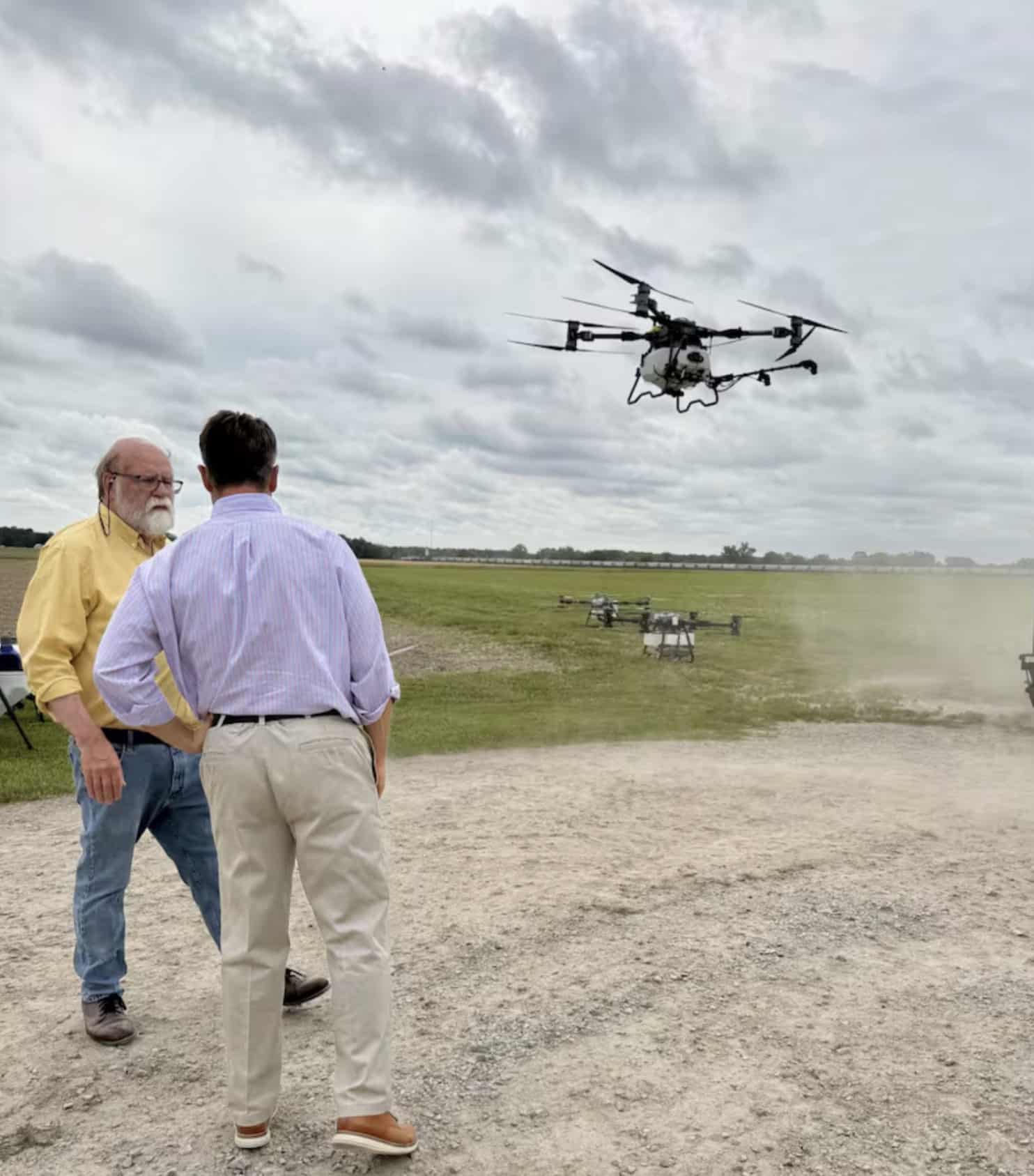
U.S. Senator Todd Young (R-IN) visited Purdue University's Southeast Agricultural Center in Butlerville on June 8 for an educational demonstration day hosted by the Indiana Spray Drone Association, watching agricultural spray drones operate at close range. These are the machines Indiana farmers rely on to seed and apply chemicals across thousands of acres of cropland. Young used the occasion to promote the state's newly established federal UAS test site.
"Drones continue to play a critical role in Indiana's agricultural industry, and Indiana's new UAS test site will help ensure our drone ecosystem can meet the industry's growing needs," Young said. He had championed the test site's application alongside Indiana's full congressional delegation last winter; it received its official designation in January of this year.
There is, however, a tension in this picture worth naming: approximately 80% of U.S. agricultural spray drone sales go to China's DJI, with most of the remainder split among other Chinese brands such as XAG, leaving domestic manufacturers a negligible slice of the market. Yet the same federal government that celebrated Indiana's new test site has spent the past six months systematically cutting off the supply of those very machines. A demonstration event populated largely by DJI Agras drones makes for a complicated backdrop to a policy aimed at weaning the United States off Chinese drone dependency.
Indiana Became the Ninth FAA UAS Test Site in January 2026
The Federal Aviation Administration formally designated the Indiana Economic Development Corporation and the Choctaw Nation of Oklahoma as new UAS test sites on January 8, 2026 — the first additions to the program in nearly a decade. The two new sites became the eighth and ninth members of the national network, which already includes sites in Alaska, North Dakota, New Mexico, Nevada, New York, Texas, and Virginia.
Secretary of Transportation Sean Duffy framed the decision in competitive terms at the time: "From delivering life-saving medicine to surveying pipelines, drones are reshaping industries and changing how people and goods interact. Our job is to make sure America leads the world in this exciting technology safely — not China." He added that the new sites would help the FAA "collect critical data, test new systems, and allow us to safely unleash innovation in the sky."
The FAA Reauthorization Act of 2024 authorized the FAA to designate up to two new test sites, while President Trump's "Unleashing American Drone Dominance" executive order accelerated the selection process. The sites focus on beyond visual line of sight (BVLOS) operations, increasingly autonomous missions, advanced air mobility (AAM), and counter-drone operations.
Indiana's Drone Credentials Are Rooted in Military Counter-UAS Capabilities
Indiana's designation rests primarily on defense infrastructure rather than agriculture. The state's application highlighted the Technology Readiness and Experimentation initiative at Camp Atterbury, restricted airspace at Muscatatuck Urban Training Center, and counter-UAS research at Naval Surface Warfare Center Crane. Purdue University anchors the academic component with the nation's first university-owned airport and one of the world's largest indoor motion-capture facilities.
The most compelling demonstration came in August 2025, when Epirus used its "Leonidas" high-power microwave system at Camp Atterbury to destroy a swarm of 49 drones with a single electromagnetic pulse. That capability is what put Indiana on the federal shortlist. The agricultural angle Young emphasized in Butlerville is genuine, but it is a supporting argument rather than the central case. The site's core mission points toward industrial logistics, energy infrastructure, and detect-and-defeat testing in service of national security requirements.
The Spray Drones on Display Are Under Pressure from an FCC Ban
Agricultural spray drones are among the fastest-growing tools in modern farming — and the market leader is a Chinese company. Research from Michigan State University indicates DJI holds approximately 80% of U.S. agricultural spray drone sales; FAA-registered agricultural drones surged from roughly 1,000 in January 2024 to approximately 5,500 by mid-2025. The Indiana Spray Drone Association, which organized the Butlerville event, exists to help these operations scale safely across the state. Yet the machines doing the work are under federal pressure.
The Federal Communications Commission placed all foreign-manufactured drones and components on its Covered List on December 22, 2025, blocking new equipment authorizations for DJI and Autel. Agencies including the Texas Department of Agriculture have warned that agriculture faces the harshest impact — existing Agras hardware can still fly, but replacement batteries are now Covered List items and import pathways are narrowing. Pentagon carve-outs for Blue UAS products and drones meeting a 65% domestic content threshold expire on January 1, 2027, and neither DJI nor Autel has any compliance pathway. A senator praising a "drone ecosystem" is effectively praising an industry being choked from the supply side by his own government's procurement rules and spectrum regulations.
Domestic Spray Drones Exist, but They Cannot Yet Fill the Gap
American solutions do exist, but their limitations deserve plain description. Texas-based Hylio manufactures NDAA-compliant agricultural drones in Houston, with entry-level units priced at roughly $20,000 and high-end systems reaching $85,000 — three to five times the cost of a DJI Agras T50 at an MSRP of approximately $18,000. Hylio CEO Arthur Erickson — the manufacturer theoretically most positioned to benefit from blocking Chinese competition — has himself called the FCC's sweeping ban "crazy" and "unexpected."
Capacity is an equally stubborn constraint. Hylio is expanding a 40,000-square-foot facility near Houston with a target of scaling annual production from an estimated 500–1,000 units today to 5,000 by 2028. Even at full capacity, that covers a fraction of DJI's current market share, and domestic manufacturers still source motors, batteries, and flight controllers from global supply chains also touched by the Covered List. An Indiana farmer who wants to fly American-made today can do so — at a higher price, with limited availability and longer lead times. That is a real option, but it is not a drop-in replacement for the existing fleet.
Spray Operators Are Still Waiting for Part 108 to Land
The test site Young celebrated exists partly to give the FAA the safety data it needs to finalize Part 108 — the regulatory framework that would legalize routine BVLOS flight without requiring case-by-case waivers. Agricultural spraying is among the operations covered, and many spray operators are already flying heavy drones above the Part 107 55-pound limit under individual waivers.
The rule is significantly overdue. The same executive order Duffy cited set a Part 108 final rule deadline of February 1, 2026; that date has passed with no final rule published. The FAA has reopened the comment period twice, most recently targeting right-of-way rules for drones sharing low-altitude airspace with manned aircraft. By the FAA's own count, more than half of approximately 3,100 substantive comments focus on that right-of-way dispute. Test sites can generate supporting evidence, but they cannot resolve the policy disagreements stalling the rulemaking.
DroneXL Analysis
This publication has tracked every step of the Part 108 rulemaking since the FAA's August 2025 notice of proposed rulemaking, and every development following the FCC's December 22, 2025 addition of all foreign-manufactured drones to the Covered List. Placing those two threads alongside a senator's photograph of spray drones lifting off over Indiana farmland makes the tension in Butlerville visible.
The test site is a genuine win for Indiana, and Young deserves credit for it. What is harder is the supply gap beneath the messaging. DJI accounts for roughly 80% of U.S. spray drone sales, and the nearest domestic alternative costs three to five times as much with a fraction of the production volume. Telling Indiana farmers that "America will lead the world in this technology" while simultaneously restricting the supply of the machines currently doing that work holds together on a podium but struggles to hold together in a field. Manufacturers like Hylio are building an American answer — but the honest version is that the answer is not yet ready at the scale and price point the 2027 deadline implicitly assumes.
Two things are worth watching: whether the FAA retains or retreats on the "presumptive right-of-way" provision in the Part 108 comment cycle this summer — if that language is scaled back, the timeline for commercial and agricultural BVLOS rules slips further — and whether the Blue UAS and domestic-content exemptions actually expire on January 1, 2027. Young was not asked, and did not answer, what Indiana spray operators are supposed to fly when the Agras fleet ages out and domestic production lines are still ramping up. That question matters more to farmers in Butlerville than any ribbon-cutting ceremony, and the federal government does not yet have an answer.
Sources: AgriNews, Federal Aviation Administration, Indiana Capital Chronicle.
DroneXL uses automated tools to assist with research and data retrieval. All reporting and editorial commentary is written by Haye Kesteloo.
原文來源: 查看原文
FAQ
Newsletter
Subscribe to our Low-Altitude Industry Newsletter
Daily curated news on low-altitude economy and drone industry, delivered to your inbox.
Reviewed and published by the LAETimes editorial desk ·