Automation vs. Autonomy: What Will Define the Future of Battlefield Drones?
As drone technology evolves rapidly on the modern battlefield, a critical question remains unresolved: where should the line between automation and autonomy be drawn? While human operators must retain control over kinetic decisions, granting drones greater autonomous capability in non-kinetic roles could serve as a decisive force multiplier for next-generation military operations.
Highlights
- Military and legal experts universally agree that human operators must remain in the decision loop for all kinetic (lethal or destructive) drone actions, as required by international humanitarian law.
- Drone autonomy in non-kinetic roles—including surveillance, swarm coordination, threat detection, and logistics—is widely recognized as a significant force multiplier for next-generation military operations.
- Automation executes pre-defined rules with high reliability but limited flexibility, while autonomy enables decision-making in unanticipated scenarios with greater adaptability but higher ethical risk.
- Fully autonomous lethal weapons systems remain one of the most contested issues in the international community, with no binding global consensus reached.
- The industry is actively developing 'human-centered autonomy' frameworks designed to boost operational effectiveness while preserving human control over critical battlefield decisions.
This is sponsored content.
Drone technology is advancing at an unprecedented pace on the modern battlefield. Yet amid the drive to enhance unmanned capabilities, one fundamental question remains unresolved: where exactly should the line between automation and autonomy be drawn?
Humans Must Stay in the Decision Loop
Despite rapid advances in artificial intelligence and machine learning, industry and military experts broadly agree that when it comes to kinetic decisions—strikes, lethal engagement, and other actions with destructive consequences—human operators must remain in the loop at all times.
This is not merely an ethical imperative; it is a foundational principle of international humanitarian law and the military doctrines of most nations. Fully autonomous lethal weapons systems remain one of the most hotly contested issues in the international community.
Autonomy as a Force Multiplier
That said, this does not render autonomy irrelevant on the battlefield. Quite the opposite: in non-kinetic mission domains, equipping drones with greater autonomous operating capability stands to become an undeniable force multiplier.
Specific applications include:
- Intelligence gathering and surveillance: Drones autonomously plan flight routes and continuously monitor target areas
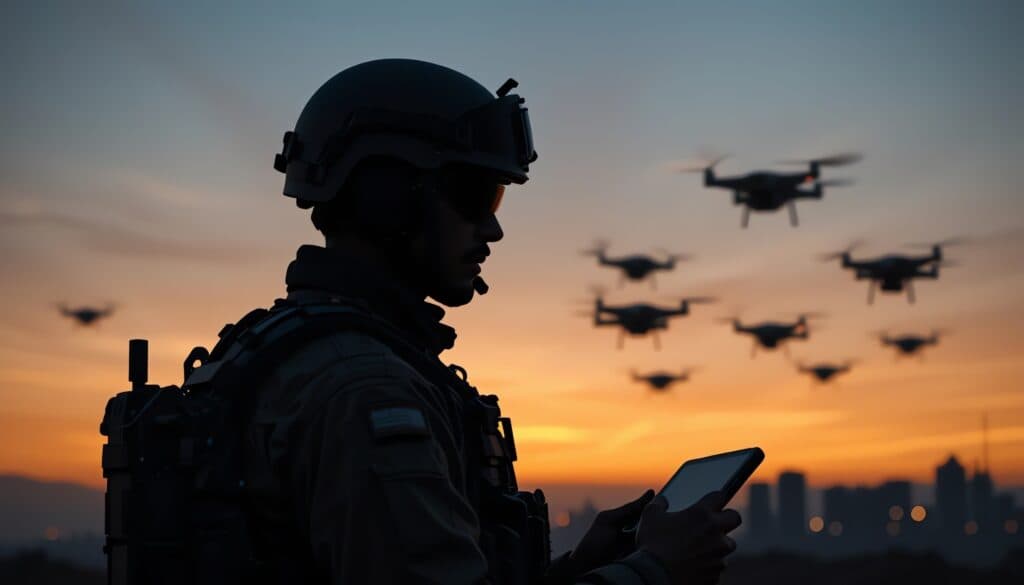
- Swarm coordination: Multiple drones coordinated by AI without requiring individual human commands
- Threat detection and early warning: Automatic identification of potential threats with alerts sent to human operators
- Logistics and resupply: Delivery of materiel in relatively secure environments
The Essential Difference Between Automation and Autonomy
Understanding the distinction between these two concepts is key to following the broader technology debate:
- Automation: A system executes specific tasks according to pre-defined rules, with human operators specifying responses to all anticipated scenarios in advance.
- Autonomy: A system can assess situations, make decisions, and act in scenarios that were not pre-programmed, possessing a degree of situational awareness and adaptability.
The former offers high reliability but limited flexibility; the latter holds enormous potential but carries equally significant risks and ethical challenges.
Looking Ahead
As battlefield environments grow increasingly complex, achieving the optimal balance between human oversight and machine autonomy will be the defining challenge for the next generation of military drones. The industry is actively exploring human-centered autonomy frameworks that aim to enhance operational effectiveness while ensuring humans retain ultimate control over critical decisions.
Automation delivers efficiency; autonomy delivers adaptability. The organic integration of both may prove to be the decisive edge for battlefield drones of the future.
原文來源: 查看原文
FAQ
Newsletter
Subscribe to our Low-Altitude Industry Newsletter
Daily curated news on low-altitude economy and drone industry, delivered to your inbox.
Reviewed and published by the LAETimes editorial desk ·