Taiwan Civilians Train on Drones to Prepare for Chinese Threat
Kuma Academy launched Taiwan's first civil defense drone training program in May 2026, deliberately removing GPS and auto-stabilization to simulate electronic warfare conditions. Around 75 people complete training monthly, with enrollment sold out through August. The initiative draws on Ukrainian combat experience and complements Taiwan's military drone battalions and a government procurement plan for over 50,000 domestically produced drones.
Highlights
- Kuma Academy launched Taiwan's first civil defense drone training program in May 2026, with approximately 75 civilians completing training per month and enrollment sold out through August 2026.
- The program deliberately removes GPS and auto-stabilization from sub-100-gram quadcopters to simulate electronic warfare jamming conditions, drawing directly on Ukrainian drone combat experience.
- Ukrainian military officials estimate drones now account for approximately 60% of Russian casualties, a statistic that directly informs Taiwan's civilian drone training philosophy.
- Taiwan's Executive Yuan has committed to procuring over 50,000 domestically produced drones through 2027, while the army established drone battalions in three regions in April 2026 with a fourth targeting Penghu County announced in June 2026.
- A $14 billion U.S. arms sale to Taiwan remains unsigned by President Donald Trump, adding urgency to Taiwan's push for domestic drone production despite opposition-led legislative budget cuts.
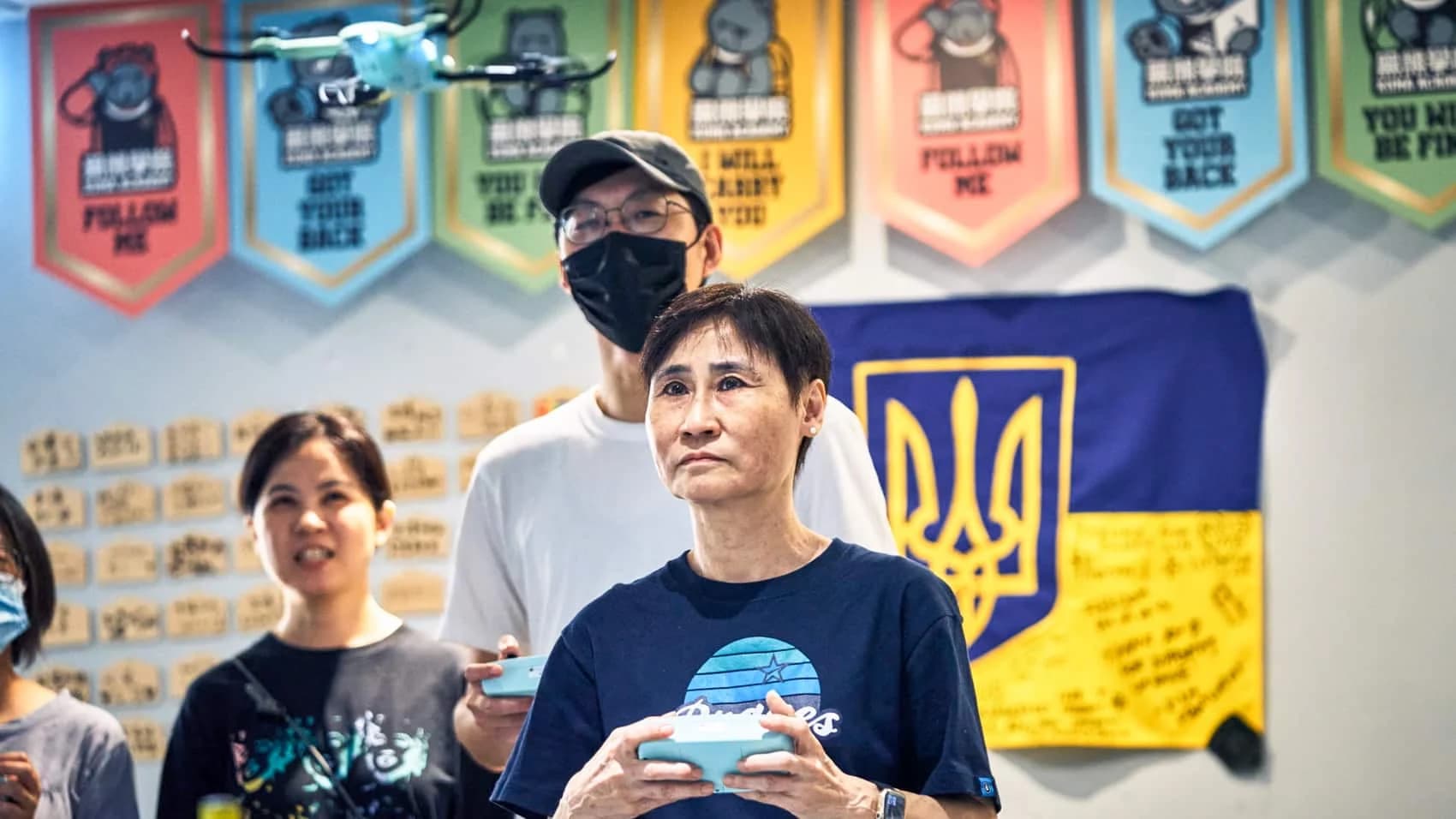
Pan Chien-chin had never flown a drone before May 2026. The 48-year-old food company employee walked into a small classroom in Taipei, picked up a Taiwan-made quadcopter weighing under 100 grams, and spent an entire afternoon learning to fly purely by feel and line of sight. No GPS. No autopilot. No stabilization assist.
That is not a design flaw — it is the entire point. Kuma Academy, the NGO running the course, has deliberately stripped out autonomous flight features. In an electronic warfare environment, the functions that make consumer drones easy to fly are precisely what an adversary will target first.
Spots fill almost immediately. As of mid-June 2026, enrollment is sold out through August.
Taiwan's Civilian Drone Training Is Built Around Real Threat Scenarios
Kuma Academy launched Taiwan's first civil defense drone training program in May 2026, with enrollment now filling two months in advance. Around 75 people complete training each month in groups of roughly 20; in recent cohorts, more than half of participants have been women.
Students range from teenagers to retirees. Karren Wang, 65, said her first session was "pretty good" and noted that even crashes draw applause: "Even if you crash terribly, they still say, 'Good job!'"
Kuma Academy spokesperson Tang Tsung-yi was direct about the program's purpose: training is designed to shift civilians "from passive defense — like taking shelter — to playing a more active role in observing risks and sharing information." This is not a combat mission. The focus is surveillance over mountainous terrain, search-and-rescue support, and real-time information relay in situations where foot patrols are slow and radio communications are unreliable.
As of December 2024, Taiwan had more than 39,000 registered drones. That same year, the Civil Aeronautics Administration lowered the minimum pilot registration age to 14. The operator base already exists; Kuma Academy is building on top of it.
Ukrainian Battlefield Data Is Shaping Taiwan's Training Philosophy
As reported by The Guardian, Kuma Academy's drone curriculum draws directly from Ukraine's experience — students bring it up unprompted. Pan Chien-chin said after his first flight: "The war in Ukraine really changed how drones are used." That observation is no longer abstract: Ukrainian military officials estimate drones now account for approximately 60% of Russian casualties.
Taiwan's civil defense movement currently includes more than 30 active volunteer-led organizations operating alongside government-backed programs. The drone course sits within a broader curriculum that also covers first aid and casualty evacuation training; it is not framed as weapons preparation. Instructor Tao Han's sessions focus on manual flight control, situational awareness operations, and basic reconnaissance logic.
Removing GPS is the program's most consequential technical decision. Consumer drones that rely on GPS assistance fail when subjected to electronic jamming; manually flown aircraft that do not depend on autonomous systems continue to operate. That trade-off is the lesson Ukrainian drone operators learned after 2022 — and what Kuma Academy teaches in Taipei.
I always say there are only two kinds of pilots: those who have already crashed, and those who are about to. Training pilots in GPS-denied Attitude (ATTI) mode under adverse conditions makes it far more likely they end up in the first category. That is real flying skill — not picking up a Mavic that does almost everything for you.
Taiwan's Drone Defense Extends Well Beyond the Classroom
Civilian training is one layer of a much larger defense buildup. Taiwan's army established drone battalions in northern, southern, and central regions in April 2026. A fourth drone battalion targeting the offshore Penghu County was announced in June 2026 with early-warning and blockade-countering capabilities and has entered active deployment.
The Executive Yuan has set a two-year procurement plan running through 2027 to order more than 50,000 domestically produced drones, applying the "expendable unit" logic that Ukraine developed after 2022: when battlefield attrition reaches thousands of units per month, production volume matters more than unit cost.
The civilian picture is more complicated. The legislature, controlled by opposition parties, recently passed a special defense budget that cut funding for domestic drone production — complicating Taiwan's push to establish a supply chain free of Chinese components at precisely the moment when demand for such alternatives is rising.
Taiwan retains some domestic weapons manufacturing capacity but remains heavily dependent on U.S. arms sales for major defense systems. President Donald Trump has yet to sign a $14 billion arms sale to Taiwan following his meeting with Chinese leader Xi Jinping in Beijing. Taiwan's defense planning must account for the possibility that committed equipment may not arrive on schedule.
What Kuma Academy teaches students to fly is none of the above hardware. The civilian program uses quadcopters under 100 grams — less than 3.5 ounces. For Pan Chien-chin, the political complexity does not change his calculation: "We can't change the larger environment," he said. "The only thing we can do is prepare ourselves as best we can."
DroneXL Editorial Perspective
The most interesting thing about this program is what it removes. Kuma Academy takes consumer drone technology, strips out the GPS and stabilization, and hands it to first-time fliers. The features that made commercial drones attractive to millions of hobbyists over the past decade are exactly what causes those drones to fail once jamming begins.
DroneXL has tracked the Ukrainian drone war since the full-scale invasion in February 2022. The shift from recreational FPV to combat-adapted manual flying happened within 18 months.
Taiwan is drawing the right lesson: a sub-100-gram quadcopter that a 65-year-old retiree can fly by feel and line of sight delivers operational value in a degraded electronic environment that a GPS-dependent consumer drone cannot.
The industry spent years selling convenience — automated drones that do everything for you. When it actually matters, those are often the least useful. You have to learn to fly manually, the way real pilots do.
Taiwan's 39,000-plus registered drones were almost certainly purchased for photography, inspection, or recreation. Kuma Academy's training does not replace them; it adds a different skill layer on top of the existing operator base. Whether that skill set is ever truly tested depends on decisions made in Beijing, Washington, and Taipei — none of which any drone course can influence.
Image credit: An Rong Xu
原文來源: 查看原文
FAQ
Reviewed and published by the LAETimes editorial desk ·