AI as Virtual Higher Command: The U.S. Army Command and General Staff College's LLM Training Experiment
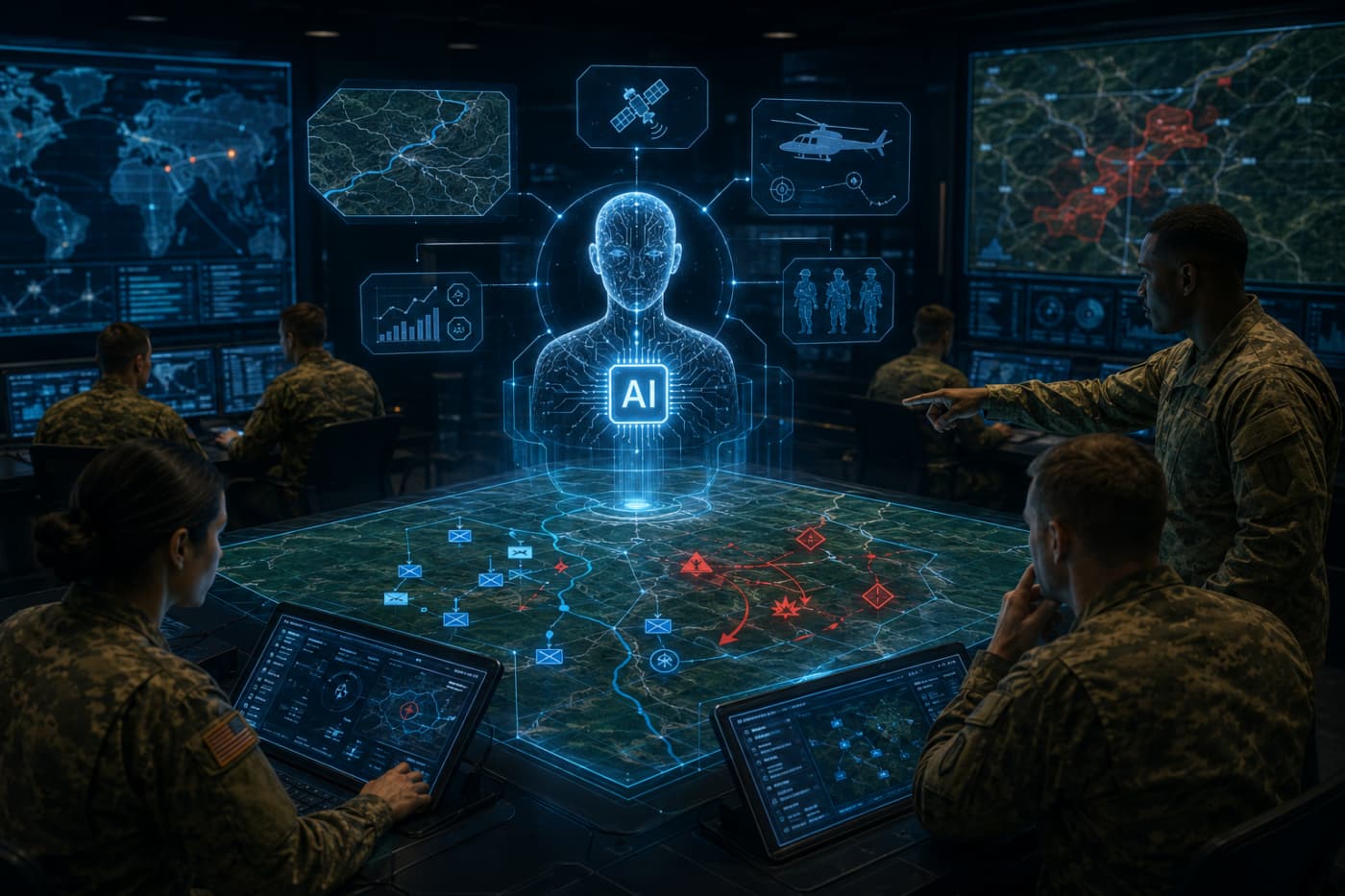
The U.S. Army Command and General Staff College (CGSC) conducted a two-week FY25 experiment with 61 students acting as 25th Infantry Division staff. Using the AI platform Vantage as a virtual corps-level headquarters, the exercise delivered battle damage assessments, intelligence updates, and targeting recommendations—addressing HICON resource shortfalls while warning against over-reliance on LLMs and the risks of automation bias.
Highlights
- CGSC conducted a two-week FY25 experiment in which 61 students acting as 25th Infantry Division staff used the Vantage AI platform as a virtual corps-level headquarters during a capstone LSCO exercise.
- The AI system operated with two separate knowledge ontologies—one covering Army doctrine and corps OPORD, the other integrating division briefing slides, HPTL, HVTL, and collection plans—to generate real-time BDA and intelligence updates.
- By day three of the exercise, iterative feedback loops caused the AI to produce 20-page intelligence summaries (up from fewer than three pages) and five-day predictive targeting recommendations.
- Faculty identified hallucination, escalatory bias, and automation bias as critical risks, warning that over-reliance on LLMs could erode the human deliberation needed to develop adaptive operational art.
- The CGSC concluded the concept is scalable to battalion-level tabletop exercises, enabling units to conduct AI-assisted staff training independently without requiring an actual higher headquarters.
AI as Virtual Higher Command: The U.S. Army Command and General Staff College's LLM Training Experiment
The evolving nature of warfare continues to push the Army to seek decisive advantages through technology. During fiscal year 2025 (FY25), faculty at the Command and General Staff College (CGSC) explored how artificial intelligence (AI) could meet training objectives at every echelon. Integrating AI into the execution phase of the Military Decision-Making Process (MDMP) represents the next frontier of that pursuit. A real-world application within the CGSC Advanced Operations Course's capstone Large-Scale Combat Operations (LSCO) exercise provides a concrete blueprint for how large language models (LLMs) can revolutionize simulation exercises as virtual higher headquarters—enabling units at any echelon to build staff proficiency on their own timeline without imposing on adjacent or higher units.
This article synthesizes findings from a two-week, 61-student practical exercise in which students served as 25th Infantry Division staff during a simulated exercise. Our exploration demonstrates that, with proper resourcing, AI can serve as a powerful cognitive collaboration partner, bridging the gap between limited manpower and the complex demands of division-level simulation.
Building the Framework: Resourcing AI for the MDMP
The initial phase involved constructing a digital battlespace that allowed AI agents to reason from the same doctrinal and operational documents used by human staff. Using the Vantage platform, we built a pipeline utilizing two separate knowledge ontologies. A "tactical ontology" aggregated all division-level information—from mission receipt through post-order combined arms rehearsals and continuous estimates across warfighting functions. An "operational higher headquarters ontology" incorporated prior-year intelligence and operational summaries to provide contextual background.
To ensure doctrinal fidelity, we validated the model's ability to cite field manuals covering operations, the MDMP, and Chinese tactics. By converting field manuals into structured ontology objects, the AI was able to parse complex operational inputs and simulate the cognitive load of a full planning staff.
Solving Resource Constraints: AI as the Higher Command (HICON)
A significant challenge in the exercise was the limited capacity of the Higher Command (HICON) cell. Responsible for managing corps-level deliverables for a division wet-gap crossing and forward passage of lines operation, and for continuously injecting Master Scenario Events List (MSELs) into the operational framework, the cell consisted of a single Medical Service (MS) officer with limited experience in targeting or intelligence collection integration. This officer was not a subject matter expert (SME) in intelligence collection (IC), targeting, or the combined arms integration of attack aviation, fires, and M2—creating friction points as division staff required continuous feedback on battle damage assessment (BDA) and collection planning to maintain training tempo.
Employing Vantage as a virtual corps headquarters transformed this constraint into a capability. By building an AI platform with two separate ontologies, the system could provide division staff across the planning, future operations (FUOPS), and current operations (CUOPS) cells with the information needed to plan across time horizons. One ontology referenced Army doctrine and the original corps base operations order (OPORD); the other integrated division briefing slides containing map positions, collection plans, the High-Payoff Target List (HPTL), and the High-Value Target List (HVTL). The AI generated enemy updates and provided real-time BDA on staff "kill contracts," enabling faculty to control exercise tempo while the AI absorbed the substantial cognitive burden of processing data for the division.
Dynamic Adjudication: AI Deliverables Across Echelons
The virtual headquarters went beyond basic feedback, helping provide updates, constraints, and new challenges to the rear, main, and tactical command posts—highly beneficial for training an entire staff. This was reflected in several high-value deliverables:
-
Operational Synchronization: The model provided 24-hour updates for three simulated divisions, allowing staff to understand how execution synchronizes across time and space. In one instance, a simulated adjacent division falling 12 hours behind prompted the AI to generate two new Priority Intelligence Requirements (PIRs) focused on potential seams between unit boundaries. It also enabled division staff to coordinate cross-boundary fire support missions and confirm effects through BDA, illustrating how properly resourced assets can support an entire corps as a system.
-
Multi-Source Intelligence Updates: The system generated geospatial, open-source, and signals intelligence updates based on course parameters, refined through existing ontologies. In one case, the AI generated a large-scale population displacement that sparked civil unrest in the division rear area, prompting supporting units to integrate their skills into the capstone exercise and allowing division staff to understand the full area of operations (AO) and provide recommendations to command.
-
Threat Assessment and Targeting: The AI assessed when enemy field artillery could mass fires and identified a new rocket system appearing near crossing sites, forcing the division intelligence element to focus on specific areas of concern and improve targeting effectiveness. The AI was also tasked with generating daily BDA for adjacent divisions, demonstrating how a corps sets conditions across the AO.
-
Significant Activity Reports: The model generated detailed reports on adjacent unit actions and offered recommendations for engineer support or obstacle reduction, driving refinement in both current and future operations.
Iterative Advantages: Predictive Analytics and Output Depth
The most significant finding of the exercise was the compounding effect of AI iterative learning. By day three—after feeding generated summaries back into the system as reference material—the AI began providing enemy order of march, tempo assessments, and recommended critical targets projected five days out. This simultaneously drove future operations planning and gave staff situational awareness of enemy activity across deep, close, and rear terrain.
Output depth also underwent a fundamental shift. Intelligence and execution summaries that rarely exceeded three pages in the past averaged 20 pages when produced by the model, incorporating updated commander's intent, close air support reallocation guidance, and a broad range of complex civil affairs issues.
Implications for the Force
This AI-assisted staff training experiment offers several important takeaways for the Army:
- Non-SME Force Multiplication: AI enables a single non-SME officer to produce high-quality, doctrinally sound guidance documents across multiple warfighting functions.
- Cross-Echelon Repetition: The concept can be scaled down to the battalion level. Staff can conduct tabletop exercises at home station, using the model to provide daily guidance—increasing repetitions and deepening analysis without relying on an actual higher headquarters.
- Training Autonomy: Units can schedule training on their own calendars, using AI to drive information flow, maintain a high training tempo, and refine plans in response to AI-simulated changes in the situation.
Risks of Over-Reliance on LLMs as Virtual Higher Headquarters
While LLMs functioning as virtual higher headquarters offer efficiency gains in resource-constrained training environments, they pose significant risks to doctrinal fidelity and professional military judgment. LLMs remain prone to hallucination—generating plausible but incorrect outputs for BDA, threat predictions, and PIRs even when supported by structured ontologies and doctrinal documents. Research into LLM use in wargaming consistently shows a tendency toward escalatory and aggressive postures that diverge from human expert judgment.
The "non-SME force multiplication" effect may foster automation bias, leading staff officers under time pressure to uncritically accept machine-generated deliverables—eroding the iterative human deliberation essential to developing adaptive operational art. Over-reliance on AI-assisted exercises therefore risks producing voluminous but superficial documentation that simulates analytical depth rather than genuinely cultivating the disciplined initiative and situational judgment demanded by multi-domain operations. Rigorous human oversight, validation protocols, and doctrinal safeguards are indispensable elements in ensuring AI augments rather than replaces the human element in staff training.
Conclusion
Integrating artificial intelligence into decision-making processes is today's reality and holds significant potential to increase the speed and depth of execution-phase simulation. By properly resourcing units with AI agents, the Army can ensure greater repetition and deeper analysis—leading to more rigorously tested plans and a staff more capable of handling the complexities of multi-domain operations.
The views expressed in this article are those of the authors and do not reflect the official policy or position of the Department of the Army, the Department of Defense, or the U.S. Government.
This article was originally published in Small Wars Journal, Arizona State University.
原文來源: 查看原文
FAQ
Reviewed and published by the LAETimes editorial desk ·