FAA Breaks Ground on Air Taxi Research Center in Oklahoma City
The U.S. Federal Aviation Administration has broken ground on a Vertical Takeoff and Landing Procedures and Analysis Range (V-PAR) in Oklahoma City. The facility, funded by $6 million from Congress and an $8.3 million construction contract, is designed to support flight testing, data analysis, and personnel training for Advanced Air Mobility (AAM) aircraft. Completion is expected by summer 2026.

Highlights
- The FAA broke ground on the V-PAR facility in Oklahoma City this week, with completion targeted for summer 2026.
- Congress approved $6 million in funding for V-PAR in 2024; the FAA also signed an $8.3 million construction contract in March 2025.
- V-PAR is specifically designed for larger AAM aircraft such as passenger air taxis, distinguishing it from existing FAA-designated UAS test sites for small drones.
- The facility will be located at the Mike Monroney Aeronautical Center adjacent to Will Rogers World Airport (KOKC), leveraging existing radar infrastructure.
- A 2024 FAA study found some VTOL aircraft can generate rotating air columns at up to 97 km/h (60 mph) at approximately 30 meters distance — a key safety issue V-PAR will investigate.
Contractors for the U.S. Department of Transportation (DOT) broke ground this week in Oklahoma City on a new facility that officials say will serve as a dedicated testing site for electric and hybrid-electric aircraft technologies.
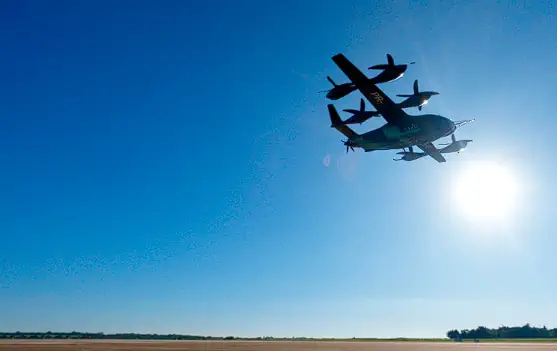
Unlike the multiple FAA-designated UAS test sites established across the country for small drones, the FAA's Vertical Takeoff and Landing Procedures and Analysis Range (V-PAR) is designed for larger aircraft — including passenger-carrying air taxis.
According to official documentation, construction is expected to be completed by summer 2026. Neither the documentation nor accompanying press releases identify any tenants or users, but like existing UAS test sites, the facility is expected to be open to commercial developers of air taxis and other Advanced Air Mobility (AAM) aircraft.
The FAA noted that activities at the site will include "coordination with air traffic control facilities and other aircraft."
Filling a Critical Regulatory Gap
One of the V-PAR's core objectives is to develop standards and procedures for AAM — a regulatory area the FAA has yet to fully resolve. The agency issued a Special Federal Aviation Regulation (SFAR) in 2024 establishing preliminary pilot training and operational requirements for powered-lift aircraft, including air taxis, covering the next 10 years, but permanent rules have yet to be established.
Building research and testing capacity for AAM aircraft is a key element of the AAM National Strategy blueprint released in December, which aims to position the United States as a global leader in the sector.
DOT Deputy Secretary Steven Bradley said in a statement that V-PAR is "a critical step in helping the FAA better understand how to safely integrate advanced air mobility aircraft into the National Airspace System."
FAA Deputy Administrator Chris Rocheleau added: "As advanced air mobility technology continues to evolve, the FAA must ensure it meets the same high safety standards of the National Airspace System. V-PAR will help us gather data and operational insights to support the safe integration of these aircraft into the national airspace."
Facility Overview and Location
The facility will be built at the FAA's Mike Monroney Aeronautical Center in Oklahoma City — the agency's primary hub for training, research, and certification, and home to air traffic controller training, the FAA Logistics Center, the Civil Aerospace Medical Institute, and the FAA Academy.
According to the documentation, V-PAR will be situated on the western side of the campus, adjacent to Will Rogers World Airport (KOKC), allowing users to take advantage of existing radar infrastructure and facilities in the area.
Funding and Construction Scope
Officials began studying the V-PAR concept as early as 2021. Congress appropriated $6 million for the project in 2024, and the FAA signed an $8.3 million construction contract in March of this year. The source of the additional $2.3 million has not been publicly disclosed.
The documentation states: "By consolidating real-world flight testing, data analysis, standards development, and personnel training within a single campus, V-PAR will drive more efficient integration operations and enhance FAA safety management priorities."
V-PAR Research Scope
Once completed, V-PAR will give the FAA a centralized site for flight testing, data analysis, and AAM workforce training. Researchers will simulate AAM traffic flows and study topics ranging from approach and departure routes to emergency response plans. The facility will also be used to assess radio-frequency interference that could disrupt the digital systems of automated aircraft, and to evaluate the safety of VTOL rotors by analyzing wake spacing and downwash. According to a 2024 FAA research report, some VTOL aircraft types were found capable of generating rotating air columns at speeds of up to 97 km/h (60 mph) at a distance of approximately 30 meters (100 feet).
Initial infrastructure at V-PAR will include a vertiport, taxiways, aprons, a covered hangar, electric charging systems, lighting, utilities, and a central control facility. Future expansion could add additional VTOL pads, charging equipment, and a short takeoff and landing (STOL) runway.
U.S. AAM Test Network Continues to Expand
The FAA is also constructing a Center for Advanced Aviation Technology (CAAT) in Texas, which will feature demonstration areas and test corridors for both drones and air taxis. Surf Air Mobility, the first Part 135 operator to join CAAT, announced in May that members would receive priority access to FAA-assigned missions, working groups, and research.
At the state level, Florida's Suntrax AAM test facility is also under active development. Once complete, Suntrax will feature what is expected to be the nation's first AAM test runway at approximately 1.6 km (1 mile) in length, along with a vertiport, hangar, and charging infrastructure.
Looking ahead, AAM developers are preparing to move their aircraft from controlled test environments into the real world. The FAA's eVTOL Integration Pilot Program (eIPP) will open airspace across 26 states for pre-certification flight operations, with manufacturers expected to conduct airport-based flights alongside live air traffic controllers. These activities are set to continue for at least three years, with V-PAR providing the FAA a more controlled environment in parallel to refine procedures for complex traffic scenarios.
This article was updated at 3:55 p.m. ET on June 27, 2025, to include additional information provided by the FAA.
原文來源: 查看原文
FAQ
Reviewed and published by the LAETimes editorial desk ·