Airborne RF Geolocation Technology: Applications in Counter-UAS and Electronic Warfare Operations
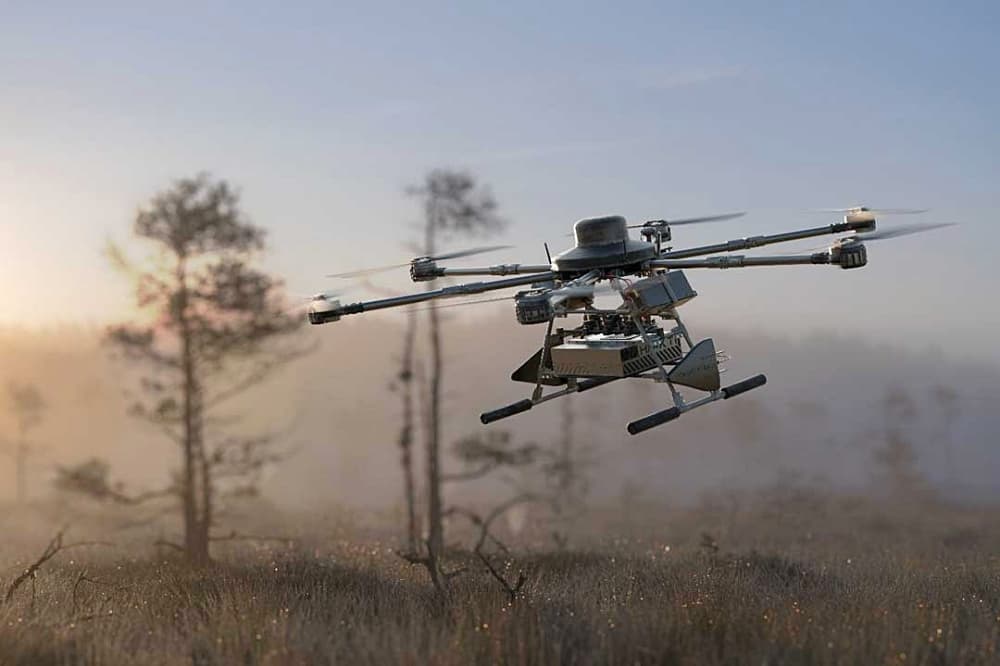
Ground-based RF sensors struggle to locate drone operators concealed behind terrain features. The AARTOS Airborne RF Geolocation System addresses this critical capability gap by mounting advanced signal-detection hardware on aerial platforms—helicopters, fixed-wing aircraft, or large drones—enabling dynamic triangulation, passive geolocation, and integration with electronic countermeasures (ECM) to track and neutralize drone operators in complex operational environments.
Highlights
- AARTOS is a passive airborne RF geolocation system designed to locate drone operators concealed up to 2 km behind terrain features that defeat ground-based sensors.
- Mounting the system on helicopters, fixed-wing aircraft, or large drones provides a top-down detection geometry that overcomes terrain masking and dramatically extends effective range.
- AARTOS operates without emitting signals, maintaining electronic silence while performing real-time RF signal analysis and cross-referencing against a known drone signal database.
- Geolocated operator coordinates can be used for directional jamming, cueing kinetic strikes, or continuous threat intelligence collection within an electronic warfare framework.
- Conflicts in Ukraine and the Middle East have demonstrated that low-cost commercial and modified attack drones are reshaping battlefields, making airborne counter-UAS detection capabilities increasingly critical.
Airborne RF Geolocation: A New Dimension for Counter-UAS and Electronic Warfare Operations
Imagine a drone swarm conducting a low-altitude attack, exploiting terrain masking to evade detection. Ground-based radio frequency (RF) sensors pick up the signals—but the operator is concealed two kilometers behind a ridgeline, completely out of reach of any ground sensor.
This is no longer a hypothetical scenario. It is a real tactical challenge on today's battlefields, and it is precisely the capability gap that the AARTOS Airborne RF Geolocation System is designed to fill.
The Inherent Limitations of Ground-Based Sensors
Conventional ground-deployed counter-UAS systems have significant blind spots in complex terrain. Hills, buildings, and vegetation can all allow drone operators to evade detection with ease. Even when a sensor successfully captures an RF signal, tracing it back to the operator's actual location remains extremely difficult.
This tactical vulnerability is widely exploited in modern asymmetric warfare, making it an urgent problem for military units and security forces worldwide.
The Tactical Advantages of Airborne Platforms
Mounting an RF geolocation system on an aerial platform—such as a helicopter, fixed-wing aircraft, or large drone—fundamentally changes the geometry of detection:
- Overcoming terrain masking: Airborne platforms can look down over terrain obstacles, dramatically extending effective detection range.
- Dynamic geolocation: A moving airborne system can continuously collect signal measurements from multiple vantage points, enabling precise triangulation.
- Rapid response and flexible deployment: Aerial platforms can reach threat hotspots far more quickly and flexibly than fixed ground sensor networks.
- Electronic warfare integration: Airborne platforms can simultaneously perform detection, identification, and electronic countermeasure (ECM) missions.
Core Capabilities of the AARTOS System
AARTOS (Airborne Advanced RF Target Observation System) is purpose-built to counter modern drone threats. Its core functions include:
RF Signal Analysis: The system continuously scans and analyzes frequency bands commonly used by drones, identifies control signals and telemetry data, and cross-references them against a database of known drone signal profiles—all in real time.
Passive Geolocation: AARTOS geolocates targets entirely passively, without emitting any signals of its own. This preserves the platform's electronic silence and avoids revealing its presence to adversaries.
Multi-Platform Integration: AARTOS is designed to be compatible with a wide range of aerial vehicles and can be flexibly configured for manned or unmanned platforms depending on mission requirements.
Integration with Electronic Warfare Operations
Within an electronic warfare (EW) framework, airborne RF geolocation is not merely a defensive tool—it is a critical intelligence source for offensive electronic operations. Once a drone operator has been precisely located, forces can take a range of follow-on actions:
- Directional jamming: Apply focused electromagnetic interference toward the operator's position to sever their control link to the drone.
- Cueing kinetic strikes: Pass the geolocated coordinates to ground or air strike assets for physical engagement.
- Intelligence collection: Continuously track the operator's movement patterns to build a threat intelligence profile.
An Urgent Requirement on the Modern Battlefield
The conflict in Ukraine and multiple incidents across the Middle East have made clear that low-cost commercial drones and modified attack UAVs have become significant factors reshaping the battlefield. In the face of this threat, reliance on ground sensor networks alone is no longer sufficient.
Airborne RF geolocation technology represents a significant milestone in the evolution of counter-UAS capabilities. By extending the detection envelope from a two-dimensional plane into three-dimensional space, it enables truly comprehensive tracking and geolocation of drone operators across all terrain types.
As drone tactics continue to evolve, systems that integrate airborne detection with electronic warfare capabilities are expected to play an increasingly central role in the counter-UAS architectures of military and security forces around the world.
原文來源: 查看原文
FAQ
Reviewed and published by the LAETimes editorial desk ·