Ukraine Explores Airbike and Flying Buggy Concepts for Rapid Front-Line Troop Deployment
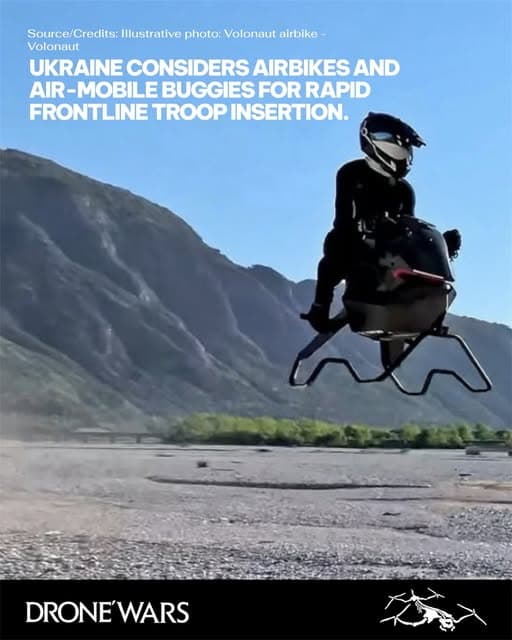
Ukraine is evaluating the development of an Airbike and an Air-mobile Buggy to rapidly insert soldiers into front-line positions while reducing detection risk. Brave1 platform director Andrii Hrytseniuk confirmed the concepts could receive grant funding. Both vehicles are envisioned with optionally unmanned capability, allowing autonomous return to base after troop drop-off.
Highlights
- Ukraine's Brave1 platform director Andrii Hrytseniuk confirmed that Airbike and Air-mobile Buggy concepts are eligible for Brave1 grant funding.
- Both flying platforms are designed with Optionally Unmanned System (OUS) capability, enabling autonomous return to base after troop delivery.
- The vehicles aim to solve front-line mobility challenges by bypassing terrain obstacles and reducing detection risk compared to ground vehicles.
- Planned mission profiles include rapid force insertion into contested sectors and special forces deep-penetration operations.
- International precedents include the Polish jet-powered Volonaut Airbike and the Swedish all-electric Jetson ONE personal aerial vehicle.
Ukraine is actively evaluating the development of an Airbike and an Air-mobile Buggy — flying platforms designed to rapidly transport troops to front-line positions while minimising the risk of detection.
Brave1 Grant Programme Could Fund Development
Andrii Hrytseniuk, director of Brave1 — Ukraine's defence technology integration platform — stated that both concepts are eligible for funding through the organisation's grant programme. Brave1 has long supported the research, development, and commercialisation of promising military technology start-ups, providing resources to innovative defence projects across Ukraine.
Addressing the Front-Line Mobility Problem
The flying platforms have been proposed in direct response to the growing challenge of moving personnel across front-line positions without being detected. Conventional ground vehicles face significant limitations on the modern battlefield: restricted manoeuvrability and high vulnerability to drone surveillance and artillery targeting systems. Aerial vehicles, by contrast, could bypass terrain obstacles and dramatically reduce transit times.
Optionally Unmanned System Design
Both the Airbike and the Air-mobile Buggy are expected to incorporate an Optionally Unmanned System (OUS) architecture. This means that after delivering soldiers to their destination, the vehicles would be capable of autonomously returning to base without requiring a human pilot for the return journey.
Anticipated mission profiles include:
- Rapid force insertion: Quickly placing soldiers into contested front-line sectors
- Special operations support: Enabling special forces units to conduct deep-penetration missions
International Precedents Exist
Although Ukraine has not yet unveiled any operational system, comparable concepts have already emerged internationally. Notable examples include Poland's jet-powered Volonaut Airbike and Sweden's all-electric Jetson ONE, both of which represent leading commercial approaches to personal aerial vehicles.
Sources: Militarnyi / Brave1; Image: Volonaut Airbike — Volonaut
原文來源: 查看原文
FAQ
Reviewed and published by the LAETimes editorial desk ·