Ukraine Is Mounting Attack Drones on Everything — Including Black Sea Robot Warships
Ukraine has upgraded its iconic 'Sea Baby' uncrewed surface vessel into a launch platform for fiber-optic-guided FPV attack drones, carrying 6–8 drones with a 1,500 km range. U.S. Special Forces used the Ukrainian Magura USV for the first time in the Indo-Pacific during Balikatan 2026 exercises, while the Pentagon studies Ukraine's innovations for potential China contingencies.
Highlights
- Ukraine's SBU-operated Sea Baby USV can carry 6–8 fiber-optic-guided FPV drones and has a 1,500 km range with a 2,000 kg payload.
- U.S. Special Operations Forces used a Ukrainian Magura USV to sink a target vessel during Balikatan 2026 exercises in the Philippines on June 24, 2026 — the first Indo-Pacific deployment of the technology.
- Ukrainian USVs have sunk or seriously damaged approximately a dozen Russian warships since 2022, each vessel costing only a few hundred thousand dollars.
- The U.S. Navy plans to deploy thousands of small uncrewed surface vessels across the Indo-Pacific by 2030, drawing directly on Ukrainian combat experience.
- Ukraine's 'Sub Sea Baby' underwater drone struck an Improved Kilo-class submarine inside Novorossiysk harbor on December 15 — assessed as the first such strike by an unmanned underwater vehicle in port.
Kyiv, Ukraine — Ukraine is already renowned for its iconic uncrewed surface vessels (USVs) — the same craft that drove the Russian fleet from the western Black Sea — and has now evolved them into launch platforms for first-person view (FPV) attack drones, significantly extending Kyiv's strike reach.
Sea Baby: The Upgraded Multi-Role Strike Vessel
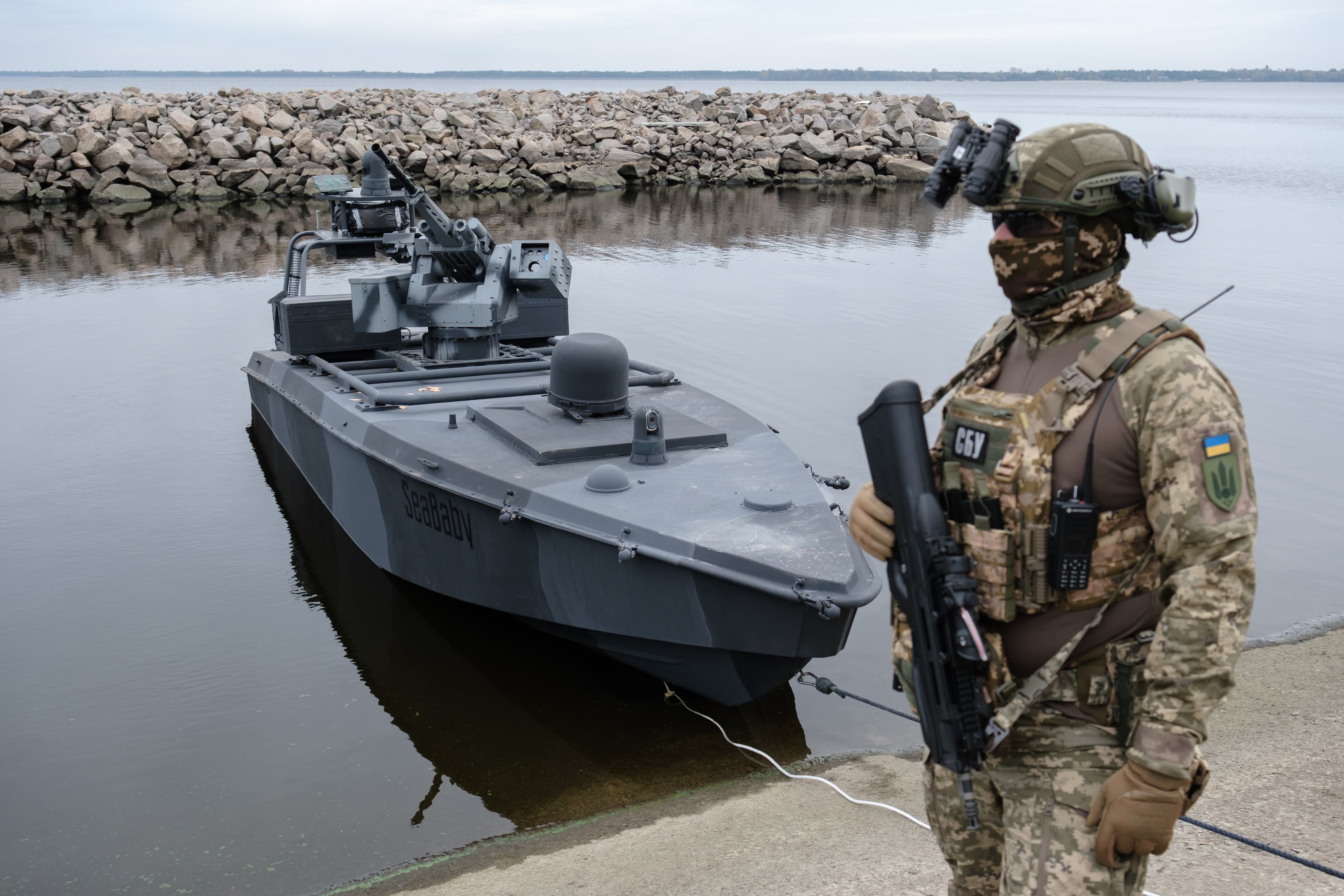
According to Forbes, citing Russian reports of a USV spotted near Kinburn Spit approximately 64 kilometers east of Odesa, the Security Service of Ukraine (SBU)-developed and operated 'Sea Baby' strike vessel can now carry 6–8 FPV drones in compartments on either side, alongside thermobaric 'Shmel' rockets. These compartments open automatically during an attack run.
Ukrainian officials emphasize that autonomous USVs can close the distance to Russian positions far more effectively than land-based launchers. SBU-published figures indicate the Sea Baby, carrying approximately 2,000 kg (4,400 lbs) of payload, has a range of 1,500 km (930 miles). Some of the embarked drones use fiber-optic guidance, rendering them resistant to Russian radio-frequency jamming and effectively immune to electronic warfare countermeasures.
Ukraine has converted almost every available combat platform into an FPV drone launcher. USVs armed with fiber-optic FPV drones struck the Russian ports of Tuapse and Novorossiysk in September; multiple vendors have converted ground robots into FPV launch platforms; and both sides have even deployed balloons to carry and release FPV drones over the battlefield.
"The SBU is the first organization in the world to pioneer this new model of naval warfare," Brigadier General Ivan Lukashevych said at the October 2025 unveiling of the next-generation Sea Baby. "We will continue to advance this technology."
Ukraine's Two Distinct USV Families
Ukraine currently fields two distinct uncrewed surface vessel families:
- Sea Baby: Developed and operated by the SBU (Ukraine's domestic security service).
- Magura: Built by Uforce for the GUR (Ukraine's military intelligence directorate) — an entirely separate system with its own development lineage and export pathway.
The Sea Baby is primarily controlled via mobile ground stations, but also carries AI-assisted targeting and navigation systems capable of autonomous operation when communications are jammed or severed — a critical feature designed for Russia's high-intensity electronic warfare environment.
U.S. Forces Put the Technology to Work
U.S. Special Operations Forces used a Ukrainian Magura USV to sink a target vessel during the Balikatan 2026 exercises in the Philippines on June 24, 2026, marking the first operational use of the technology in the Indo-Pacific.
The interest is far from casual. A low-cost, expendable vessel capable of delivering a batch of attack drones within strike range is precisely the type of weapon the United States is seeking as it prepares for a potential conflict with China across the vast expanses of the Pacific.
"Magura's success on the Ukrainian front has demonstrated its value for the Indo-Pacific," Oleg Roginsky, CEO of Uforce — the London-based startup that manufactures the Magura — told Bloomberg last week.
Roginsky revealed that Uforce is in talks with potential buyers in the Indo-Pacific region and is considering establishing at least two production facilities there. Ukraine banned weapons exports from 2022 to ensure materiel remained on the front lines, only beginning to open its arms export market in 2025.
An Impressive Combat Record at a Fraction of the Cost
According to a September report by the U.S. Naval Institute (USNI), Ukrainian USVs have sunk or seriously damaged approximately a dozen Russian warships since 2022, forcing the Black Sea Fleet to relocate its primary operating base to Novorossiysk.
Each vessel costs only a few hundred thousand dollars — a fraction of the price of a single modern torpedo.
The Pentagon Is Paying Close Attention
The Pentagon is studying these lessons with one eye on a potential China contingency. Captain Garrett Miller, commander of Surface Development Squadron One (SURFDEVRON 1), stated at a naval symposium on April 20 — as reported by USNI News — that the U.S. Navy plans to deploy thousands of small uncrewed surface vessels across the Indo-Pacific by 2030.
A July report by the Center for Strategic and International Studies (CSIS) also urged the U.S. military to emulate Kyiv's procurement model, noting that "unlike theoretical models or peacetime trials, Ukraine's innovations in defense acquisition have been validated in actual combat."
Underwater Breakthroughs and NATO's Lessons Learned
Ukraine's pace of innovation shows no signs of slowing. The SBU announced that its 'Sub Sea Baby' uncrewed underwater vehicle struck an Improved Kilo-class submarine at Novorossiysk harbor on December 15 — the first time in history that an uncrewed underwater vehicle has struck a submarine inside a port.
Russia denied any damage, but satellite imagery the following day showed a 9-meter-wide crater on the dock, the submarine visibly listing, and the vessel — later confirmed as B-271 Kolpino — still moored and immobile more than a month later. Ukrainian and independent analysts assessed the strike as a mission kill.
NATO has also begun absorbing Ukrainian tactics. At the REPMUS maritime drone exercises held in Portugal, the Ukrainian Navy served as NATO's Red Team commander for the first time, defeating the Alliance's Blue Team in all five scenarios during the September exercises — a historic first.
原文來源: 查看原文
FAQ
Reviewed and published by the LAETimes editorial desk ·