Drone-Mounted Imaging System Detects Underwater Unexploded Ordnance with Remarkable Precision
Researchers at the University of Miami's Rosenstiel School have developed a novel airborne imaging system combining advanced multispectral sensing and artificial intelligence to detect unexploded ordnance (UXO) in shallow coastal waters. Integrating NASA's Fluid Lensing and MiDAR technologies aboard a drone, the system successfully identified all test munitions during trials over the Florida Keys. Findings have been published in Frontiers in Marine Science.
Highlights
- University of Miami's Rosenstiel School developed a drone-mounted system combining NASA Fluid Lensing and MiDAR multispectral sensing to detect underwater UXO in shallow coastal waters.
- An AI machine learning model trained on drone imagery successfully identified 100% of test munitions at Broad Key in the Florida Keys, even after weeks of biofouling and sediment cover.
- The system overcomes the core limitation of shallow-water UXO detection by correcting wave-induced light distortion in real time, where conventional sonar and cameras typically fail.
- Existing UXO detection methods — including diver surveys and acoustic vessels — cannot safely operate in water shallower than ten metres, making airborne drones a critical alternative.
- The research has been published in Frontiers in Marine Science, with future testing planned across diverse environments including turbid Atlantic and deep Pacific waters.
Drone-Mounted Imaging System Detects Underwater Unexploded Ordnance with Remarkable Precision
Researchers at the University of Miami's Rosenstiel School of Marine, Atmospheric, and Earth Science have unveiled a breakthrough airborne imaging technology capable of precisely detecting submerged weapons, marking a significant advance in global coastal security.
The new airborne imaging system combines advanced multispectral sensing with artificial intelligence, purpose-built for the detection of unexploded ordnance (UXO) in shallow-water environments.
"Unexploded ordnance in shallow water remains a serious global challenge. Our results demonstrate a scalable airborne solution that can improve detection accuracy and help create safer coastal environments," said Ved Chirayath, Wittekind Endowed Chair Professor of Earth Sciences and Chair of the Department of Ocean Sciences.
Drones Paired with NASA Space Technology
Decades of global conflict have left a chilling legacy beneath the water's surface: undetonated bombs, mines, and artillery shells lying silently in shallow coastal zones, posing serious threats to divers, marine life, and shipping lanes.
Locating these hazards has historically been both difficult and costly. Conventional sonar often fails in shallow water, while standard cameras are rendered ineffective by shifting sands and wave-induced light refraction.
The single greatest obstacle to mapping shallow seafloors is the water itself — ocean waves act as moving lenses, distorting light and blurring underwater imagery.
To overcome this surface interference, a research team led by Ved Chirayath flew drones over the Florida Keys while simultaneously deploying two advanced NASA-derived technologies.
The first is Fluid Lensing — a custom algorithm that corrects in real time for wave-induced image distortion, producing sharp, high-resolution imagery of the seafloor. The second is MiDAR, an active multispectral sensing system that projects multiple wavelengths of light through the water column to illuminate the otherwise dark marine environment below.
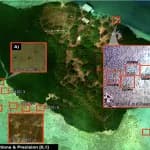
During the trials, the team placed inert test munitions and decoy objects on the seafloor around Broad Key, a research island in the northern Florida Keys.
Detecting a munition that has just sunk is relatively straightforward — finding one that has been corroding underwater for fifty years is an entirely different challenge. Over decades, tidal currents shift surrounding sediment, while marine growth such as algae colonises the surface of devices, allowing them to blend seamlessly into the natural reef environment.
To address this, researchers fed high-resolution drone imagery into a machine learning model. The AI system was trained to recognise the characteristic geometric profiles of munitions and distinguish them from natural coral, rock, and debris.
Results showed that the system successfully identified every single test target — without exception — even after weeks of biofouling and sediment accumulation had significantly obscured them.
Building Safer Coastal Environments
The implications of this technology extend well beyond Florida's coastline. UXO left behind from European battlefields and Pacific disposal sites continues to pose serious hazards — steadily leaching toxic chemicals into fragile ecosystems and frequently disrupting critical coastal infrastructure projects.
Existing UXO detection methods are slow and limited in scope: divers face extreme personal risk, while acoustic survey vessels cannot safely operate in water shallower than ten metres. Airborne drones offer a rapid and safe alternative, capable of covering vast stretches of coastline in a single flight.
Despite the high accuracy achieved in initial trials, researchers note that the system must be tested across a broader range of marine environments — from turbid Atlantic waterways to deep Pacific bays — before wider deployment.
The study has been published in Frontiers in Marine Science.
原文來源: 查看原文
FAQ
Newsletter
Subscribe to our Low-Altitude Industry Newsletter
Daily curated news on low-altitude economy and drone industry, delivered to your inbox.
Reviewed and published by the LAETimes editorial desk ·