Ukrainian Drones Strike Saki Air Base in Crimea, Six of Seven Hardened Hangars Damaged
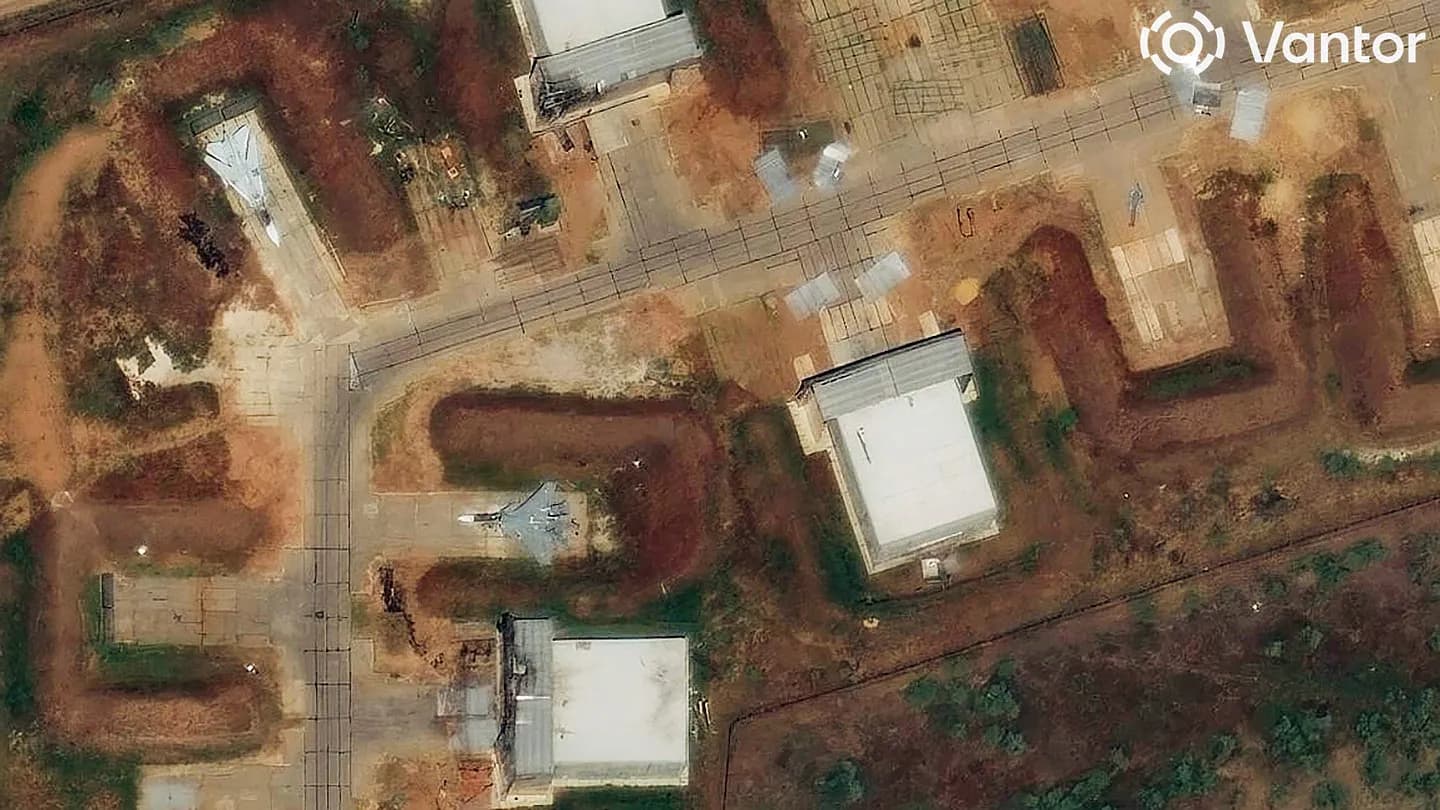
Ukraine's Security Service (SBU) launched a drone strike on Russia's Saki Air Base in Crimea. Satellite imagery provided by Vantor confirms damage to six of seven hardened aircraft shelters, with four hangar doors blown off. The SBU claims at least seven Su-30SM, Su-30, and Su-24 aircraft were destroyed or damaged in strikes conducted on Friday and Wednesday, as part of Ukraine's broader campaign to pressure Russia over Crimea.
Highlights
- Ukraine's SBU conducted drone strikes on Saki Air Base in Crimea on Friday, claiming at least seven Su-30SM, Su-30, and Su-24 aircraft were destroyed or damaged across two separate attacks.
- Satellite imagery from Vantor confirms six of seven hardened aircraft shelters at Saki sustained damage, with four hangar doors blown completely off and debris on the taxiway.
- Saki Air Base is the home base of Russia's 43rd Independent Naval Attack Aviation Regiment and has been a recurring high-priority target for Ukraine since the start of the war.
- Russian Reserve Colonel Viktor Murakhovsky disclosed participation in a 'Crimea Alert' exercise simulating a Ukrainian landing on Crimea, involving drone swarms, precision weapons, and small high-speed watercraft.
- Ukraine's sustained asymmetric campaign — combining air drones, maritime drones, and commando raids — has effectively forced Russia's Black Sea Fleet out of Crimea and degraded military infrastructure across the peninsula.
Ukrainian Drones Strike Saki Air Base in Crimea, Six of Seven Hardened Hangars Damaged
Ukraine's Security Service (SBU) launched a drone strike on Russia's Saki Air Base in Crimea on Friday. The attack is the latest in a series of Ukrainian strikes targeting Russian aviation and logistics infrastructure on the peninsula, and forms a key component of President Volodymyr Zelensky's broader strategy to pressure Vladimir Putin into ending the war.
SBU Claims Multiple Combat Aircraft Destroyed
The SBU stated that Friday's strike, combined with a separate attack on Wednesday, destroyed several Russian tactical combat aircraft. Saki Air Base is home to Russia's 43rd Independent Naval Attack Aviation Regiment, which operates Su-30SM Flanker fighters. The base has long been a priority target for Ukraine and suffered a devastating strike early in the war.
"Seven hangars at Saki airfield containing aviation equipment — including Su-30SM, Su-30, and Su-24 fighters and frontline bombers — were struck," the SBU said. "According to preliminary information, at least seven aircraft were destroyed or damaged."
Satellite Imagery Confirms Hangar Damage
With the SBU unable to provide visual evidence of the attack, this outlet contacted satellite imagery firm Vantor for the latest imagery of the base. Vantor supplied images captured earlier in the morning showing clear damage to four hardened aircraft shelters — with some structures sustaining direct hits and several hangar doors blown completely off, debris scattered across the adjacent taxiway.
As the imagery is captured from a top-down perspective, it is not possible to confirm whether aircraft were inside the shelters at the time of the strike or whether any were damaged. A comparison with Planet Labs imagery dated June 27 shows no equivalent damage at that time, though pinpointing the exact timing of the attack from a single image remains difficult.
Nonetheless, the fires or fragmentation damage alleged by the SBU remain plausible. Notably, the overall structural integrity of the shelters appears largely intact. This outlet has previously reported extensively on Russia's use of hardened shelters to protect aircraft, including deployments in Crimea.
Sustained Pressure Campaign Across Crimea
The strike series comes amid months of sustained Ukrainian attacks on the bridge linking Crimea to the Russian mainland and on fuel infrastructure across the peninsula. Conditions have deteriorated to the point where Crimean officials have attempted to implement fuel rationing — causing significant hardship for residents during the traditional summer tourism peak season.
Russia Conducts 'Crimea Alert' Military Exercise
In response to Ukraine's ongoing pressure campaign, a Russian military officer disclosed that he recently participated in an exercise assessing the ability to defend Crimea against Ukrainian attack.
Russian Reserve Colonel and military analyst Viktor Murakhovsky wrote on Telegram: "I participated in the 'Crimea Alert' operational command-and-staff military exercise, which simulated a landing by the Armed Forces of Ukraine in Crimea and our countermeasures. The staff was organized according to scenario by active-duty reserve and retired officers."
He added: "The 'Blue Force' employed unconventional tactics with extensive use of the latest detection and strike capabilities; the 'Red Force' was placed in a defensive posture. Overall, the exercise was completed successfully and at a high level under the direction of the organizing party."
Award-winning outlet The Insider analyzed the exercise and noted that it appeared to simulate an amphibious or maritime operation — maps showed numerous blue arrows and routes crossing the Black Sea from the direction of Odesa and the northwestern Black Sea toward Crimea, with red defensive positions marked inside Crimea, particularly concentrated around Sevastopol, in northern Crimea, and along the peninsula's eastern edge.
The Insider assessed: "Based on Murakhovsky's post, the exercise scenario likely did not simulate a World War II-style conventional amphibious landing — hundreds of vessels approaching the shore — but rather a modern operation incorporating large-scale drone use, long-range precision-guided weapons, reconnaissance systems, and potentially small high-speed watercraft."
Ukraine's Asymmetric Pressure Campaign Continues
As this outlet has reported on numerous occasions, Ukraine has over several years conducted sustained air and maritime drone strikes against Russian air defense systems and radar installations deep inside Russian-controlled territory, as well as attacks on Russian naval ports. Through innovative maritime drone operations, Ukraine has effectively driven Russia's Black Sea Fleet out of Crimea.
Ukraine has also conducted multiple infiltration operations on the peninsula. In October 2023, Ukraine's Defense Intelligence Directorate (GUR) landed a small assault team north of Tarkhankut Bay, with personnel crossing the Black Sea aboard Sea-Doo GTX 300 personal watercraft and carrying grenade launchers, machine guns, and man-portable air-defense systems (MANPADS) to strike Russian positions.
While these raids have not resulted in sustained territorial footholds — nor were they intended to — their purpose has been to boost morale and remind Moscow that Crimea can never be considered beyond reach.
Whether Ukraine can ever amass sufficient asymmetric assets and forces to mount any large-scale amphibious operation against Crimea remains an open question — and by most assessments, a highly unlikely prospect. What is certain, however, is that Ukraine is inflicting real and measurable damage on Russian military assets and capabilities across the peninsula.
[UPDATE] 4:49 PM ET
Vantor has provided additional satellite imagery of Saki Air Base. Preliminary analysis indicates that six of the seven hardened aircraft shelters sustained damage, with four hangar doors blown off. In wider-angle imagery of the base, two additional shelters also appear to have sustained damage.
Satellite imagery ©2026 Vantor
Contact the author: howard@twz.com
原文來源: 查看原文
FAQ
Newsletter
Subscribe to our Low-Altitude Industry Newsletter
Daily curated news on low-altitude economy and drone industry, delivered to your inbox.
Reviewed and published by the LAETimes editorial desk ·