South Korean Researchers Develop Dry Electrode Technology That Could Extend EV Range and Speed Up Charging
The Korea Institute of Materials Science (KIMS) and Korea Electrotechnology Research Institute (KERI) have jointly developed a shape-controlled graphite particle dry electrode manufacturing technology for battery anodes. By replacing PTFE binders with the eco-friendly CMC-SBR system and spheronizing graphite particles via spray drying, the technique improves lithium-ion diffusion pathways, promising greater EV range, faster charging, and lower production costs.
Highlights
- KIMS and KERI jointly developed a PTFE-free dry electrode technology using an eco-friendly CMC-SBR binder, published in Energy Storage Materials.
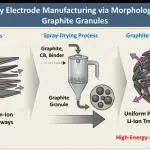
- Spray drying converts graphite, conductive additives, and binder into spherical composite particles with randomly oriented internal flakes, creating multidirectional lithium-ion diffusion channels.
- The new dry anode outperformed conventional slurry-based anodes in both fast-charging performance and long-term cycle stability in experimental testing.
- Thicker electrodes enabled by improved ion diffusion allow more energy storage in the same physical space, directly extending EV driving range.
- Compatibility with existing CMC-SBR-based production lines minimizes retrofitting costs, lowering the barrier to commercial adoption.
South Korean Researchers Develop Breakthrough Dry Electrode Technology Set to Reshape EV Battery Manufacturing
Research teams from the Korea Institute of Materials Science (KIMS) and the Korea Electrotechnology Research Institute (KERI) have jointly developed a novel shape-controlled graphite particle dry electrode manufacturing technology for battery anodes. The advance could simultaneously address three of the electric vehicle industry's most persistent challenges: limited driving range, slow charging speeds, and high production costs.
"This technology offers a new direction for overcoming the limitations of conventional PTFE-based dry electrode processes," said Jihee Yoon, senior researcher at KIMS. "We expect it to be highly applicable to next-generation EV batteries that require both high energy density and fast-charging performance."
Moving Away from Controversial Chemicals Toward Greener Manufacturing
Driven by surging demand for electric vehicles and energy storage systems, the global battery industry is racing to achieve higher energy density, faster charging, and longer cycle life.
Dry electrode manufacturing has long been viewed by automakers as an ideal solution. The process eliminates the conventional wet-slurry approach entirely, doing away with toxic chemical solvents and energy-intensive high-temperature drying steps. The result is a smaller manufacturing footprint and significantly reduced carbon emissions.
However, current dry electrode processes have a fundamental drawback: they rely on polytetrafluoroethylene (PTFE)—commonly known to consumers as Teflon—as a binder. While PTFE bonds dry materials effectively, it belongs to the PFAS "forever chemicals" family, is known to gradually degrade under the harsh electrochemical conditions inside battery anodes, and faces tightening environmental regulations in multiple jurisdictions. Until now, making dry electrodes without PTFE was widely considered impractical.
The Korean research team took a fundamentally different approach.
Spherical Particles Open a 'Multi-Lane Highway' for Lithium Ions
The researchers replaced PTFE with the industry-standard, eco-friendly CMC-SBR binder system—already widely used in conventional wet-process battery production. Swapping the binder alone, however, was not sufficient; the electrode material itself also required a thorough physical transformation.
Conventional battery anodes use flat, flake-shaped graphite particles. Under dry-pressing, these flakes align uniformly—like a tightly stacked deck of cards—forcing lithium ions to take circuitous routes around particle edges and creating a significant ion-transport bottleneck.
To solve this problem, the researchers employed spray drying to convert a slurry of graphite, conductive additives, and binder into spherical composite particles. Inside these new spherical particles, graphite flakes are arranged in random orientations, creating multidirectional transport channels. Lithium ions can travel directly through the full thickness of the electrode—akin to driving on a multi-lane highway—dramatically improving diffusion efficiency.
Critically, this freedom of ionic movement enables manufacturers to produce thicker electrodes, storing more energy within the same physical space and thereby extending EV driving range.
"Experimental results showed that the developed dry anode outperformed conventional slurry-based anodes in both fast-charging performance and long-term cycle stability," the researchers noted. "The technology also significantly improved lithium-ion diffusion characteristics under high energy-density conditions, confirming its potential for high-capacity batteries with thick-electrode architectures."
High Compatibility With Existing Production Lines Lowers Adoption Barriers
Another key advantage of the technology is its compatibility with existing manufacturing infrastructure. Because it uses the standard CMC-SBR binder system already employed by battery makers, current production lines require minimal retrofitting, substantially lowering the barrier to commercialization.
The findings have been published in the international peer-reviewed journal Energy Storage Materials.
原文來源: 查看原文
FAQ
Newsletter
Subscribe to our Low-Altitude Industry Newsletter
Daily curated news on low-altitude economy and drone industry, delivered to your inbox.
Reviewed and published by the LAETimes editorial desk ·