Smart Exoskeleton Glove Restores Grip for Paralyzed Patients
Researchers at the Technical University of Munich (TUM) have developed a soft pneumatic exoskeleton glove that uses forearm electromyography (EMG) signals and machine learning to predict a user's gripping intent, then inflates internal air chambers to assist finger and wrist movement. The system achieves a 97% grip-intent prediction accuracy and has already enabled an ALS patient to hold a fork for the first time in four years.
Highlights
- TUM's soft pneumatic exoskeleton glove uses forearm EMG signals and machine learning to predict grip intent with 97% accuracy.
- The glove features 13 pneumatic channels that can independently flex or extend each finger and assist wrist rotation for everyday gripping tasks.
- In clinical testing, an ALS patient successfully held a fork for the first time in four years using the device.
- The system recognized grasping intent in approximately 90% of attempts, and just five minutes of thumb-controlled game training improved performance significantly.
- Prof. Tobias Wächter of Klinik Passauer Wolf stated the glove could help flaccid paralysis patients, including those with peripheral nerve injuries or polyneuropathy.
Researchers have developed a soft pneumatic glove that could help patients with hand paralysis regain the ability to grasp and handle everyday objects.
Developed at the Technical University of Munich (TUM), the "soft hand exoskeleton" uses electrical signals generated by forearm muscles combined with machine learning to detect a user's movement intent. The glove then inflates soft internal air chambers to assist finger and wrist movements, enabling users to firmly grip cups, plates, and utensils.
The research team noted that the glove also incorporates motion sensors that maintain stable grip force while objects are being carried, significantly reducing the risk of accidental drops and further enhancing the daily independence of paralyzed patients.
Soft Grip Technology
This soft pneumatic hand exoskeleton is designed specifically to restore grasping ability in patients with hand paralysis. Unlike rigid robotic exoskeletons, the system is built around a lightweight fabric glove embedded with inflatable air chambers that provide flexible and precise assistance to the fingers and wrists.
The glove features a network of 13 pneumatic channels that can independently inflate separate air chambers arranged along the hand. By precisely controlling air pressure, the system can individually flex or extend each finger while also assisting wrist rotation, allowing users to perform everyday gripping tasks such as holding a plate, picking up a cup, or using a fork or spoon.
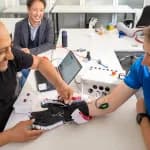
With the glove's assistance, patients with severe disabilities can more effectively regain the ability to grip objects. Image credit: TUM
The exoskeleton is controlled via electromyography (EMG) technology, which measures the faint electrical signals produced by forearm muscles. Sensors mounted on the forearm continuously capture these signals, while a machine learning algorithm analyzes the data in real time to predict when the wearer intends to grip an object. Once the intended movement is detected, the glove automatically inflates the corresponding air chambers to assist with the action.
To improve reliability during use, the system also integrates motion sensors that detect carrying movements after an object has been gripped, ensuring the glove maintains sufficient grip force throughout transport and reducing the risk of accidental drops for a more natural and safer hand movement experience.
Intelligent Grasping Exoskeleton
Researchers designed this soft hand exoskeleton with the dual goals of combining intelligent movement prediction and an affordable, lightweight wearable form factor.
The system employs a machine learning algorithm to interpret electrical signals from the wearer's forearm muscles, achieving a grip-intent prediction accuracy of 97%. The glove body uses low-cost fabric and integrates inflatable air chambers, making this technology far more affordable than most conventional robotic rehabilitation devices while remaining practical for everyday use.
The technology was developed and tested in close collaboration with a patient diagnosed with amyotrophic lateral sclerosis (ALS), a progressive neurological disease that gradually destroys the nerve cells controlling voluntary muscle movement.
During testing, the patient retained only limited mobility in the first joint of the thumb. Researchers attached EMG sensors to the forearm to detect electrical activity in the flexor pollicis longus muscle. Even these minimal muscle signals were sufficient to trigger inflation of the glove's pneumatic chambers.
Test results showed that the system successfully recognized the user's grasping intent in approximately 90% of attempts. The patient was able to pick up everyday objects and held a fork for the first time in four years, as well as manipulate small building blocks. Researchers also found that as little as five minutes of thumb-controlled video game training was enough to significantly improve grasping performance, demonstrating the system's high adaptability for patients with severe neurological damage.
"In principle, this glove can help patients with flaccid paralysis — for example, those with peripheral nerve injuries caused by motorcycle or bicycle accidents, or patients suffering from polyneuropathy," said Prof. Tobias Wächter, a neurologist at Klinik Passauer Wolf.
原文來源: 查看原文
FAQ
Newsletter
Subscribe to our Low-Altitude Industry Newsletter
Daily curated news on low-altitude economy and drone industry, delivered to your inbox.
Reviewed and published by the LAETimes editorial desk ·