China's 'Jiutian' Jet-Powered Drone Carrier Completes Maiden Flight, Capable of Deploying 100-Drone Swarms
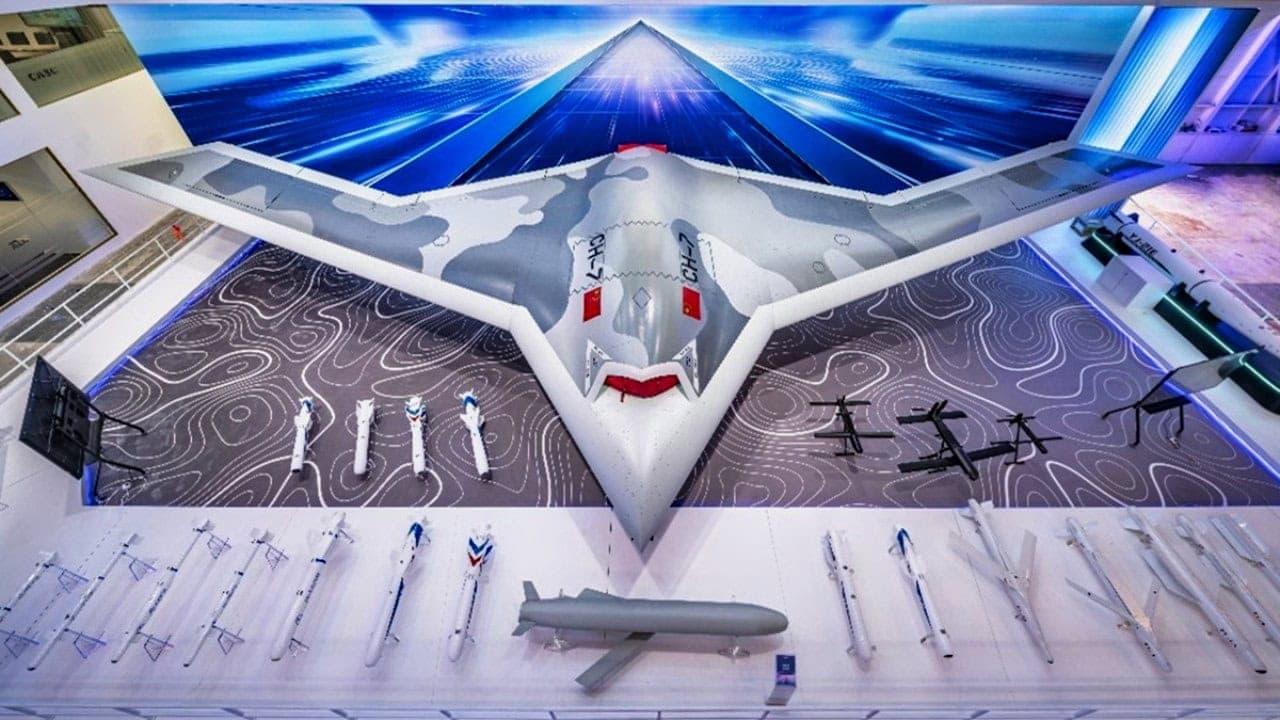
China's state-owned Aviation Industry Corporation of China (AVIC) has successfully completed the maiden flight of 'Jiutian,' a jet-powered heavy drone carrier aircraft, in Pucheng, Shaanxi Province. The platform can deploy up to 100 small drones simultaneously, reaches a top speed of approximately 378 knots, has a range of 4,349 miles, a service ceiling of 49,212 feet, and features eight underwing hardpoints for air-to-ground and air-to-air missiles. Analysts view it as a significant threat to U.S. military positions along the First Island Chain.
Highlights
- China's state-owned AVIC completed the maiden flight of 'Jiutian,' a jet-powered heavy drone carrier, at Pucheng, Shaanxi Province.
- Jiutian can deploy swarms of up to 100 small drones simultaneously, with a range of 4,349 miles and a service ceiling of 49,212 feet.
- The platform reaches a top speed of approximately 378 knots and carries 8 underwing hardpoints for missiles and guided bombs.
- Jiutian's primary strategic role is to saturate U.S. air defense systems with expendable drone swarms before more expensive Chinese strike assets engage.
- Defense analysts view Jiutian as a serious escalating threat to U.S. military survivability along the First Island Chain, potentially forcing a reassessment of Washington's Indo-Pacific basing strategy.
China has unveiled another major military development: a jet-powered aircraft capable of carrying and releasing up to 100 small drones in a single swarm sortie has completed its maiden flight over Shaanxi Province. The 'Jiutian' (Nine Heavens) is not designed to directly destroy targets itself — rather, its mission is to exhaust adversaries' expensive air defense systems, clearing the way for follow-on strike assets.
A New Milestone in China's Military Rise
If the current conflicts in the Middle East have taught U.S. military planners anything, it is how vulnerable forward-deployed bases can be against a modern adversary. Iranian missiles and drones have inflicted serious damage on U.S. military facilities at Gulf Arab partner nations, to such a degree that — even with substantial air defense systems in place — the prospect of rebuilding those bases has seemed increasingly unjustifiable.
Looking at the broader strategic picture, there are growing questions about the survivability of U.S. military installations along what is known as the "First Island Chain" — the arc of islands stretching from the Kamchatka Peninsula through Japan, Taiwan, the Philippines, and into the South China Sea.
If Iran was able to inflict such significant damage on U.S. Middle East bases during just over three months of conflict, the question becomes: what could China — which possesses a far more advanced arsenal of missiles, drones, and hypersonic weapons — do to U.S. bases along the First and even Second Island Chains?
China's Drone Strategy Is Rewriting the Rules of War
The Chinese drone threat alone is sufficient to force Washington into a serious reassessment of its commitment to maintaining military installations along the First Island Chain. Chinese drones are inexpensive, increasingly sophisticated, and expendable. In the new era of modern warfare, these three characteristics make China's drone force the single largest — and hardest to defend against — threat to U.S. forces positioned along the First Island Chain.
Saturating attacks with drones are not necessarily intended to directly destroy sensitive U.S. assets on those bases — that mission is left to Chinese ballistic missiles and hypersonic weapons. Of course, if a drone does happen to strike a U.S. target, Beijing would welcome the outcome. But the primary mission of these drone swarms is to force the limited and extraordinarily costly air defense and missile defense systems to expend their intercept capacity against cheap drone swarms, rather than reserving it for expensive Chinese missiles, hypersonic weapons, and combat aircraft.
First Island Chain Defenses Grow Increasingly Precarious
Furthermore, U.S. forces deployed along the First Island Chain — including in Japan and Guam — are fixed targets sitting entirely within the engagement envelope of China's Anti-Access/Area Denial (A2/AD) systems.
Beijing has explicitly outlined a strategy of destroying key runway infrastructure at U.S. bases along the First Island Chain as a means of neutralizing U.S. Air Force power projection capabilities.
Drone swarms released ahead of China's primary strike forces would play a decisive role before any major attack on U.S. installations. Moreover, China's A2/AD systems would simultaneously threaten approaching U.S. Navy vessels — and again, Chinese drones would be deployed first to overwhelm the air and missile defense systems of U.S. surface combatants, including aircraft carriers, before the launch of more expensive missiles and hypersonic weapons.
Drone Carriers Dramatically Extend the Threat Radius
Beijing clearly understands the immense advantage that low-cost, mass-produced, expendable drone swarms provide against conventional U.S. military power positioned along the First Island Chain.
China is accelerating its exploitation of its comparative advantage in drone manufacturing to build a massive drone arsenal. More significantly, China is developing multiple new types of drone carriers — both airborne and maritime — with the core purpose of maintaining a persistent presence and capability to deploy drone swarms at ever-increasing scale, overwhelming the sophisticated and nearly irreplaceable U.S. air and missile defense systems. Once cheap Chinese drones exhaust those defenses, U.S. bases and aircraft carriers would be left exposed to Chinese missiles and hypersonic weapons.
The 'Jiutian' is one such system currently under development.
This jet-powered heavy drone carrier completed its maiden flight in Pucheng, Shaanxi Province, and is manufactured by the state-owned Aviation Industry Corporation of China (AVIC). It represents an impressive weapons platform.
Key specifications of the 'Jiutian':
- Drone payload capacity: Up to 100 small drones
- Top speed: Approximately 378 knots
- Range: 4,349 miles (approx. 6,999 km)
- Service ceiling: 49,212 feet (approx. 15,000 m)
- Underwing hardpoints: 8, capable of carrying air-to-ground and air-to-air missiles, or 1,000 kg-class guided bombs
The system is difficult to track, capable of providing persistent coverage over contested areas along the First Island Chain, and represents a genuine threat to the safety and survivability of U.S. military deployments in the region.
The U.S. Needs a Fundamentally New Indo-Pacific Strategy
Washington has attempted to address these threats through a "denial defense" strategy, dispersing U.S. forces to smaller, more remote islands. This new approach also relies heavily on U.S. drones and stealth bombers, which can operate outside the reach of China's A2/AD network.
Yet this raises a fundamental question: why should the United States continue expending enormous time and resources maintaining such expensive bases within the engagement envelope of China's A2/AD systems?
The Chinese drone swarm threat will only continue to grow, not diminish. The conflicts involving Iran have already demonstrated to the world how futile it is for the U.S. military to maintain large forward bases in contested regions.
Given that the character of warfare over the past decade has clearly shifted in favor of long-range, unmanned operations, Washington should seriously consider the difficult decision to withdraw from the First Island Chain and redeploy forces beyond the reach of Chinese drones, missiles, and hypersonic weapons.
Such a strategic adjustment would not only save U.S. taxpayers enormous expenditure, but could preserve U.S. military lives and critical equipment — and might even help de-escalate the increasingly tense and unsustainable situation across the Indo-Pacific.
The author, Brandon J. Weichert, is a Senior National Security Editor at 19FortyFive.com and the author of four national security books. His latest work is A Disaster of Our Own Making: How the West Lost Ukraine.
原文來源: 查看原文
FAQ
Reviewed and published by the LAETimes editorial desk ·