World's Top 5 Air Forces by Fleet Size: Who Has the Most Aircraft?
When most people think of the world's most powerful air forces, fighter jets and stealth bombers come to mind — but true air power encompasses far more. Transport aircraft, helicopters, tankers, reconnaissance planes, trainers, and support aircraft all contribute to a nation's military aviation ecosystem. This article ranks the world's top five air forces by total fleet size, revealing the full picture of modern air power.
Highlights
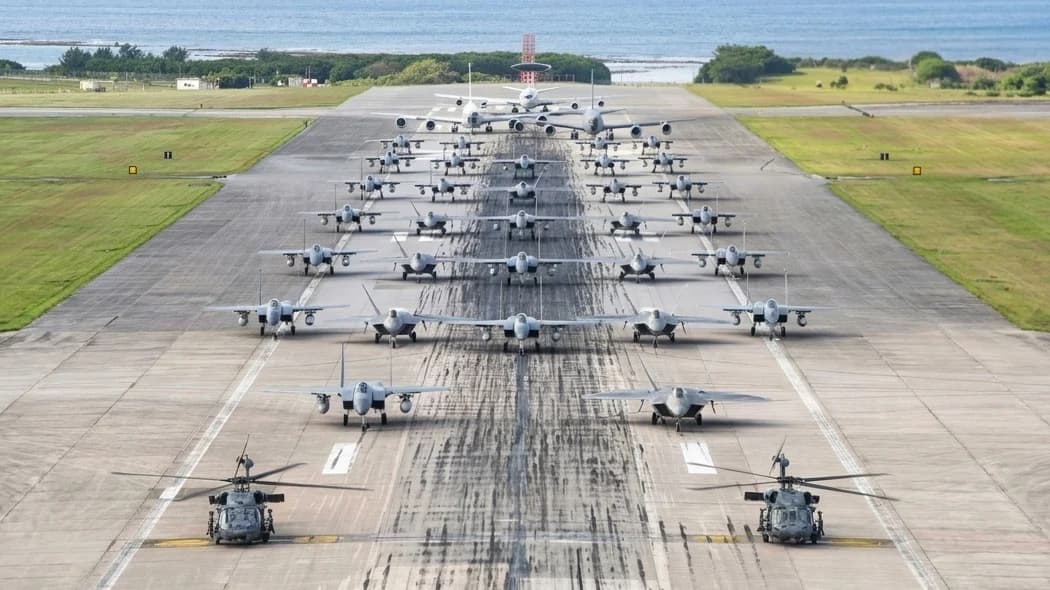
- The U.S. Air Force ranks first globally by fleet size, operating thousands of aircraft including F-22, F-35, B-2, C-17, and KC-46 platforms across bases on every continent.
- Russia's Aerospace Forces hold second place, fielding Su-27/30/35 fighters, Tu-95/160 strategic bombers, and the new Su-57 fifth-generation stealth fighter.
- China's PLAAF ranks third and is the largest air power in Asia-Pacific, with J-20 stealth fighters and mass deliveries of J-16 and J-10C pushing combat capability significantly higher.
- South Korea's ROKAF ranks fifth, distinguished by F-35A service entry and the indigenous KF-21 Boramae program, placing it among a small group of nations that develop advanced fighters domestically.
- Analysts note that growing UAS adoption in military aviation may require a fundamental revision of how air force strength is measured and ranked in the future.
When the phrase "most powerful air force" comes up, many people immediately picture supersonic fighters tearing through the clouds or stealth bombers vanishing over the horizon. But the full measure of air power is far more complex than that.
Behind every military aircraft that takes to the skies stands an enormous aviation ecosystem — transport planes, helicopters, aerial refueling tankers, reconnaissance and surveillance aircraft, trainers, and a wide range of logistical support platforms. Together, these aircraft types determine a force's true capacity to project power and sustain operations anywhere in the world.
Why Fleet Size Matters
Total fleet size is one of the most straightforward quantitative indicators of an air force's overall strength. A larger fleet signals not only greater strike capability, but also enhanced operational flexibility, more robust supply chains, and the endurance to maintain high sortie rates over an extended conflict.
The World's Top 5 Air Forces by Fleet Size
1. United States Air Force (USAF)
The U.S. Air Force has long held the top position globally, fielding thousands of aircraft across every category. Its inventory includes fifth-generation fighters such as the F-22 Raptor and F-35 Lightning II, the B-2 Spirit stealth bomber, C-17 Globemaster III and C-130 Hercules transports, KC-135 Stratotanker and KC-46 Pegasus aerial refuelers, and the E-3 Sentry airborne early warning aircraft. With bases on every continent, the USAF possesses an unrivaled global power-projection capability.
2. Russian Aerospace Forces (Vozdushno-Kosmicheskiye Sily)
Russia inherited the vast military aviation legacy of the Soviet Union, giving it the world's second-largest fleet. Core aircraft include the Su-27, Su-30, and Su-35 multirole fighters, as well as the Tu-95 Bear and Tu-160 Blackjack strategic bombers. In recent years, Russia has pushed an ambitious modernization program, introducing the Su-57 fifth-generation stealth fighter into frontline service.
3. People's Liberation Army Air Force (PLAAF)
China's air force has expanded rapidly over the past decade and a half, emerging as the largest air power in the Asia-Pacific region. The introduction of the J-20 stealth fighter confirmed China's entry into the fifth-generation club, while large-scale deliveries of the J-16 multirole fighter and J-10C have significantly elevated overall combat capability.
4. Indian Air Force (IAF)
The Indian Air Force operates one of the world's largest and most diverse fleets, blending Russian and Western platforms. Its inventory includes the Su-30MKI Flanker, the French-made Rafale, and the indigenously developed Tejas light combat aircraft. Multiple ongoing procurement programs continue to drive the IAF's modernization forward.
5. Republic of Korea Air Force (ROKAF)
Although the ROKAF is smaller in scale than the four above it, it is exceptionally well-equipped and rigorously trained. The F-35A Lightning II has entered frontline service, the F-15K Strike Eagle forms the backbone of its strike fleet, and the domestically developed KF-21 Boramae places South Korea among a select group of nations capable of designing and producing advanced combat aircraft at home.
Conclusion
Fleet size is undoubtedly a key metric for assessing air force strength, but the outcome of modern air warfare often hinges on factors such as training standards, logistics, the integration of command-and-control systems, and the depth of adoption of emerging technologies like unmanned aerial vehicles (UAVs). As unmanned aircraft systems (UAS) claim an ever-growing share of military aviation, the very criteria by which we rank the world's air forces may be fundamentally rewritten.
原文來源: 查看原文
FAQ
Reviewed and published by the LAETimes editorial desk ·