China's Tianwen-2 Probe Returns First-Ever Images of Earth's Quasi-Moon Kamo'oalewa
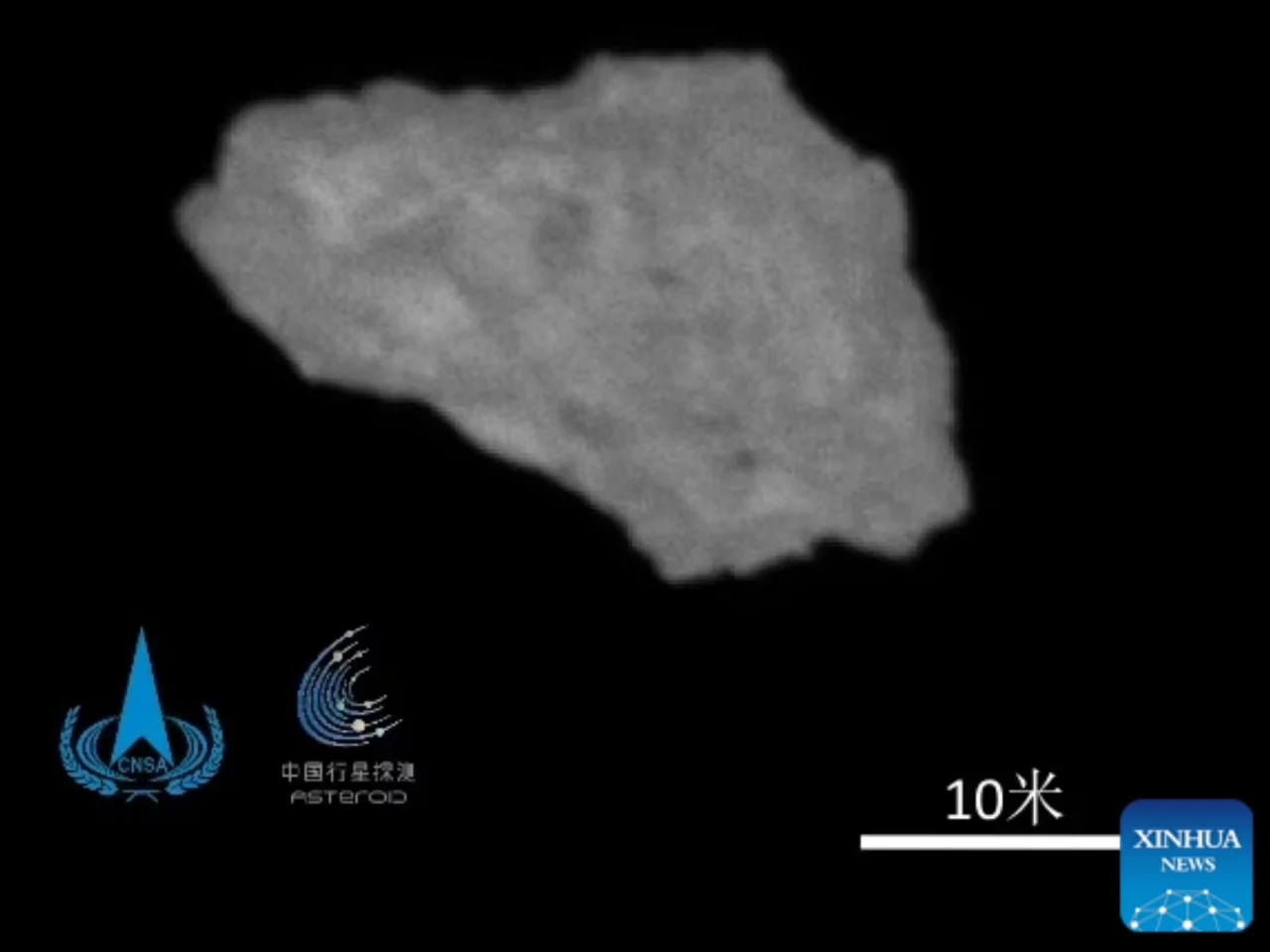
China's Tianwen-2 spacecraft has successfully captured and transmitted the first close-up images of Kamo'oalewa, Earth's so-called quasi-moon. Although small and blurry — the asteroid resembles a corn chip in shape — the images mark a historic milestone in planetary science and lay the groundwork for a planned sample-return mission.
Highlights
- China's Tianwen-2 probe transmitted humanity's first close-up images of quasi-moon asteroid Kamo'oalewa, marking a historic milestone in deep-space exploration.
- Kamo'oalewa is a tiny near-Earth asteroid in orbital resonance with Earth; its extremely low brightness has made ground-based observation nearly impossible until now.
- Although the returned image is low-resolution and shows an irregular, corn-chip-like shape, it is sufficient for scientists to confirm the asteroid's outline and morphology.
- The Tianwen-2 mission plans to proceed to a sample-return phase, with researchers hoping to analyze Kamo'oalewa's composition to study early solar system formation history.
- The mission has drawn widespread international attention, reinforcing China's growing technical standing in deep-space exploration.
The image is small, blurry, and shaped somewhat like a corn chip — yet it represents a landmark moment in astronomical history. China's Tianwen-2 spacecraft has transmitted humanity's first close-up view of Kamo'oalewa, the enigmatic near-Earth asteroid known as Earth's "quasi-moon."
What Is Kamo'oalewa?
Kamo'oalewa is a tiny near-Earth asteroid whose orbital path maintains a special resonance with Earth, causing it to linger in our planet's vicinity over long timescales. Astronomers classify it as a "quasi-moon" — not a true satellite in orbit around Earth, but an object whose trajectory, as observed from Earth, mimics the regular motion of a moon. Its extremely small size and very low brightness have made detailed ground-based observations exceedingly difficult.
A Major Milestone for the Tianwen-2 Mission
The successful close-range imaging of Kamo'oalewa by China's Tianwen-2 probe marks a significant step forward for the deep-space mission. While the resolution of the returned image is limited by shooting distance and instrument capability, scientists say it is sufficient to confirm the asteroid's outline and general morphology — information that was previously unobtainable.
Far-Reaching Scientific Value
The images returned by Tianwen-2 represent humanity's first direct look at Kamo'oalewa, and they will serve as a critical foundation for the mission's subsequent sample-return phase. Researchers hope that analyzing the asteroid's composition will shed new light on the early formation history of the solar system, as well as the evolutionary processes that shaped the Earth-Moon system.
The mission has drawn significant attention from the global astronomy and aerospace community, once again highlighting China's growing technical capabilities in deep-space exploration.
原文來源: 查看原文
FAQ
Reviewed and published by the LAETimes editorial desk ·