Taiwan Fits Skyguard Anti-Aircraft Guns with Anti-Drone Netting to Counter Chinese UAS Threats
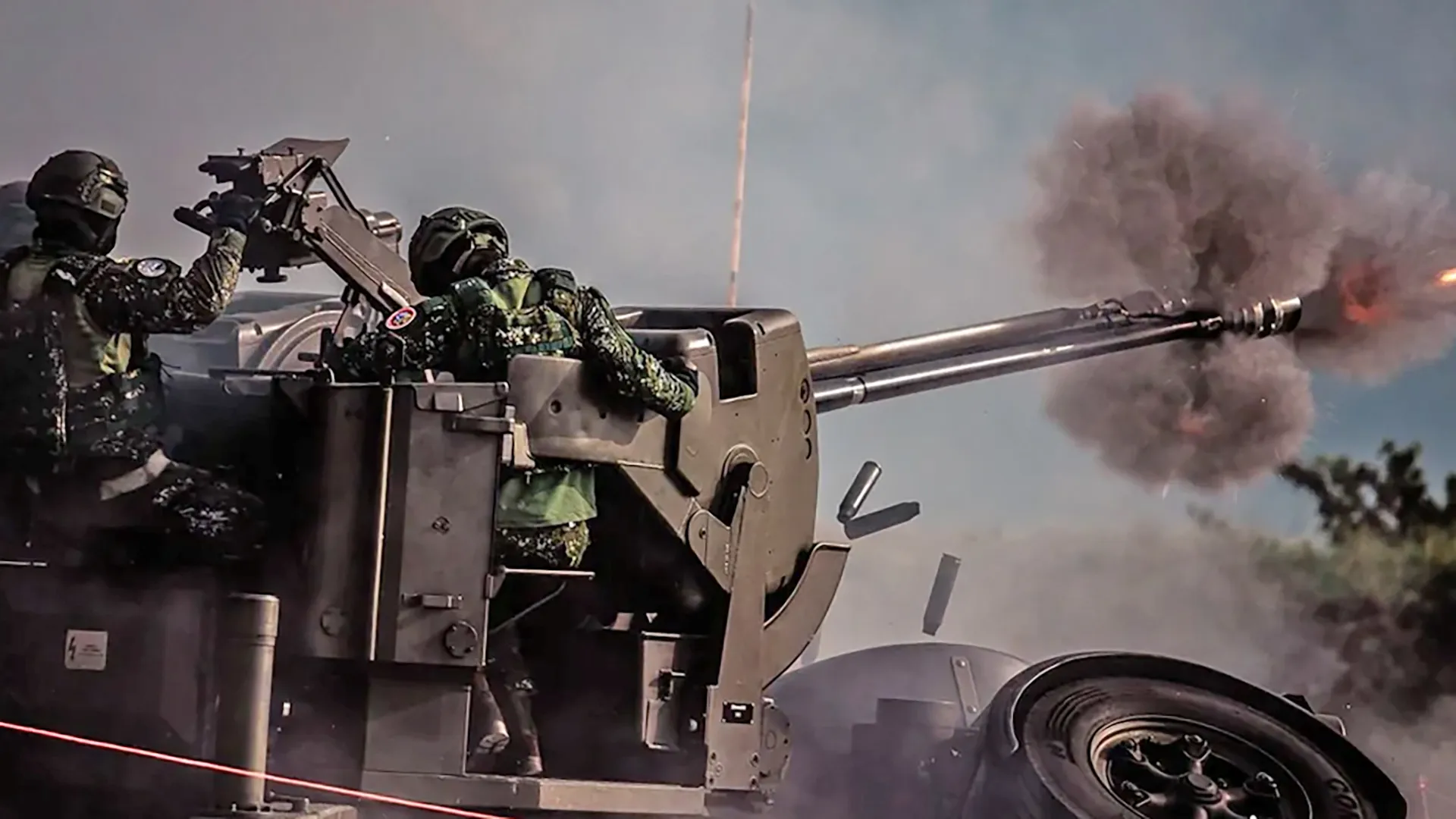
The Republic of China Air Force (ROCAF) has fitted its Swiss-made Skyguard GDF-006 twin-barrel 35mm anti-aircraft guns with geodesic-dome-style anti-drone netting to protect the systems from Chinese FPV drone dive attacks. The move underscores a growing reality: even air-defense assets designed to shoot down drones are themselves increasingly vulnerable to drone strikes.
Highlights
- The ROCAF has fitted at least two Skyguard GDF-006 twin-barrel 35mm anti-aircraft guns with geodesic-dome anti-drone netting to protect against Chinese FPV dive attacks.
- Taiwan operates approximately 24 Swiss-made Skyguard GDF-006 systems, typically deployed to guard air force bases.
- The Skyguard can fire AHEAD programmable air-burst ammunition, which releases a sub-projectile cloud to improve kill probability against small drones, cruise missiles, and rockets.
- The United States approved the sale of NASAMS to Taiwan in 2024, adding a medium-range layer capable of firing existing AMRAAM stockpiles against cruise missiles and one-way attack drones.
- China's expanding drone fleet can conduct one-way attacks, ISR, target designation, and electronic warfare, making even dedicated air-defense assets vulnerable without physical protection.
Anti-drone netting and protective cages are spreading rapidly across the modern battlefield—over roads, around structures, atop armored vehicles, and aboard naval vessels. A new case from Taiwan shows that anti-aircraft gun emplacements are now being added to that list, as the island's military takes steps to guard its air-defense assets against the growing drone threat posed by China's military.
Geodesic-Dome Netting Spotted on Skyguard Guns
A heavily processed image circulating recently shows two Republic of China Air Force (ROCAF) Skyguard towed twin-barrel 35mm anti-aircraft guns covered by a geodesic-dome lattice structure wrapped in anti-drone netting, with the twin barrels protruding through the frame to preserve their field of fire. The configuration is designed primarily to defend the gun emplacements against small first-person-view (FPV) drones attempting dive attacks.
The ROCAF operates approximately 24 of the Swiss-made systems, specifically the GDF-006 variant. These systems are regularly deployed to protect Taiwan's air force bases, and the location where the netting was fitted is most likely also an air force base.
Skyguard Remains a Key Point-Defense Weapon for Taiwan
Despite being a Cold War-era legacy design, the Swiss-made Skyguard remains one of Taiwan's most capable point-defense weapons against the wide range of aerial threats that have proliferated in recent years, including drones and cruise missiles.
Keeping Skyguard systems operational throughout any conflict is critical, making additional physical anti-drone protection a sound tactical measure.
Notably, the radar-guided system can fire AHEAD (Advanced Hit Efficiency and Destruction) ammunition against drones. This programmable air-burst round releases a cloud of sub-projectiles in front of a target, significantly increasing the probability of kill against small, slow, and maneuvering aerial threats, while also being effective against cruise missiles, rockets, and mortar rounds. The air-burst effect also reduces the risk of collateral damage on the ground.
Taiwan's Layered Air Defense Network
The Skyguard systems serve in the ROCAF alongside more modern platforms as part of Taiwan's multi-layered integrated air defense network. The air force's ground-based air defense arsenal also includes American-made Patriot missiles and domestically developed Sky Bow (Tien Kung) series missiles for long-range air defense and ballistic missile defense. At a lower tier, Sea Sparrow surface-to-air missile launchers can be integrated with the Skyguard's radar and fire-control systems to add another layer of protection. Taiwan officially retired its last Hawk surface-to-air missile batteries in 2023, with some subsequently donated to Ukraine.
As previously reported, the United States approved the sale of the National Advanced Surface-to-Air Missile System (NASAMS) to Taiwan in 2024. This medium-range system is particularly well-suited to intercepting cruise missiles and one-way attack drones, and it can share the AIM-120 Advanced Medium-Range Air-to-Air Missile (AMRAAM) stockpiles already held by ROCAF fighter aircraft.
The Republic of China Army fields a more diverse ground-based air defense inventory, including more mobile platforms and Man-Portable Air-Defense Systems (MANPADS). Army air defense units also operate anti-aircraft guns—specifically the indigenously developed T-82T towed twin-barrel 20mm cannon, a design derived from the M39 cannon originally developed for the U.S. Air Force in the late 1940s.
China's Drone Threat Continues to Escalate
Taiwan's multi-layered integrated air defense network is central to the island's ability to defend against a wide range of aerial attacks from China. However, as China rapidly expands both the quantity and sophistication of its drone fleet, even air-defense assets themselves are increasingly susceptible to drone attack.
Fitting Skyguard guns with protective netting is a direct response to this evolving threat. Chinese drones of various types can be used for one-way attack missions as well as intelligence gathering, target designation for long-range strikes, communications relay, and electronic warfare. Swarms of low-cost drones can also be used to overwhelm Taiwan's defenses, forcing critical air-defense assets to expend valuable ammunition while remaining exposed to attack.
Taiwan's air force bases would be among Beijing's highest-priority targets in any conflict scenario. The ROCAF has already prepared for this contingency through regular exercises, routinely practicing operations from dispersal airfields and highway runways. Wherever ROCAF aircraft are deployed, air-defense systems such as Skyguard are essential to protecting those locations.
Even in peacetime, Taiwan faces drone incursions—particularly on its outlying islands, which lie in close proximity to mainland China. A series of Chinese drone intrusions in 2022 prompted Taiwan's military to announce it would shoot down uncrewed vehicles that failed to respond to warnings, a policy it subsequently acted upon. Those incidents followed announcements that Taiwan would deploy undisclosed domestically developed counter-drone systems across the island, as well as the viral spread of footage showing Chinese drones filming Taiwanese sentries throwing rocks at them.
Taiwan has also invested considerably in ensuring its military assets can survive a potential invasion—including concealing tanks and armored vehicles in urban environments using creative camouflage techniques, such as hiding them under debris or disguising them as civilian construction equipment.
Anti-drone netting—whether strung over roads, fitted to tanks, draped over artillery positions, or installed on warships—has become one of the defining visual signatures of the drone age. The ROCAF's decision to fit its Skyguard anti-aircraft guns with protective netting makes clear that even air-defense systems specifically designed to shoot down small drones are far from invulnerable.
原文來源: 查看原文
FAQ
Reviewed and published by the LAETimes editorial desk ·


